Why hydrogen is hard to sense
Summary
Section titled “Summary”Most cheap gas sensors are infrared absorption sensors. CO2, CH4, and CO have a charge asymmetry that oscillates as they vibrate, so they absorb IR strongly at signature wavelengths and an NDIR detector reads them out for a few dollars. H2 is two identical atoms sharing electrons symmetrically: it has no permanent dipole moment, vibration and rotation do not create one, and ordinary IR absorption is forbidden. There is no NDIR-style hydrogen sensor and there cannot be one.
Every practical H2 sensor therefore uses a workaround: heat flow, speed of sound, electrical resistance of a palladium film, catalytic combustion, electrochemical oxidation, or the residual (very weak) quadrupole and Raman couplings. Each workaround trades away cost, selectivity, temperature/pressure robustness, or ppm-level sensitivity. That one fact of molecular symmetry explains why soil-gas surveys run on electrochemical cells rather than lasers, why no drop-in downhole H2 sensor exists, and why every technology in this wiki is a compromise.
Why the optical routes fail
Section titled “Why the optical routes fail”No dipole. H2 is homonuclear: the D∞h symmetry forces the electric dipole moment to zero at every internuclear distance, so there is no dipole-allowed rovibrational spectrum [1]. Dipole-allowed IR absorbers like CO, HCl, and H2O have line strengths of typically 10⁻²¹–10⁻¹⁹ cm/molecule; H2 has none. This is why H2 is absent from an ordinary FTIR spectrum and why NDIR is structurally inapplicable.
Quadrupole lines, 5–7 orders weaker. The electric-quadrupole term survives, with selection rule (O, Q, S branches) [1]. Herzberg first observed this spectrum in 1949 [2]. The strongest H2 quadrupole lines, near 4000 cm⁻¹ (≈2.5 µm), have intensities of order 10⁻²⁶ cm/molecule, the values in HITRAN since HITRAN2012 [1]; weaker branches and overtones fall toward 10⁻²⁷. Every laser-absorption H2 sensor therefore needs meters of pathlength, a high-finesse cavity, or both (see IR absorption and proxies). Laboratory instruments do get there: comb-referenced CRDS has measured (2–0) band lines near 1.2 µm to sub-100 kHz accuracy [3], resolved the collision-induced (H2)2 dimer at room temperature [4], and reached noise-equivalent absorption of ~4×10⁻¹⁰ cm⁻¹ Hz^(−1/2) on the 3–0 band [5]. These are metrology tools, not field sensors.
Collision-induced absorption is a density effect, not a sensing route. During a collision, two molecules transiently induce a dipole in each other, giving a continuum absorption that scales roughly with density squared () [6][7]. It is negligible at atmospheric density and dominant only in planetary and stellar atmospheres.
Electronic transitions sit in the vacuum UV, where air is opaque. The dipole-allowed Lyman (B¹Σᵤ⁺–X¹Σg⁺) and Werner (C¹Πᵤ–X¹Σg⁺) bands span roughly 90,000–119,000 cm⁻¹ (11.2–13.6 eV; ~90–115 nm strong, weak tail toward ~160–180 nm) [8][9], and atomic hydrogen has Lyman-α at 121.567 nm [10]. O2 absorbs essentially completely across this range: the Schumann–Runge continuum covers ~130–175 nm and structured bands ~175–200 nm [11][12], so a VUV photon survives centimeters to meters of open air. (Solar Lyman-α sits in a local minimum of the O2 cross-section and penetrates to ~70–75 km altitude [13]; an aeronomy detail, not a sensing opportunity.) Even in vacuum, window materials cap the technique: LiF cuts off near 103–105 nm and is hygroscopic, MgF2 near 115 nm [14][15]. Two-photon laboratory schemes exist for plasma diagnostics: TALIF on atomic H (2×205.1 nm excitation, Balmer-α fluorescence at 656.3 nm) [16] and two-photon excitation of H2 to the E,F¹Σg⁺ state near 201–202 nm [17][18]. Neither is field-deployable. See UV/EUV & fluorescence.
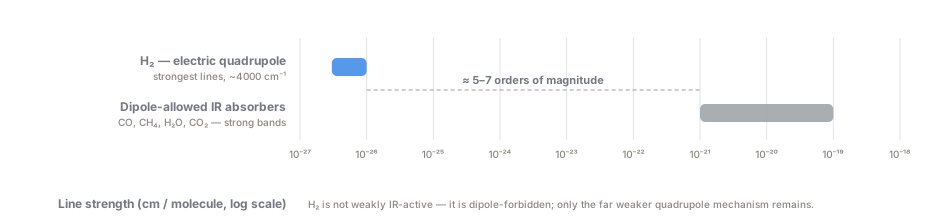
The reason there is no cheap IR hydrogen sensor: H₂’s only infrared coupling is the electric-quadrupole mechanism, five to seven orders of magnitude weaker than the dipole-allowed bands behind NDIR CO₂ and CH₄ sensors.
The physical handles that remain
Section titled “The physical handles that remain”Every practical H2 sensor exploits one of these properties, in most cases not an optical spectrum at all:
| Physical property | H2 value | Comparison | Sensor family it enables |
|---|---|---|---|
| Polarizability | ≈5.41 atomic units ≈ 0.80 ų [19][20] | ~1/3 of N2’s | Raman scattering: weak, but an independent selection rule |
| Thermal conductivity | ≈0.18 W/(m·K) near room temp. [24] | ~7× air (~0.026 W/(m·K)); highest of any gas except He | Thermal-conductivity (katharometer/MEMS) sensing |
| Speed of sound | ≈1315 m/s @ 25 °C [24] | ~3.8× air (343 m/s), via and H2’s low molar mass | Acoustic/ultrasonic gas-ID sensing |
| Molecular diffusivity in air | ≈0.76×10⁻⁴ m²/s [21] | among the highest of any gas | Shapes leak-detection geometry and soil-gas transport modeling |
| Catalytic dissociative chemisorption on Pd/Pt | H2 → 2H(ads) | — | Heat of combustion (pellistors); work-function shift |
| Absorption into Pd lattice → PdHx | up to ~3% linear lattice expansion; resistivity increase up to ~80% | — | Palladium resistive, capacitive, and Pd-coated fiber sensors |
| Electrochemical oxidation at a Pt electrode | H2 → 2H⁺ + 2e⁻ | — | Amperometric electrochemical cells |
| Residual quadrupole IR / Raman activity | ~10⁻²⁶ cm/molecule (quadrupole IR) | 5–7 orders weaker than dipole absorbers | Laser absorption (TDLAS/WMS/CRDS); Raman spectroscopy |
Sensor families this enables
Section titled “Sensor families this enables”This table is the map the wiki is organized around. No family covers the whole problem; each trades sensitivity, selectivity, robustness, or field-readiness against the others.
| Family | What it senses | Headline verdict | Page |
|---|---|---|---|
| Catalytic combustion (pellistor / catalytic bead) | Heat of combustion on a heated Pt/Pd bead [25] | Cheap and fast, but needs ambient O2 and cannot distinguish H2 from other combustibles | Catalytic pellistors |
| Thermal conductivity (TCD / MEMS-TC) | H2’s unusually high thermal conductivity [22][23] | Immune to poisoning, very low drift, but chemically nonspecific and not ppm-capable | Thermal conductivity & acoustic sensors |
| Chemiresistive / metal-oxide (MOX) | Surface conductance change on heated SnO2-type films [26][27] | Sub-ppm capable and cheap, but humidity- and cross-gas-sensitive | MOX chemiresistors |
| Electrochemical (amperometric) | Faradaic current from H2 oxidation at a Pt electrode [28] | Today’s soil-gas workhorse: ppm-level, compact, low-power; limited (1–3 yr) cell life and CO cross-sensitivity | Electrochemical cells |
| Palladium hydride, resistive/capacitive | Volume/resistivity change on PdHx formation [29][30] | Mature and non-consumable per vendor claims; H2S-vulnerable and temperature-limited | Palladium resistive sensors |
| Palladium work-function (MIS/MIM/Schottky/HEMT) | Interfacial dipole shifting a threshold voltage or barrier height | O2-independent, best-matched family for high-temperature downhole work; H2S poisoning is the likely failure mode | Work-function devices |
| Pd-coated optical fiber (FBG/SPR) | PdHx transduced optically instead of electrically [31][32][33] | The only technology with zero downhole electronics; demonstrated only at 1–4 vol%, room T/P | Fiber-optic sensors |
| Raman spectroscopy | H2’s anisotropic polarizability, independent of dipole/quadrupole rules [34] | Multi-species readout, no sample consumption; intrinsically weak signal | Raman spectroscopy |
| Enhanced Raman / plasmonic-field techniques | Same polarizability handle, boosted by a plasmonic or waveguide-enhanced local field | Frontier route to closing Raman’s sensitivity gap for trace H2 | Enhanced Raman |
| Laser absorption (TDLAS / WMS / CRDS) | The weak quadrupole lines directly [35][3][4][5] | Selective and non-consuming; needs meters of path or a high-finesse cavity, capital-instrument grade | IR absorption and proxies |
| UV/EUV & fluorescence (TALIF, VUV absorption) | Lyman/Werner electronic bands, atomic Lyman-α | Vacuum-chamber only; O2 destroys the signal in open air | UV/EUV & fluorescence |
| Plasmonic metamaterials | Engineered resonant structures (often Pd-functionalized) coupling light to PdHx | Research frontier, not field-proven | Plasmonic metamaterials |
Acoustic/speed-of-sound gas-ID sensing appears in the handle table but is not carried forward as an exploration-grade family: helium and any other low-molar-mass gas confounds the reading. See Thermal conductivity & acoustic sensors.
Performance envelope
Section titled “Performance envelope”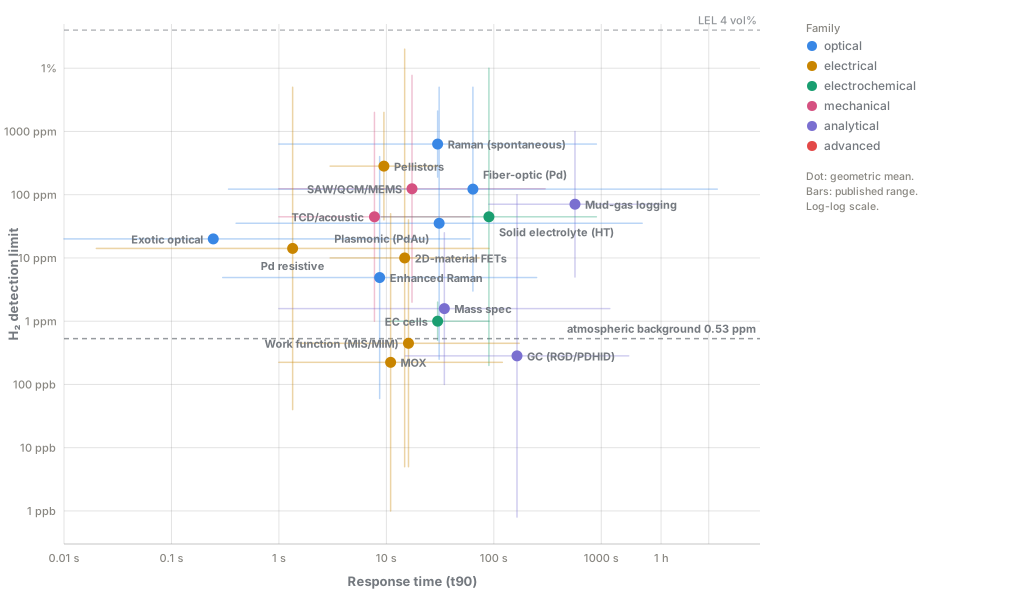
The sensitivity landscape: every technology family in this wiki, placed by detection limit and response time (dots: geometric mean of the published range; bars: the range). More on the charts page.
| Sensor family | Typical demonstrated range | Best-case LOD | Response time (t90) | Field readiness | Refs |
|---|---|---|---|---|---|
| Catalytic bead (pellistor) | 0–100% LEL (0–4 vol% H2 typical span) | Not ppm-capable; ~100s ppm–%LEL | <10 s classic; MEMS <12 s, some <2 s | Mature, ubiquitous safety instrument | [40][41][25] |
| Thermal conductivity (MEMS-TC) | 0–16 vol% to 0–100% depending on model | Coarse; not sub-100 ppm capable | <100 ms (best-in-class MEMS) | Mature; safety/LEL role, not trace exploration | [22][23][42] |
| Electrochemical (amperometric) | 0–1,000 ppmv (soil-gas survey instruments); 0–2,000 ppm (OEM cells) | ~1 ppmv precision; <0.7 ppm RMS noise | <45 s, 0→400 ppm | Mature; de facto soil-gas field standard | [28][43][44][45][46] |
| Metal-oxide semiconductor (MOX/SnO2) | sub-ppm to % (claimed) | Sub-ppm demonstrated in lab | Seconds, degraded by humidity | Lab-proven; not field-proven for quantitative exploration | [26][27][47] |
| Pd/Pd-alloy resistive (solid-state) | ppm to % | Manufacturer claims no cross-sensitivity to other gases | Seconds (design-dependent) | Commercial (industrial/process instrument class) | [29][30][48][49][50] |
| Pd-coated fiber-optic (FBG/SPR) | ~1–4 vol% demonstrated | Tens of pm wavelength shift per vol% H2 | Seconds (diffusion-limited by film thickness) | Research/early-commercial; only zero-downhole-electronics candidate | [31][32][33] |
| Raman gas analyzer | Percent-level process streams (commercial); ppm-level in specialized lab setups | Weak signal limits ppm-level field use today | Seconds (spectral acquisition) | Commercial for process streams; not yet trace-background capable | [51][52][53] |
| TDLAS / WMS on quadrupole line (2121.8 nm) | Demonstrated 0.02 vol% precision, 1 m path, 1 s integration | Sub-0.1 vol%-class demonstrated | Seconds | Lab/process demonstration; not field-hardened | [35] |
| CRDS on quadrupole lines | Research-grade; not a field product | NEA ~4×10⁻¹⁰ cm⁻¹ Hz^(−1/2) demonstrated | Seconds per spectrum | Laboratory only (metrology tool) | [3][4][5] |
Every LOD, response-time, and field-readiness entry above is a vendor or paper claim; see Reading the specs for how to separate lab best-case numbers from field-realistic ones.
Cross-sensitivity & environment
Section titled “Cross-sensitivity & environment”Cross-cutting summary; each family’s page has the detail.
| Factor | Who it hits and how | Ref |
|---|---|---|
| Temperature | Electrochemical cells rated roughly −30…+50 °C [28]; TC/MEMS tolerate up to 105 °C with no chemistry to disrupt [22]; commercial Pd:Ni lines rated only to ~60 °C in process configurations [48], below wellbore and many summer surface temperatures | [22][28][48] |
| Humidity | First-order confound for MOX (baseline and kinetics both shift; “anti-humidity” coatings remain an active research topic) [26][27][47]. Electrochemical cells are rated across wide RH bands; buried field probes regulate internal humidity to protect electronics [45]. TC sensors are largely immune | [26][27][45][47] |
| Pressure | 500–1400 mbar has only minor effect on a widely used electrochemical field analyzer, but depressurization below ~1 atm causes measurable overestimation of H2 [46]: relevant at altitude, during barometric pumping, and at wellheads without pressure conditioning | [46] |
| O2 availability | Pellistors stop working or under-read in O2-depleted or inert atmospheres [40]; two-electrode electrochemical cells also rely on O2 at the counter electrode | [40] |
| CO | Principal residual interferent for several electrochemical H2 cells [45]; CO-selective inlet membranes can nearly eliminate it short-term (unverified) [54]. Seep redox environments can co-produce trace CO | [45][54] |
| CH4 | Low cross-sensitivity for electrochemical cells [44]. Pellistors respond to any combustible and cannot distinguish H2 from CH4 without a dual-bead scheme | [44] |
| H2S | Poisons the two most H2-selective chemical mechanisms, catalytic and Pd-based: sulfide layers block the sites H2 dissociation needs, measured directly on single Pd nanoparticles [55][56]. For pellistors, sulfur (with silicones, lead, halogenated solvents) is an irreversible poison, distinct from recoverable inhibitors [41] | [41][55][56] |
| CO2 | Weak direct interferent, but elevated soil CO2 is itself a seep/microbial co-indicator, and CO2 channels are commonly bundled in the same field instrument | [44] |
H2S deserves emphasis: natural hydrogen accumulations are frequently co-evolved with H2S, so prefer electrochemical or TC sensors as the primary quantitative instrument, use catalytic/Pd sensors as a secondary check, and budget Pd/pellistor replacement or thermal regeneration where H2S is expected [55].
Use for geologic H₂
Section titled “Use for geologic H₂”Soil-gas surveys. The best-served use case. Portable electrochemical multi-gas analyzers report H2 at 0–1,000 ppmv with ~1 ppmv precision alongside O2, CO2, CH4, and optionally CO/H2S; dual-range instruments extend to 0–10,000 ppmv and 0.1–100 vol% for rich seeps [44]. Purpose-built probes bury the cell at ~1 m to damp diurnal temperature swings, with CO as the main residual cross-sensitivity [45]. The GA5000 metrology assessment [46] is worth reading before any campaign: generally reliable across field T/RH/P, with the depressurization bias noted above. Standard sampling methodology (~1 m depth, ~2 cm drainage radius, up to 500 mL/min pumped) brings representativeness and cross-contamination concerns that are procedural, not sensor, limitations [57].
Downhole / borehole logging. Unsolved. Borehole temperatures reach 150–175 °C onshore and ~200 °C offshore while downhole-rated Si/SiC electronics stop at ~175 °C commercially [58][59], and Hestia prefers no downhole electronics at all. On top of that: pellistors need O2 a reducing borehole may lack, electrochemical electrolytes are neither temperature-rated nor long-lived, and Pd hydride sensing loses sensitivity with temperature and is H2S-vulnerable. Pd-coated fiber is the exception in principle (passive sensing point, surface interrogator, same fiber infrastructure as DTS completions [31][32][33]), but demonstrated performance is 1–4 vol% at room T/P [31]. The pragmatic answer today is mud-gas / wireline fluid sampling with surface analysis [57].
Continuous monitoring stations. Power budget, calibration-free lifetime, and drift immunity dominate over LOD. TC/MEMS offers sub-mW power and multi-year calibration-free life [22][23][42] but cannot resolve ppm anomalies; it fits wellhead safety, not baseline science. Electrochemical stations are the only demonstrated ppm-resolution unattended option, at the cost of multi-year service life and desiccant/recalibration management [45]. A ruggedized Raman or TDLAS/CRDS station would remove the poisoning failure modes but exists nowhere as a field product; that gap is a candidate R&D investment.
See Geologic context for the exploration-side framing.
Vendors & products
Section titled “Vendors & products”Landscape summary; detailed vendor tables live on each technology page.
| Technology | Representative vendors / products | Field readiness | Page for full table |
|---|---|---|---|
| Catalytic bead / pellistor | SGX Sensortech, Winsen, Draeger, Blackline Safety | Mature, ubiquitous | Catalytic pellistors |
| MEMS thermal conductivity | Infineon XENSIV TCI, Posifa PGS1000/PGS4100, SGX TC-1326 | Mature; safety/LEL role | Thermal conductivity & acoustic sensors |
| Chemiresistive / MOX | SnO2-based OEM chemiresistors; sensor-array research prototypes | Lab-proven; not field-proven for quantitative exploration | MOX chemiresistors |
| Electrochemical | Alphasense H2-AF/H2-B4; Geotech GA2000/GA5000/BIOGAS5000; Ion Science/Geotech Variotec 460; MONHyTOR (buried probe) | Mature; de facto field standard | Electrochemical cells |
| Pd/Pd-alloy resistive (solid-state) | H2scan HY-OPTIMA / HY-ALERTA lines | Commercial (industrial/process instrument) | Palladium resistive sensors |
| Pd/Pt work-function (MIS/MIM/Schottky/HEMT) | AppliedSensor/ams HLS-440 family; H2scan hybrid MIS+resistor lines; SenSiC SiC-FET | Mature (MIS) to research-stage (HEMT/nanostructured) | Work-function devices |
| Pd-coated optical fiber | Academic groups (FBG/SPR designs); no dominant commercial vendor identified | Research/early-commercial | Fiber-optic sensors |
| Raman gas analyzer | Endress+Hauser Raman Rxn5; NETL (DOE) Raman Gas Analyzer prototype | Commercial for process streams | Raman spectroscopy |
| Laser absorption (TDLAS/WMS) | Research-prototype instruments (2121.8 nm quadrupole line) | Lab/process demonstration | IR absorption and proxies |
OEM element manufacturers do not publish list prices; analyzers and spectroscopic systems are complete instruments at higher price points. No verified list prices were located for any SKU, so all cost-class statements in this wiki are relative.
Open questions
Section titled “Open questions”- No field-validated downhole H2 sensor exists in the surveyed literature. Before committing downhole R&D capital, look for any Pd-FBG demonstration above 100 °C / tens of MPa, and ask whether an oilfield DTS/DAS vendor could piggyback a Pd-functionalized channel on an existing deployment.
- Quantify H2S poisoning kinetics for the specific sensors Hestia will buy, via vendor support or an independent test lab; basin-realistic ppm-level poisoning curves are not in the literature reviewed.
- Reconcile the two diffusivity figures (0.61 vs. 0.76–0.80 cm²/s) against the primary Marrero & Mason (1972) compilation; diffusivity feeds soil-gas transport models.
- Evaluate whether a Raman or TDLAS/CRDS system could be ruggedized into a continuous exploration-baseline station before assuming it is purely a research problem.
- Get an authoritative price quote sheet; no verified list prices were found for any SKU.
- Build a decision-tree / selection-matrix artifact mapping Hestia’s three deployment contexts against the performance table and cross-sensitivity flags.
Related pages
Section titled “Related pages”- Reading the specs: how to read the datasheet numbers behind the performance-envelope table above
- Raman spectroscopy
- Enhanced Raman
- IR absorption and proxies
- UV/EUV & fluorescence
- Fiber-optic sensors
- MOX chemiresistors
- Work-function devices
- Palladium resistive sensors
- Thermal conductivity & acoustic sensors
- Catalytic pellistors
- Electrochemical cells
- Plasmonic metamaterials
- Geologic context
References
Section titled “References”Full reference list (59 entries)
- Somogyi, W., Yurchenko, S.N., Yachmenev, A., “Calculation of electric quadrupole linestrengths for diatomic molecules: Application to the H2, CO, HF and O2 molecules,” J. Chem. Phys. 155, 214303 (2021). DOI: 10.1063/5.0063256. https://pubs.aip.org/aip/jcp/article/155/21/214303
- Herzberg, G., “Quadrupole Rotation-Vibration Spectrum of the Hydrogen Molecule,” Nature 163, 170 (1949). https://ui.adsabs.harvard.edu/abs/1949Natur.163..170H
- “The high-accuracy spectroscopy of H2 rovibrational transitions in the (2-0) band near 1.2 μm,” Phys. Chem. Chem. Phys. (2023). https://pubs.rsc.org/en/content/articlelanding/2023/cp/d3cp01136d
- Fleurbaey, H., Kassi, S., Campargue, A., “Room temperature detection of the (H2)2 dimer,” Phys. Chem. Chem. Phys. 26, 21974–21981 (2024). DOI: 10.1039/D4CP02605E. https://pubs.rsc.org/en/content/articlelanding/2024/cp/d4cp02605e
- NIST, “The 3-0 Quadrupole Band in H2 by Cavity Ring-Down Spectroscopy.” https://www.nist.gov/publications/3-0-quadrupole-band-h2-cavity-ring-down-spectroscopy
- “High-temperature (1000–7000 K) collision-induced absorption of H2 pairs computed from first principles, with application to cool and dense stellar atmospheres.” https://www.sciencedirect.com/science/article/abs/pii/S0022407300000236
- “Pressure-induced infrared absorption of hydrogen and hydrogen–foreign gas mixtures.” https://cdnsciencepub.com/doi/10.1139/p58-009
- Wikipedia, “Lyman–Werner photons.” https://en.wikipedia.org/wiki/Lyman%E2%80%93Werner_photons
- “Highly accurate transition frequencies in the H2 Lyman and Werner absorption bands.” https://www.academia.edu/19365646/Highly_accurate_transition_frequencies_in_the_H_2_Lyman_and_Werner_absorption_bands
- Wikipedia, “Lyman-alpha.” https://en.wikipedia.org/wiki/Lyman-alpha
- ScienceDirect Topics, “Schumann-Runge Band.” https://www.sciencedirect.com/topics/earth-and-planetary-sciences/schumann-runge-band
- Blake, A.J., “An atmospheric absorption model for the Schumann-Runge bands of oxygen,” J. Geophys. Res. Space Phys. (1979). https://agupubs.onlinelibrary.wiley.com/doi/abs/10.1029/JA084iA07p03272
- “The H Lyman-Alpha actinic flux in the middle atmosphere.” https://www.researchgate.net/publication/241275320_The_H_Lyman-Alpha_actinic_flux_in_the_middle_atmosphere
- “Passivation Strategies for Far-Ultraviolet Al Mirrors Using Plasma-Based AlF3 Processing,” Chem. Mater. (2025). https://pmc.ncbi.nlm.nih.gov/articles/PMC12461835/
- NASA NTRS, “Enhanced Aluminum reflecting and solar-blind filter coatings for the [FUV].” https://ntrs.nasa.gov/api/citations/20170007449/downloads/20170007449.pdf
- Niemi, K., Schulz-von der Gathen, V., Döbele, H.F., “Absolute calibration of atomic density measurements by laser-induced fluorescence spectroscopy with two-photon excitation,” J. Phys. D: Appl. Phys. 34, 2330 (2001). https://pureadmin.qub.ac.uk/ws/files/551190/niemi01JPD34_2330.pdf
- “Laser-induced fluorescence of hydrogen via the E,F1Σg+→B1Σu+ transition: Rotational-state-dependent collisional quenching.” https://www.sciencedirect.com/science/article/abs/pii/S0009261411001503
- “Quantitative determination of H2, HD, and D2 internal-state distributions by (2+1) resonance-enhanced multiphoton ionization.” NASA Technical Reports Server. https://ntrs.nasa.gov/citations/19910057997
- “Polarizability of molecular hydrogen and gas metrology,” Phys. Rev. A 111, 012801 (2025). https://link.aps.org/doi/10.1103/PhysRevA.111.012801
- “On the Polarizability of the Hydrogen Molecule.” https://www.researchgate.net/publication/230982280_On_the_Polarizability_of_the_Hydrogen_Molecule
- h2tools.org, “Hydrogen Diffusion in Air” (H2 Tools FAQ). https://h2tools.org/faq/hydrogen-diffusion
- Infineon Technologies, “XENSIV™ TCI H2 sensor: Hydrogen sensor based on thermal conductivity principle.” https://www.infineon.com/cms/en/product/sensor/gas-sensors/h2-sensors/tci/
- Posifa Technologies, “Hydrogen Sensor for fuel cell and safety applications - PGS1000.” https://posifatech.com/pgs1000/
- Engineering ToolBox, “Hydrogen - Thermophysical Properties” (thermal conductivity, sound velocity). https://www.engineeringtoolbox.com/hydrogen-d_1419.html
- Winsen Sensor, “Catalytic Bead Hydrogen Sensors: Principles, Features, and Applications.” https://www.winsen-sensor.com/knowledge/catalytic-bead-hydrogen-sensors.html
- Frontiers, “Review: Influences of Semiconductor Metal Oxide Properties on Gas Sensing Characteristics.” https://www.frontiersin.org/journals/sensors/articles/10.3389/fsens.2021.657931/full
- “Review of noble metal and metal-oxide-semiconductor based chemiresistive hydrogen sensors” (2024). https://www.sciencedirect.com/science/article/abs/pii/S0924424724004345
- Alphasense, H2-AF hydrogen sensor. https://www.alphasense.com/products/view-by-target-gas/hydrogen-h2
- “High-Performance Nanostructured Palladium-Based Hydrogen Sensors—Current Limitations and Strategies for Their Mitigation,” ACS Sensors (2020/2021). https://pubs.acs.org/doi/10.1021/acssensors.0c02019
- “Recent Advances in Palladium Nanoparticles-Based Hydrogen Sensors for Leak Detection.” https://pmc.ncbi.nlm.nih.gov/articles/PMC6832907/
- “Tilted Fiber Bragg Grating Sensor Using Chemical Plating of a Palladium Membrane for the Detection of Hydrogen Leakage,” Sensors 18(12), 4478 (MDPI, 2018). https://www.mdpi.com/1424-8220/18/12/4478
- “Palladium-based optical fiber Bragg grating hydrogen sensors: A comprehensive review,” Opt. Laser Technol. (2024). https://www.sciencedirect.com/science/article/abs/pii/S0030399224003086
- “Optical Fiber Grating Hydrogen Sensors: A Review,” Sensors 17(3), 577 (MDPI, 2017). https://www.mdpi.com/1424-8220/17/3/577
- Li, H. et al., “Raman vibrational spectral characteristics and quantitative analysis of H2 up to 400°C and 40 MPa,” J. Raman Spectrosc. 49 (2018). https://analyticalsciencejournals.onlinelibrary.wiley.com/doi/10.1002/jrs.5420
- “Hydrogen Sensor Based on Tunable Diode Laser Absorption Spectroscopy,” Sensors 19(23), 5313 (MDPI, 2019). https://www.mdpi.com/1424-8220/19/23/5313
- Novelli, P.C., Lang, P.M., Masarie, K.A., Hurst, D.F., Myers, R., Elkins, J.W., “Molecular hydrogen in the troposphere: Global distribution and budget,” J. Geophys. Res. Atmos. 104(D23), 30427–30444 (1999). DOI: 10.1029/1999JD900788. https://agupubs.onlinelibrary.wiley.com/doi/abs/10.1029/1999JD900788
- Barnes, D.H. et al., “Hydrogen in the atmosphere: Observations above a forest canopy in a polluted environment,” J. Geophys. Res. Atmos. (2003). https://agupubs.onlinelibrary.wiley.com/doi/full/10.1029/2001JD001199
- Praxair, “Hydrogen Compressed Gas” Safety Data Sheet (LEL 4%, UEL 75%). https://dept.harpercollege.edu/chemistry/msds/Hydrogen%20Compressed%20Gas%20Praxair.pdf
- Industrial Monitor Direct, “Hydrogen Gas LEL Limits and Exposure Safety for Industrial Facilities” (comparative ignition-energy/burning-velocity figures). https://industrialmonitordirect.com/blogs/knowledgebase/hydrogen-gas-lel-limits-and-exposure-safety-for-industrial-facilities
- Winsen Sensor knowledge base on catalytic-bead sensors (see ref. 25); SGX Sensortech, “Pellistor Application Note 6 — Pellistor Poisoning.” https://www.sgxsensortech.com/content/uploads/2014/08/AN6-%E2%80%93-Pellistor-Poisoning.pdf
- SGX Sensortech, “Pellistor Application Note 6 — Pellistor Poisoning” (see ref. 40).
- SGX Sensortech, “TC-1326 MEMS - Thermal Conductivity Sensor Elements.” https://www.sgxsensortech.com/products-services/industrial-safety/tc-1326-mems-thermal-conductivity-sensor-elements/
- Winsen Sensor, “Electrochemical Hydrogen Sensors: Principles, Applications, and Advantages.” https://www.winsen-sensor.com/knowledge/electrochemical-hydrogen-sensors.html
- Mainson, M., Heath, C., Pejcic, B., Frery, E., “Sensing Hydrogen Seeps in the Subsurface for Natural Hydrogen Exploration,” Applied Sciences 12(13), 6383 (MDPI, 2022). DOI: 10.3390/app12136383. https://www.mdpi.com/2076-3417/12/13/6383
- “In-soil hydrogen concentration monitoring using MONHyTOR: application for natural hydrogen exploration,” Adv. Geosci. (ADGEO) 67, 57 (2025). https://adgeo.copernicus.org/articles/67/57/2025/
- “Assessing the Portable Gas Analyzer GA5000 for Accurate H2 Monitoring in Geological Exploration” (2024/2025). https://hal.science/hal-04861335
- “A High-Precision Hydrogen Sensor Array Based on Pt-Modified SnO2 for Suppressing Humidity and Oxygen Interference,” Chemosensors 13(8), 294 (MDPI). DOI: 10.3390/chemosensors13080294
- H2scan, “HY-OPTIMA 700B Series Process Hydrogen Analyzer.” https://h2scan.com/product/hy-optima-700b-series-process-hydrogen-analyzer/
- H2scan, “Solid-State Area Hydrogen Monitor HY-ALERTA 5021.” https://h2scan.com/product/hyalerta-hydrogen-monitor/
- “Effects of poisoning gases on and restoration of PdCuSi metallic glass in a capacitive MEMS hydrogen sensor.” https://www.sciencedirect.com/science/article/abs/pii/S0360319919341527
- Endress+Hauser, “How to measure hydrogen in natural gas with Raman spectroscopy.” https://endressprocessautomation.com/how-to-measure-hydrogen-in-natural-gas-with-raman-spectroscopy/
- NETL (U.S. DOE), “Raman Gas Analyzer” fact sheet. https://netl.doe.gov/sites/default/files/rdfactsheet/Fact%20Sheet%20R-D106,%20June%202022,%20Raman%20Gas%20Analyzer.pdf
- “Demystifying Raman analyzers: A comprehensive guide,” Swagelok / PI Process Instrumentation. https://www.piprocessinstrumentation.com/instrumentation/article/53098867/swagelok-demystifying-raman-analyzers-a-comprehensive-guide
- “Electrochemical Sensor for Hydrogen Leakage Detection at Room Temperature.” https://pmc.ncbi.nlm.nih.gov/articles/PMC11723446/ (does not support the claim)
- “Nanoscale Analysis of Sulfur Poisoning Effects on Hydrogen Sorption in Single Pd Nanoparticles” (2025). https://pmc.ncbi.nlm.nih.gov/articles/PMC12574217/
- “Hydrogen Sensors Based on Pd-Based Materials: A Review,” Sensors 25(11), 3402 (MDPI). https://www.mdpi.com/1424-8220/25/11/3402
- “Natural H2 exploration: tools and workflows to characterize a play,” Sci. Technol. Energy Transition (STET) (2023). https://www.stet-review.org/articles/stet/full_html/2023/01/stet20230116/stet20230116.html
- “Sensing Electronics for Downhole Drilling in Extreme Environments.” https://labpartnering.org/technologies/3f72efda-2142-450a-aa56-547d82b5ed4b
- “Downhole Electronic Components: Achieving Performance Reliability,” JPT (SPE). https://jpt.spe.org/downhole-electronic-components-achieving-performance-reliability