Choosing a sensor
Summary
Section titled “Summary”Every H2 sensor measures a proxy (heat of combustion, thermal conductivity, a surface reaction on palladium, a faint Raman line; see Why hydrogen is hard to sense), and each proxy fails somewhere that matters. The exploration problem spans eleven decades, from the 0.53 ppm atmospheric background to the 4 vol% (40,000 ppm) LEL, and no single technology covers it. Selection means picking the device whose errors you can tolerate for a specific job, running two or three complementary instruments, and logging enough covariates to tell a real anomaly from an artifact.
The firm facts:
- Electrochemical cells are the ppm-capable field workhorse; they drift, cross-talk with CO, and live 1–3 years.
- GC-RGD/PDHID is the only class that resolves the atmospheric background; slow and lab-bound.
- Nothing is field-proven downhole. The one plausible route is passive Pd-coated fiber, unvalidated above room conditions.
- Mud-gas logging screens the whole wellbore while drilling; the legacy FID base is H2-blind and raw readings are artifact-dominated.
- Mass spectrometry is the reference for composition and isotopes and never leaves the surface.
Start from the use case
Section titled “Start from the use case”Buying an instrument for its headline LOD, then discovering it was designed for a different regime, is the standard procurement failure. Pick the scenario first.
(a) ppm-level soil-gas survey (roving)
Section titled “(a) ppm-level soil-gas survey (roving)”The target is high-tens-to-hundreds-of-ppm anomalies against a noisy few-ppm floor, tens of readings per day, from a probe at ~1 m depth. That rules out capital spectroscopy (too slow, too heavy) and catalytic/TC families (LOD hundreds to thousands of ppm). Amperometric electrochemistry is the only mature, portable, ppm-capable option; metal-oxide is a cheap densifying layer.
Hardware:
- Electrochemical multi-gas handheld (primary). Electrochemical cells at 0.5–2 ppm LOD, ~1 ppm field precision, seconds-to-90 s response. Instruments named in the published natural-H2 survey literature: Geotech/QED GA5000 (0–1,000 ppm H2 cell, dual-wavelength IR CH4/CO2), Industrial Scientific iBrid MX6 (0–2,000 ppm), Dräger X-am 8000 (safety class). OEM cells: Alphasense H2-AF/H2-B4, Membrapor H2/M-1000, Winsen ME3-H2.
- MOX chemiresistor array (optional pre-screen). MOX sensors (Figaro TGS2600/TGS821, Bosch BME688) cost $2–50 and reach sub-ppm in the lab, but are non-selective and humidity-dominated. Use them to decide where to point the electrochemical instrument, never as the quantitative record.
- Portable GC for confirmation (scenario e). A borderline reading is confirmed only when a GC measures it.
Log alongside: soil temperature at probe depth, volumetric soil moisture, barometric pressure and its rate of change, gas-line RH (Environmental covariance); a co-measured proxy gas (CO2, CH4, ideally He) for interferents and a He/H2 ratio; purge volume (3–5 dead-volume exchanges for an equilibrated hole, 8–12 fresh) and settling/repeat-read times.
Classic mistakes:
- Drilling once and reading once. A systematic Yilgarn/Perth Basin study found drilling-induced hydrogen artifacts at 85% of locations (up to 464 ppm), only 15% naturally occurring: a single post-drill reading measures drill-bit chemistry about six times out of seven.
- Using a catalytic LEL monitor (0–100% LEL) for ppm work: wrong regime by three orders of magnitude.
- Reading during a pump transient or depressurization, which biases the cell high (the GA5000 over-reads ~13% at 500 mbar).
- Storing samples in untreated butyl-septum Exetainers, which can inflate H2 ~3× in 30 days from septum off-gassing (scenario e).
Details in Soil-gas surveys.
(b) fixed continuous monitoring station
Section titled “(b) fixed continuous monitoring station”The tradeoffs invert: power budget, calibration-free lifetime, and drift immunity outrank absolute LOD, plus the station must catch transients. Documented real signals are sporadic multi-day pulses and ~6-hour diurnal emissions with spikes to ~598 ppm, invisible to one-time visits and under-sampled by a multi-minute GC cycle. Electrochemical is again the only technology demonstrated at ppm resolution and packaged for unattended operation.
Hardware:
- Buried diffusive electrochemical probe. The Geo Numeric/ISTerre MONHyTOR (0–1,000 ppm, 0.1 ppm resolution, months of autonomy, non-pumping) is buried at ~1 m to damp diurnal temperature swings; CO is its only stated cross-sensitivity.
- Autonomous pumped electrochemical logger. The Axiom Sensing WHALI/EVA (0–2,000 ppm, solar-capable, ~300 mL/min duty-cycled) delivered the first autonomous H2 microseepage monitoring in the Perth Basin.
- TC MEMS for wellhead safety only. TC/acoustic sensors (Infineon XENSIV TCI, Posifa PGS1000, Sensirion STC31) are poison-immune, low-drift, low-power, but the ~100–2,000 ppm floor and He/CH4/CO2 confounds make them a %-level safety instrument, not a ppm anomaly tracker.
- Plasmonic/optical: watchlist. Plasmonic sensors (Insplorion NPS-P2) are spark-free and reach ppb in the lab, but the sole shipping product covers 0.4–4 vol% and its vendor was divesting the business as of early 2026.
Log the same four covariates as (a), continuously, for at least several weeks and ideally a full season; only a record that long lets multivariate regression separate a geologic pulse from barometric pumping, humidity shock, and drilling relaxation. The daily ambient 0.53 ppm zero check is a free drift test.
Classic mistakes:
- Expecting to buy a station off a shelf. Every rigorously interpreted station in the literature (MONHyTOR, WHALI/EVA, PARHyS) is a bespoke research build.
- Using MOX or TC as the primary channel and drowning in humidity/He artifacts.
- Deploying without covariate logging, leaving anomalies indefensible.
- Assuming a multi-minute GC station can catch fast pulses.
(c) downhole / borehole
Section titled “(c) downhole / borehole”Almost nothing survives here. Borehole temperatures reach 150–175 °C onshore and ~200 °C offshore; downhole-rated silicon electronics stop near ~175 °C; and Hestia prefers no downhole electronics at all. Every active chemical family fails: catalytic needs O2 that may be absent, electrochemical electrolytes are neither temperature-rated nor long-lived, Pd-resistive sensors lose sensitivity as the α↔β transition shifts with T and are H2S-vulnerable, and solid-electrolyte devices need 300–900 °C with no validated 100–300 °C bridge.
Hardware (today = sampling; tomorrow = fiber):
- Physical sample to surface + surface analysis (the field-ready answer). A Leutert geothermal positive-displacement sampler (−20…250 °C, titanium, gas-tight) or a fully mechanical Kuster-type PVT bottle captures pressure-compensated fluid for surface GC/MS. This is the workflow of the only published direct downhole natural-H2 campaign (Llanos Basin, Colombia).
- Passive fiber-optic (the R&D bet). Fiber-optic sensors (Pd-FBG, gasochromic WO3) are the only route with zero downhole electronics and can share a well with existing DTS/DAS fiber. Demonstrated performance is 1–4 vol% at room temperature and pressure. A Raman immersion probe (Kaiser/Endress+Hauser RXN2 + WetHead) has run in a flooded borehole for CO2/CH4 but is not calibrated for trace H2.
- High-T work-function/SiC (research only). Work-function devices (Pt-AlGaN/GaN, Pd/SiC Schottky) are demonstrated at 500–800 °C but uncharacterized at downhole pressure or for H2S.
Log alongside: fluid temperature at the extraction point; total pressure (Pd transduction follows Sieverts’ √p, so doubling total pressure at fixed mole fraction multiplies the reading ~1.41×); co-gases (CH4, CO2, He, N2, H2S); DBM tracers (CO, ethene). For fiber, baseline and track hydrogen darkening (H2 diffuses into the glass and attenuates signal). Seals: Viton/FKM has the lowest H2 permeability of common elastomers; EPDM is ~5× worse, silicone up to ~75–450× worse.
Classic mistakes:
- Scoping a program around a “downhole H2 sensor” product that does not exist.
- Lowering an electrochemical/MOX/pellistor probe into a hot, anoxic well.
- Applying a surface (1 ATM, room-T) Pd calibration downhole without Sieverts and temperature corrections.
- Forgetting fiber darkening, or sealing with EPDM/silicone.
See Downhole deployment.
(d) drilling / mud-gas
Section titled “(d) drilling / mud-gas”Mud-gas logging is a during-drilling measurement chain (gas extractor + transport lag + surface analyzer), not a discrete sensor. It observes the entire open-hole interval in real time during the one operation every well gets. The detector in the logging cabin determines whether the data is usable.
Hardware:
- Dedicated H2 fluid-logging service. SLB FlairFlex (dual inbound/outbound extraction, GC-MS, now marketing H2/He/CO2) and the SLB DQ1000 wellsite quadrupole MS (~50 ppm–15/20 vol% H2 once QC’d, ~90 s cycle). Halliburton GasFACTS and Excellence Logging are positioning around H2.
- Detector chemistry to verify. Trust only a GC-TCD on Ar/N2 carrier (not He, below), a GC-MS, or a calibrated quadrupole MS with 3-point H2 calibration.
Log alongside: lag time (minutes shallow to hours deep), mud temperature at extraction (Henry’s-law partitioning), mud type (OBM vs WBM fail differently), drilling mechanics (ROP, WOB, RPM, bit type/vibration), and DBM tracers CO and ethene/propene. Track He/H2 and watch for H2 that persists through shut-in (corrosion signature, not DBM).
Classic mistakes:
- Assuming “the rig has a mud logger” means H2 capability. The legacy FID installed base has zero response to H2 at any concentration; an absent gas show proves nothing.
- Trusting a He-carrier GC-TCD, which produces an inverted, non-monotonic “W-peak” above ~8–10% H2.
- Reading raw numbers as formation values. Colombia saw raw mud-gas H2 >40 vol%, much of it later attributed to drilling artifact.
- Contracting a “mud-logging” line item without requiring raw and DBM-corrected H2 curves, disclosed carrier gas/detector type, and tracer co-logs.
See Mud-gas logging.
(e) lab-grade truth & isotopes
Section titled “(e) lab-grade truth & isotopes”To confirm a borderline reading against the 0.53 ppm background, or to fingerprint a source (δD-H2, δ13C-CH4, He R/Ra), only chromatography and mass spectrometry qualify, at minutes-per-sample and bench/skid scale.
Hardware:
- GC with reduction-gas or pulsed-discharge detector (the quantitative gold standard). Gas chromatography with RGD or PDHID is the only class that resolves sub-background H2: demonstrated LODs of 800 ppt–25 ppb (SRI 8610C-class RGD; AMETEK ta3000R/ta5000R; Peak Performer 1 RCP). Micro-GC (Agilent 990, INFICON Micro GC Fusion) reaches ~1 ppm in a field case. Plain GC-TCD is limited to ~10–100 ppm by the He-carrier artifact.
- Mass spectrometry (reference composition and isotopes). Mass spectrometry: bench RGA/QMS (SRS RGA, Hiden QGA), membrane-inlet MS for dissolved gas (Hiden HPR-40 DSA), and IRMS/noble-gas MS for δD-H2 and He R/Ra.
Log alongside: container type and hold time, where samples degrade. Untreated butyl-septum Exetainers gain H2 to ~16 ppm in 9 days; use silicone-plug/steel-modified Exetainers (stable >60 days) or Tedlar bags. Note carrier-gas purity and HgO reagent-bed status for RGD.
Classic mistakes:
- Trusting an N2-calibrated MS sensitivity, which under-reports H2 by ~2×.
- Ignoring He interference (truth 7 below).
- Using Summa steel canisters, whose wall chemistry can generate H2 in situ.
- Treating aluminum-cylinder ppm-level H2 standards as stable past ~1 year.
See Calibration & QA/QC.
The decision tree
Section titled “The decision tree”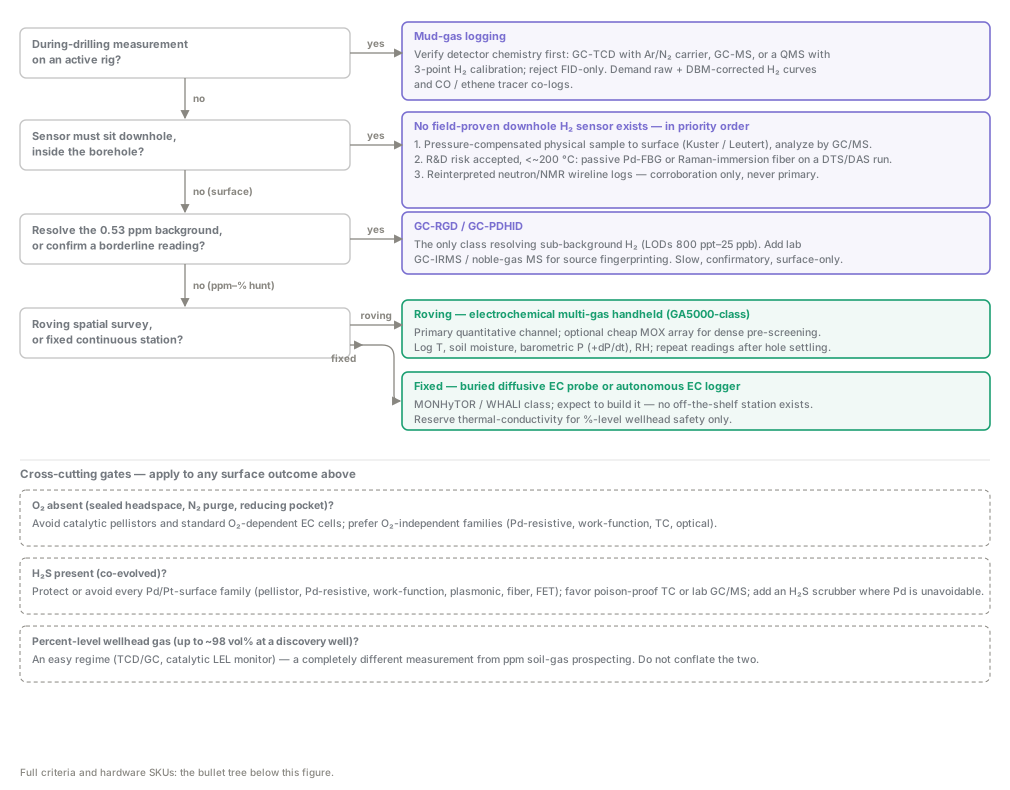
The same logic as the bullet tree below, as a picture. The three dashed gates at the bottom modify any surface outcome.
- Is this a during-drilling measurement on an active rig?
- Yes → Mud-gas logging (page). Verify detector chemistry and contract terms per scenario (d) above; cross-check before any resource decision.
- No → continue.
- Does the sensor have to sit inside the borehole, above ~150 °C?
- Yes → no field-proven downhole H2 sensor exists. In priority order: pressure-compensated sample to surface for GC/MS; passive Pd-FBG or Raman-immersion fiber as R&D (<~200 °C); neutron/NMR wireline as corroboration only. Details in scenario (c).
- No (surface / near-surface) → continue.
- Do you need to resolve the 0.53 ppm background, or confirm a borderline few-ppm reading?
- Roving spatial survey, or fixed continuous station?
- Roving → electrochemical multi-gas handheld (GA5000-class) as the primary channel (page); optional MOX array for dense pre-screening. Covariates per scenario (a).
- Fixed → buried diffusive EC probe (MONHyTOR-class) or autonomous EC logger (WHALI). Expect to build it (scenario b). Reserve TC for %-level wellhead safety.
- Cross-cutting gates (any surface choice):
- O2 absent (sealed headspace, N2 purge, reducing pocket)? Avoid pellistors and standard O2-dependent EC cells; prefer O2-independent families (Pd-resistive, work-function, TC, optical).
- H2S present? Protect or avoid every Pd/Pt-surface family (pellistor, Pd-resistive, work-function, plasmonic, fiber, FET); favor poison-proof TC or lab GC/MS; add an H2S scrubber where a Pd sensor must be used.
- Percent-level wellhead gas (up to ~98 vol% at a discovery well)? An easy regime (TCD/GC, catalytic LEL monitor) and a different measurement from ppm prospecting. Do not conflate the two.
Master comparison matrix
Section titled “Master comparison matrix”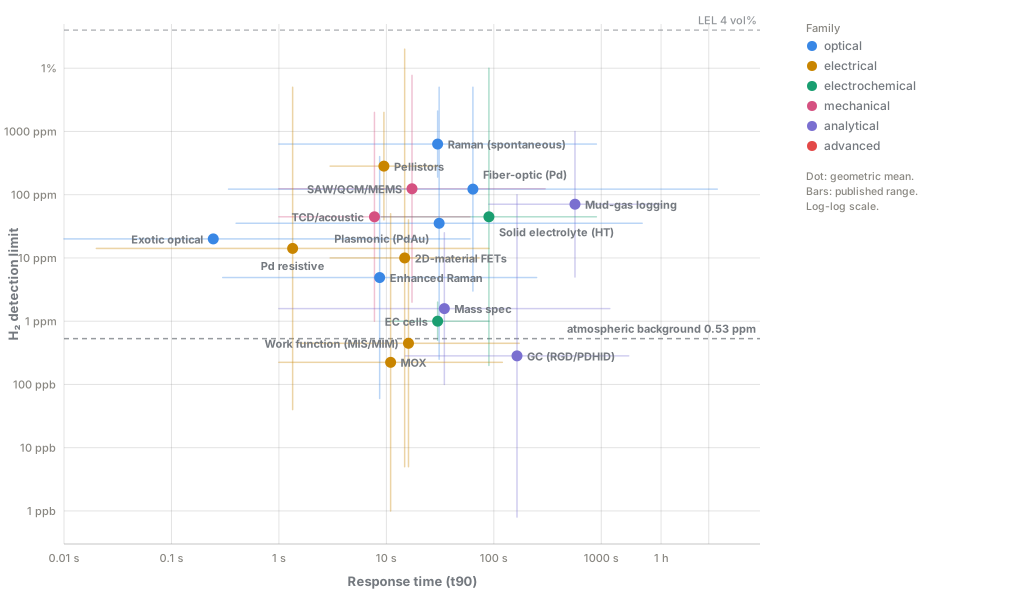
The same trade space as a picture. All four synthesis charts live on the charts page.
One row per technology family, populated from the modality datasheets in src/data/modalities/ and the underlying dossiers.
| Family | LOD (ppm) | Range (ppm) | Response t90 | Selectivity | T range (°C) | O2 needed? | Drift | Key poisons | Power | Cost class | TRL | Field verdict | Page |
|---|---|---|---|---|---|---|---|---|---|---|---|---|---|
| Catalytic pellistor | 40–2,000 | 0–40,000 | 3–30 s | none | −40…75 | yes (>10–12%) | high | silicones, H2S, lead | 5 mW–0.4 W | A–B | 9 | Cheap %LEL safety backstop; too coarse, O2-bound | link |
| Thermal conductivity / acoustic | ~1–2,000 | 500–10⁶ | 1–60 s | low | −40…90 | no | low | none | 0.05 mW–5 W | A–C | 9 | Poison-proof, low-drift; He/CH4/CO2 fool it, not ppm | link |
| MOX chemiresistor | 0.001–50 | 1–10,000 | 1–120 s | low | −30…85 | yes (>18%) | high | siloxanes, H2S | 15 mW–0.9 W | A | 9 | Cheap dense pre-screen; humidity-dominated, non-selective | link |
| Electrochemical cell | 0.5–2 | 0–50,000 | 10–90 s | medium | −30…50 | yes (typ.) | medium | H2S, siloxane | 1 mW–0.5 W | A–B | 9 | The soil-gas field workhorse; drift, CO, 1–3 yr life | link |
| Solid-electrolyte / high-T EC | 0.2–10,000 | 0.2–980,000 | 9–900 s | low | 200…900 | yes | medium | H2S, Pt sintering | 1–20 W | B (unver.) | 4 | Needs 300–900 °C; no 100–300 °C bridge; unproven | link |
| Palladium resistive / nanomaterial | 0.04–5,000 | 0.04–10⁶ | 0.02–90 s | high | −40…150 | no | medium | H2S, high CO, siloxanes | 0.1 µW–10 W | A–C (unver.) | 9 (%-level) | O2-free, commercial at %-level; H2S-poisoned, ppm not field-hard | link |
| Work-function (MIS / Schottky / GasFET) | 0.005–40 | 0.005–50,000 | 1.5–172 s | low | −40…800 | no | high | CO, H2S, SO2, siloxanes | 1 mW–0.5 W | A–C (unver.) | 7 | Only branch demoed to 500–800 °C; H2S, drift | link |
| 2D-material / FET (graphene, CNT, MXene) | 0.005–20,000 | 0.005–40,000 | 3–73 s | low | 0…255 | no | high | H2S, humidity/condensation | 1 µW–0.3 W | A (unver.) | 3 | Low-power lab promise; no product, humidity-wrecked | link |
| SAW / QCM / MEMS mechanical | 2–7,700 | 2–10⁶ | 1–300 s | medium | −40…350 | no | high | H2S, CO, In2O3 reduction | 0.1 nW–0.4 W | A–C (unver.) | 4 | Passive-wireless niche only; severe T-drift, no product | link |
| Raman (spontaneous) | 190–2,100 | 190–10⁶ | 1–900 s | high | −20…150 | no | low | none (optical fouling) | 0.15–300 W | D | 9 (process) | Multi-gas fingerprint incl. H2; ~1000× too coarse for ppm | link |
| Enhanced Raman (CERS / FERS) | 0.06–400 | 0.06–10⁶ | 0.3–250 s | high | 5…400 (physics) | no | medium | SERS-oxidation, Pd/H2S | 0.01–240 W | D | 5 | Cavity/fiber routes reach ppb in lab; not fielded | link |
| IR absorption (proxy gases) | 0.0003–50 | 0–10⁶ | 1–120 s | high | −25…200 | no | low | dust/condensate, H2S corrosion | 1–300 W | C–D | 9 | Cannot see H2; senses CH4/CO2/C2H6 proxies only | link |
| UV/EUV & fluorescence | n/a | n/a | n/a | none (field) | n/a | no* | high | LiF solarization | 0.5–5 kW | C–E | 2 | Air is opaque in VUV; lab-only | link |
| Fiber-optic / chemochromic | 3–5,000 | 3–50,000 | 0.34 s–200 min | high | −54…232 | no | medium | H2S, SO2 | 0 W head (0–15 W system) | B–D | 4 | Only zero-downhole-electronics path; unproven >4 vol%, room T/P | link |
| Plasmonic / metamaterial (LSPR) | 0.25–5,000 | 0.25–40,000 | 0.4 s–40 min | medium | −30…130 | no | medium | CO, H2S/SOx | unver. | unver. | 5 | Spark-free ppb lab demos; sole vendor divesting, %-level | link |
| Exotic optical (LIBS / interferometry / flame-UV) | ~20 (LIBS) | up to 10⁶ | 1 ms–60 s | none | −55…200 | no* | medium | window fouling | 0.5–500 W | C–D | 9 as safety / 2–4 as H2 | Wellsite safety/leak-imaging role; not H2-selective | link |
| Gas chromatography (RGD / PDHID / TCD) | 0.0008–100 | 0.0008–10⁶ | 15 s–30 min | high | −10…45 (instrument) | no | low | HgO-bed depletion, column | 15 W–1 kW | C–D | 9 | Only tech resolving sub-background H2; slow, surface-only | link |
| Mass spectrometry (RGA / QMS / MIMS / IRMS) | 0.1–25 | 0.1–10⁶ | 1 s–20 min | high | −10…70 | no | medium | siloxane, H2S, pump oil | 35 W–1.5 kW | C–D | 8 | Reference truth + isotopes; m/z 2–4 crowded, surface-only | link |
Cost class: A = <$100 (bare element) · B = $100–1k · C = $1k–20k · D = $20k–200k (capital instrument) · E = >$200k / day-rate service. Bare-element vs. full-instrument pricing differs by family; most OEMs publish no list price. * on O2: UV/EUV and flame-UV do not need O2 to sense H2, but flame detectors only fire after ignition, and ambient O2 makes air opaque in the VUV.
Mud-gas logging is deliberately not a matrix row: it is a wellsite measurement chain built on the GC/MS/TCD families above, treated as scenario (d) and on its own page.
Cross-cutting truths
Section titled “Cross-cutting truths”Seven theses recur across every dossier and matter as much as any single spec.
- Only GC-RGD/PDHID resolves sub-background today. Demonstrated LODs of 800 ppt–25 ppb make it the only class that separates the 0.53 ppm background from a modest anomaly. Every other family’s realistic field floor sits at or above background (the electrochemical workhorse’s ±2.5% FS accuracy is tens of ppm), so their honest job description is “detect a high-tens-to-thousands-of-ppm anomaly against a noisy few-ppm floor.”
- Electrochemical cells are the workhorse, with artifact caveats. Uniquely ppm-capable, portable, low-power, and cheap; also drifting, CO-cross-sensitive, O2-dependent at the counter electrode, high-biased under depressurization, and 1–3 years to end of life. Fit-for-purpose because its covariates are better characterized than the alternatives’, not because it is clean.
- H2S poisoning threatens everything Pd/catalytic. Pellistors, Pd-resistive, work-function, plasmonic, Pd-fiber, and Pd-FET sensors all need a clean noble-metal surface, and H2S sulfides those sites. Anchor quantitation on poison-proof TC or lab GC/MS; run Pd/catalytic sensors as scrubber-protected secondaries.
- Nothing survives downhole T yet except fiber concepts. Every active family is ruled out by temperature, the no-electronics preference, or its own failure mode; passive Pd-fiber fits the constraints and is unvalidated above room T/P or ~4 vol%. Today’s downhole program is sampling plus surface analysis.
- Humidity is the universal confounder. Dominant for MOX and 2D-FET (one FET lost 51% of response between 50–80% RH); sign-flipping bias for TC (peaking near 40–60% RH); slows Pd and fiber response; swells or dries electrochemical electrolyte. No raw reading is interpretable without co-logged RH.
- FID is H2-blind. Structurally zero H2 response at any concentration (it detects carbon). “The rig has a mud logger” is not evidence of H2 capability.
- He needs its own path. Raman and IR cannot see it; TC reads 1 vol% He as ~+7,700 ppm-equivalent of false H2; it is isobaric with D2/HT at m/z 4 and co-elutes near H2 on molecular-sieve GC columns. Yet a stable He/H2 ratio is one of the best natural-vs-artifact diagnostics, and noble-gas MS (R/Ra) does source attribution. Plan a deliberate helium channel.
What we would actually deploy today
Section titled “What we would actually deploy today”Opinionated, costed straw-man kits. Cost bands use the matrix legend; unverified prices are flagged. The reasoning is constant: a fast, cheap screening layer decides where and when to look; a slow, quantitative confirmation layer establishes what the number really is.
(a) Roving soil-gas survey, ~$15–40k of hardware (indicative; handheld list prices undisclosed). Primary: an electrochemical multi-gas handheld (GA5000-class, cost class C) with an H2 cell plus NDIR CH4/CO2 and O2/H2S channels. Optional densifier: MOX/BME688 boards (class A) between quantitative reads. Confirmation: grab samples in silicone/steel-modified Exetainers or Tedlar bags for GC-RGD. Covariate pack: soil-moisture/temperature probe, logging barometer, gas-line RH sensor.
(b) Fixed continuous station: a build, not a purchase, ~$10–30k per node. Core: a buried diffusive EC probe (MONHyTOR-class) or autonomous pumped EC logger (WHALI-class), class B–C, solar + battery + LoRa. Add a TC MEMS channel (class A–B) only for wellhead %-level safety. Full covariate telemetry, run for at least a season (scenario b).
(c) Downhole: sampling today, fiber as an R&D bet, ~$5–30k per run. A pressure-compensated mechanical sampler (Kuster PVT bottle or Leutert PDS, class B–C, zero downhole electronics) analyzed at surface by GC/MS; corroborate with reinterpreted neutron/NMR wireline. R&D line item: a passive Pd-FBG or Raman-immersion fiber on an existing DTS/DAS string for targets <~200 °C; a 3–7 year bet, not a capability. Seals and darkening per scenario (c).
(d) Drilling / mud-gas: a service contract, not a box, ~$0.5–2M/well day-rate. Contract an H2-branded fluid-logging service (SLB FlairFlex or a DQ1000-equipped unit; class E) with the QC written into the contract: detector must be GC-MS, QMS with 3-point H2 calibration, or GC-TCD on Ar/N2 carrier, never FID-only or He-carrier TCD; raw and DBM-corrected H2 curves plus CO/ethene co-logs; cross-check against discrete can samples at an offsite lab.
(e) Lab-grade truth & isotopes, ~$20–150k capital or send-out. Anchor: a GC-RGD/PDHID (SRI 8610C-class or online AMETEK ta3000R, class C–D). Add access to GC-IRMS and noble-gas MS for δD-H2, δ13C-CH4, and He R/Ra, the evidence that turns a high reading into a defensible resource claim; and a membrane-inlet MS (Hiden HPR-40) if dissolved-H2 groundwater work is in scope. Guard the sample chain per scenario (e).
Related pages
Section titled “Related pages”- Why hydrogen is hard to sense: the physics that constrains every choice above
- Reading the specs: how to read the datasheet numbers behind the comparison matrix
- Geologic context · Soil-gas surveys · Downhole deployment · Environmental covariance · Calibration & QA/QC
- Electrochemical cells · Gas chromatography · Mass spectrometry · Mud-gas logging · Fiber-optic sensors