Standards, regulations & certification
Summary
Section titled “Summary”Every other page in this wiki asks a physics question — how well can this transducer sense hydrogen? This page asks a legal and administrative question instead: what do the numbers on a sensor’s spec sheet actually mean, and which certification stamps actually matter? Two separate regimes are at play, and confusing them is an expensive mistake. The first is a body of performance standards — mostly written for hydrogen refueling stations and industrial safety systems — that test whether a detector reliably warns of an approaching explosive atmosphere; passing one of these says essentially nothing about whether a sensor can resolve a faint 2 ppm geologic anomaly against a natural background of roughly 0.5 ppm, because the safety standards operate in percent-of-LEL units, some five orders of magnitude coarser than an exploration signal. The second regime is hazardous-area certification — ATEX, IECEx, the National Electrical Code’s Class/Division system — which answers a different and far less negotiable question: is it even legal to power this instrument on at a wellsite, gas-gathering skid, or transformer vault where an explosive atmosphere can form? Hydrogen sits in the most demanding hazard category of any commonly encountered industrial gas, so this second regime touches every piece of hardware Hestia fields, irrespective of how well it measures ppm-level hydrogen. No standard anywhere certifies exploration-grade ppm sensitivity for geologic hydrogen, and for that Hestia is and will remain in a standards vacuum; but the hazardous-area rules governing whether a sensor may be energized at all are among the strictest, most mature, and most fully enforced regimes in industrial safety. Which stamp is actually required should be established before a purchase order is written.
Mechanism & physics
Section titled “Mechanism & physics”What standards bodies certify is a set of reproducible pass/fail outcomes against a written test protocol, with numeric thresholds derived from physical theory. Three bodies of theory underpin essentially every number in this dossier.
Response-time formalism: what t₉₀ actually measures
Section titled “Response-time formalism: what t₉₀ actually measures”ISO 26142:2010 defines time of response (t₉₀) as the time interval, with the apparatus warmed up, between an instantaneous step change from clean air to a standard test gas at the sensor inlet and the moment the response reaches 90% of its final indication, with a parallel time of recovery t₁₀ defined identically for the return step [1]. “Final indication” is itself pinned down by a formal stabilization criterion: three successive readings taken 30 s apart must not differ by more than 5% of the test-gas volume fraction [1]. These are the legally operative definitions that a certification lab measures compliance against.
Two experimental confounds make an apparently simple “time to 90%” measurement surprisingly hard to standardize, and both matter for anyone benchmarking a sensor in-house rather than trusting a vendor number. First, the intrinsic sensor response (surface kinetics, diffusion, RC time constants of the readout electronics) is convolved with an extrinsic delay from the test apparatus itself — the time needed to actually deliver a step change in concentration to the sensor inlet [3]. For a test chamber behaving as a continuously stirred tank of volume fed at flow rate , the concentration approach to a step change follows
while a plug-flow (laminar, small-tube) geometry instead follows along the flow path [3]. Hübert et al. (BAM, Germany) show experimentally that a naively large test chamber () requires >130 s just for the gas itself to reach 90% of its final concentration, a confound large enough that two genuinely different sensors can produce nearly identical, artifact-dominated response curves [3]. Properly designed fast-switching rigs (pneumatic or solenoid-valve gas exchange, sub-cm³ dead volumes) reduce this extrinsic delay to 0.03–1 s, small enough that the measured curve reflects sensor physics rather than plumbing [3]. Second, response time is not independent of step size: a MOX sensor’s t₅₀ falls from ~5.6 s at a 0.001% step to <1 s at a 0.1–1% step, attributed to surface-coverage kinetics and, for semiconductor sensors, an RC time constant that itself shrinks as resistance drops with rising H₂ [3]. A vendor’s single quoted “t₉₀ = X s” is therefore always implicitly tied to an unstated (usually large) test concentration step, and is not simply portable to a ppm-level exploration transient.
The ignition-physics basis of hazardous-area classification
Section titled “The ignition-physics basis of hazardous-area classification”Explosion-protection certification (ATEX/IECEx/NEC) is a direct encoding of combustion physics into equipment-design rules. Three physical parameters classify a flammable gas into an equipment-relevant hazard group: minimum ignition energy (MIE), the smallest spark energy statistically capable of igniting the stoichiometric mixture; maximum experimental safe gap (MESG), the largest gap between two chambers of a standardized dual-chamber apparatus through which an internal explosion will not propagate flame externally; and autoignition temperature (AIT), the temperature at which the mixture ignites with no spark at all. Hydrogen sits at the extreme end of all three axes among industrially common gases: MIE ≈ 0.017 mJ [18] — roughly an order of magnitude below methane’s ≈0.28–0.31 mJ and propane’s ≈0.24–0.25 mJ [18] — MESG in the range ≈0.08–0.28 mm depending on test apparatus (well below the ≥0.9 mm cutoff for Group IIA and the 0.5–0.9 mm band for Group IIB) [17], and AIT ≈ 560 °C [17]. The MESG and MIE values are precisely why hydrogen (with acetylene) sits alone in Group IIC, the most stringent apparatus-design category: a flameproof (Ex d) enclosure rated for methane or propane service does not automatically contain a hydrogen explosion, because hydrogen’s tiny quenching gap lets flame propagate through joint tolerances that would safely arrest a IIA/IIB flame [17]. The 560 °C AIT is comfortably inside Temperature Class T1 (maximum allowed equipment surface temperature ≤450 °C) [17] — so hydrogen’s temperature classification is the least restrictive part of its hazard profile; the gap and spark-energy axes are what make H₂ demanding to certify, which matters when reading an ATEX code string [15].
Metrological traceability as a formal chain
Section titled “Metrological traceability as a formal chain”A calibration-gas certificate’s numeric value is only as good as the documented, unbroken chain of comparisons connecting it to a primary realization of the mole. ISO 6142-1 codifies the top of that chain: a gravimetric method in which pure component gases are weighed into a cylinder and mole fraction is computed from measured masses and molecular weights, with an uncertainty budget built from balance repeatability, component purity, and verification-analysis uncertainty [27]. ISO 6143 sits one link down: a comparison method that assigns or checks a working mixture’s composition by bracketing it against reference mixtures of known composition on an analytical instrument, propagating the reference mixtures’ uncertainty into the new value [28]. NIST’s Primary Standard Gas Mixture program (a NASA-motivated effort established in 1993, spanning He/H₂/Ar/O₂ balanced in N₂) sits at the top of the U.S. traceability pyramid; SI-traceable value assignment for lower tiers (SRMs, NTRMs, EPA Protocol Gases) is made by comparison to these primaries, not by independent re-derivation [30]. This is the same CCL/primary/secondary hierarchy described in depth on Calibration, drift & QA/QC; this page’s contribution is to note that ISO 6142/6143 are the formal international standard numbers underneath that hierarchy, and that possessing an ISO-6142-compliant certificate is what “traceable” is supposed to mean in a legal/audit sense.
Variants & subtypes
Section titled “Variants & subtypes”The standards landscape splits into five non-overlapping families, each answering a different question and enforced by a different mechanism — voluntary consensus standard, legally mandatory directive, or national electrical code.
| Family | Governing question | Enforcement mechanism | Key instruments |
|---|---|---|---|
| A. Sensor performance / product standards | Does this detector model meet a written accuracy/response/robustness spec? | Voluntary consensus standard, invoked by a purchaser’s spec or a listing body (UL/CSA/FM) | ISO 26142 [1]; IEC 60079-29-1/-2/-4 [5,8,9]; ISA 12.13.01 [10]; UL 2075 [11]; CSA C22.2 No. 152 / FM 6310-6320 [35] |
| B. Hazardous-area / explosion-protection certification | May this equipment be legally energized in this classified atmosphere? | Legally mandatory in the jurisdiction (EU directive; national electrical code) | ATEX 2014/34/EU [12,13]; IECEx Certified Equipment Scheme [16]; NEC/CEC Class/Division [19,20]; API RP 500/505 for petroleum sites [21] |
| C. Vehicle/automotive H₂ safety regulation | Does this FCEV design (including its onboard detector) meet minimum crash and leak safety? | Regulatory template (UN GTR) or industry-consensus recommended practice | UN GTR No. 13 [23,24]; SAE J2578 [25]; SAE J2579 [26]; ISO 19880-1 (fueling stations) [37] |
| D. Metrology / calibration-gas standards | Is the reference gas used to calibrate any of the above traceable and of known uncertainty? | Voluntary consensus method standard, underlying NMI/CCL practice | ISO 6142-1/-2 [27]; ISO 6143 [28]; WMO-GAW CCL scale practice [29]; NIST SRM/NTRM/Protocol Gas program [30]; NPL Primary Reference Gas Mixtures [31] |
| E. Stationary installation / facility codes | How must a hydrogen-handling facility (not a single instrument) be designed, ventilated, and monitored? | Adopted into building/fire code by local authority having jurisdiction | NFPA 2 Hydrogen Technologies Code [34]; IEC 60079-29-2 (selection/installation/maintenance) [8] |
Family A — the performance standards. ISO 26142:2010 (“Hydrogen detection apparatus — Stationary applications”) is the only standard written specifically for hydrogen in this list; everything else in Family A is a combustible-gas-generic standard that happens to apply to H₂ because H₂ is combustible. It was drafted by ISO/TC 197 (“Hydrogen technologies”) primarily for refueling-station detectors but is written to apply to any stationary H₂ detection apparatus [1,2]. IEC 60079-29-1 is the international generic combustible-gas performance standard (construction, testing, performance methods for portable/transportable/fixed detectors) [5,6]; 60079-29-2 is its companion selection, installation, use and maintenance guidance for equipment already compliant with -29-1 or -29-4 [8]; 60079-29-4 covers open-path (line-of-sight spectroscopic) detectors measuring an integrated path-concentration in LFL·m rather than a point value [9]. ISA 12.13.01 is the North American mirror of the IEC 61779/60079-29-1 lineage; that committee’s ongoing work has been transferred to UL under UL STP 60079, converging the North American and IEC tracks [10]. UL 2075 differs in scope, not just geography: it targets fixed/portable, factory-calibrated, non-field-recalibratable detectors for ordinary (non-hazardous) locations, combustible-gas thresholds at or below 25% LEL, and explicitly includes sensors used inside fuel-cell detection circuits [11].
Family B — explosion protection. ATEX is two EU directives working together: 2014/34/EU (the “equipment” directive, governing what manufacturers may sell) and 1999/92/EC (the “workplace” directive, governing how employers classify and manage hazardous areas) [12,13]. IECEx is the international analog, using the same IEC 60079 test standards as ATEX but operating as a voluntary certification scheme recognized across roughly 30+ member-body countries, with mutual recognition between accredited Ex Test Laboratories (ExTLs) and Ex Certification Bodies (ExCBs) [14,16]. North America instead uses the NEC/CEC Class/Division system (Class I = flammable gas/vapor; Division 1 = hazard present under normal conditions; Division 2 = hazard present only under abnormal conditions) [19,20], which API overlays onto petroleum practice via API RP 500 (Division-system classification of petroleum facilities) and API RP 505 (Zone-system classification, aligned with IEC/ATEX practice) [21]. Division 1 is roughly the union of Zone 0 and Zone 1; Division 2 maps approximately to Zone 2 [19].
Family C — automotive. UN GTR No. 13, adopted 2013 under UN/WP29 sponsorship, is a global technical regulation — a harmonization template that national authorities commit to a good-faith effort to align binding regulation with, rather than directly self-executing law [23]. SAE J2578 (“General Fuel Cell Vehicle Safety”) governs overall vehicle/system integration and crashworthiness; SAE J2579 (“Fuel Systems in Fuel Cell and Other Hydrogen Vehicles”) is the more prescriptive companion for the storage/delivery subsystem, incorporated into J2578 by reference [25,26]. ISO 19880-1 governs the fueling station side of the same ecosystem rather than the vehicle [37].
Family E — facility codes. NFPA 2 is the U.S. consolidated hydrogen facility code (2026-edition scope now spans compressed and cryogenic-liquid H₂ generation, storage, piping, use, and blends down to 95 vol% H₂), and it independently specifies a gas-detection trigger “at or below 1% by volume” — a number that closely matches ISO 26142’s own alarm-set-point floor discussed below [34].
Method comparison & quantitative envelope
Section titled “Method comparison & quantitative envelope”ISO 26142:2010 — the clause-level requirements
Section titled “ISO 26142:2010 — the clause-level requirements”Reading the standard’s own definitions and clauses 4–6 gives the following load-bearing requirements, most of which are absent from secondary summaries:
| Requirement | Clause | Value / rule | Note |
|---|---|---|---|
| Measuring range | 4.1.3 | Manufacturer-declared; must span ≥1 order of magnitude | Multi-technology apparatus must declare per-sensor sub-ranges |
| Alarm set point | 4.1.4.1 | ≥1 latching alarm at or below H₂ volume fraction 1×10⁻² (1%, i.e. 25% LEL) | 2+ set points allowed; the lower one may be non-latching |
| Fault signalling | 4.1.4.2 | Mandatory on power loss, sensor short/open circuit, or flow failure (aspirated units) | Distinguishes “fault” (device broken) from “alarm” (gas present) |
| Indicator colour code | 4.1.5.4 | Red = alarm, yellow = fault, green = operating, in that priority order | |
| Stabilization criterion | 3.24 | 3 readings 30 s apart differing ≤5% of test-gas value | Defines “final indication” used in t₉₀/t₁₀ |
| Time of response, t₉₀ | 3.26 / 6.4.13 | Time to 90% of final indication after a step from clean air | |
| Time of recovery, t₁₀ | 3.27 / 6.4.13 | Time to fall to 10% of final indication after a step to clean air | |
| Hazardous-area construction | 4.1.1 | Must comply with IEC 60079-0 and relevant IEC 60079 parts | ISO 26142 defers explosion-protection design to IEC 60079 rather than duplicating it |
| Test battery | Clause 6 | Response, range/calibration, stability, alarm set point, T/P/RH, vibration, orientation, flow, t₉₀/t₁₀, selectivity, poisoning, over-range, power variation, warm-up, EMC, field-cal kit | 21 distinct sub-tests under 6.4 alone |
All rows above are drawn directly from the standard’s own definitions and clauses 4–6 [1].
The independently reported literature consensus is that essentially every modern commercial hydrogen sensor beats ISO 26142’s implicit “reasonable” response bar by a wide margin: Hübert et al.’s own dynamic-chamber measurements found t₉₀ = 1.8–2.0 s (thermal-conductivity), 2.1–3.5 s (MIS-FET/work-function), 2–16 s (metal-oxide, two products), and 20–50 s (catalytic pellistor) [3]. Only the slower end of catalytic-pellistor performance risks brushing against a formal “<30 s” threshold, if one existed as a hard line in a given product standard.
IEC 60079-29-1 — the generic combustible-gas bar
Section titled “IEC 60079-29-1 — the generic combustible-gas bar”The current edition specifies construction, testing, and performance across four categories — accuracy, stability, environmental, and timing — with a stated minimum requirement that manufacturers report the transfer function at 0/10/30/50/70/90/100% of full-scale output, and it supports measuring ranges up to 20% LEL, not merely the traditional 0–100% LEL span [5,6]. No single universal numeric accuracy pass/fail threshold (e.g. “±X% LEL”) could be surfaced outside the paywalled standard text; summaries consistently describe the requirement qualitatively as “verifying the accuracy of gas reading,” which is itself a useful finding: the accuracy tolerance is edition- and range-dependent and cannot be safely quoted as one figure without the primary text [5,6,7].
UN GTR No. 13 — the tightest numbers in this dossier
Section titled “UN GTR No. 13 — the tightest numbers in this dossier”The tightest numeric requirements in this survey come from the automotive regulation rather than the stationary-detector standard, because a vehicle cabin fire/explosion risk window is measured in seconds, not minutes [23]:
| GTR 13 clause | Requirement | Cited value |
|---|---|---|
| §5.2.1.3.2(a) Exhaust system | H₂ at point of discharge, 3-second rolling average, normal operation | shall not exceed 4 vol% |
| §5.2.1.3.2(b) Exhaust system | Instantaneous H₂ at point of discharge | shall not exceed 8 vol% at any time |
| §5.2.2.2 Post-crash compartment limit | H₂ in passenger/luggage/cargo compartments after a crash | shall not exceed 3 ± 1.0 vol% |
| Post-crash hold period | Window over which the compartment limit applies | within 1 hour of impact (helium surrogate allowed at ≤3 vol% instead of 4 vol%) |
| Recommended verification-detector response | To confirm the exhaust limit against an 8 vol% pulse of only 1 s duration | t₉₀ ≈ 300 ms recommended |
The same NREL/JRC compliance paper reports the state of the art against this target: as of its writing the fastest independently validated hydrogen sensor response time in the literature was 4 s, and the sub-1-second response DOE flagged as a critical performance gap remained unmet by any independently verified commercial device — one thermal-conductivity sensor (Xensor TCG3880) carried a manufacturer-claimed <250 ms response, “although not yet independently verified” [23]. That is a two-orders-of-magnitude gap between ISO 26142’s stationary-detector expectation and GTR 13’s automotive verification-instrument target: “meets ISO 26142” and “meets GTR 13’s implied verification-instrument speed” are not the same claim. Two independent secondary sources also describe an operational onboard warning/shutoff requirement distinct from the static post-crash limit above: audible/visual warning at 2 ± 1.0 vol% and automatic fuel-source shutoff at 3 ± 1.0 vol% [24] — consistent in magnitude with, and likely the operational counterpart to, the §5.2.2.2 static limit.
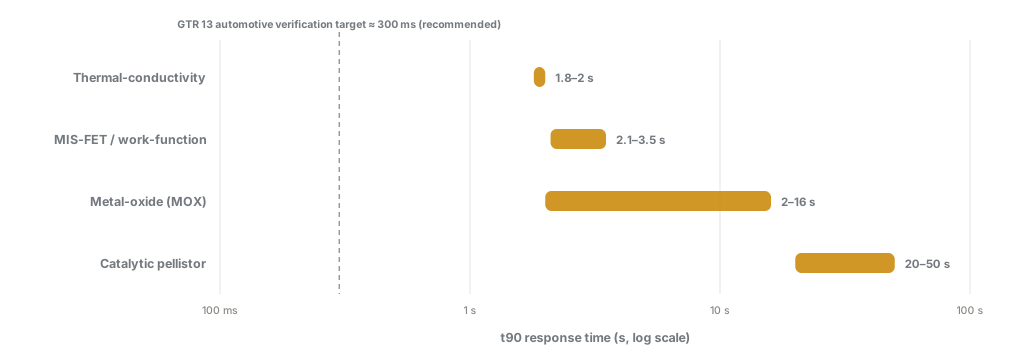
Every family here already clears any plausible stationary-detector expectation; none comes close to GTR 13’s automotive verification target.
Hazardous-area classification crosswalk
Section titled “Hazardous-area classification crosswalk”| System | H₂-relevant designation | Meaning | Ref |
|---|---|---|---|
| IEC/ATEX gas group | Group IIC | Most stringent gas group (with acetylene); MESG < 0.5 mm | [12,17] |
| IEC/ATEX temperature class | T1 (≤450 °C) | H₂ AIT ≈ 560 °C gives comfortable margin — the least restrictive of H₂’s three hazard axes | [17] |
| NEC/CEC Class/Group | Class I, Group B | Explicitly hydrogen-named group; equipment rated only for Groups C/D is non-compliant for H₂ | [19,20,22] |
| NEC seal-off practice | Div. 1/2 Group B conduit seals | Group B conduit systems commonly require sealing fittings at tighter intervals than less-stringent groups; only Group-B-listed fittings may be used | [22] |
| ATEX/IECEx category ↔ zone | Cat. 1/Zone 0 (Ex ia, EPL Ga); Cat. 2/Zone 1 (Ex d/e/ib, EPL Gb); Cat. 3/Zone 2 (Ex n/p, EPL Gc) | Category 1 devices must remain safe through two independent simultaneous faults | [13] |
| Division ↔ Zone crosswalk | Division 1 ≈ Zone 0 ∪ Zone 1; Division 2 ≈ Zone 2 | Zone system is more granular; a IIC/Division-1-only inventory forces conservative, expensive equipment selection | [19] |
Ingress protection and the metrology-chain numbers
Section titled “Ingress protection and the metrology-chain numbers”IEC 60529 defines the two-digit IP code (first digit = solids/dust ingress 0–6, second = liquid ingress 0–9); IP66 = dust-tight plus protection against powerful water jets; IP67 = dust-tight plus 30 minutes’ immersion at 1 m; IP68 = dust-tight plus a manufacturer-defined continuous submersion rating beyond IP67’s fixed test. Passing IP67 does not imply passing the IP66 jet test, or vice versa, since the two liquid sub-tests are independent [33]. On the metrology side, ISO 6142-1’s gravimetric method and ISO 6143’s comparison method are the two standards underneath essentially every “certified ±X%” cylinder tag Hestia will ever purchase [27,28]; NIST’s Primary Standard Gas Mixture program sits at the top of the U.S. chain, cross-checked internationally through CCQM key comparisons [30], and NPL is the UK NMI equivalent, supplying ISO 17034-accredited hydrogen Primary Reference Gas Mixtures [31].
Environmental covariance & cross-sensitivity
Section titled “Environmental covariance & cross-sensitivity”ISO 26142’s selectivity/poisoning framework is tuned for industrial and refueling-station atmospheres, not geologic seep chemistry. The standard formally distinguishes an interferant (a substance whose presence reversibly affects sensitivity) from poisoning (an interferant’s effect that is permanent) [1], and clauses 6.4.14/6.4.15 mandate dedicated selectivity and poisoning tests. A companion cross-sensitivity study run jointly by the EC Joint Research Centre (Petten, NL) and DOE’s National Renewable Energy Laboratory, performed explicitly in accordance with ISO 26142’s recommendations, is the most detailed independently reproducible source for what these tests look like in practice [4]. Their protocol held 25 °C ± 2 °C and 100 kPa ± 10 kPa with dry test gas (RH typically <5%) at 1000 sccm flow, comparing sensor response with and without an interferent present via two defined factors, (interferant-alone response normalized to the 1 vol% H₂ response) and (change in the H₂ response induced by co-exposure) [4].
One result bears directly on Hestia’s co-evolved-gas problem. The interferents tested — CO₂ (5000 ppm), CH₄ (10,000 ppm = 1 vol%), and CO (50 ppm) — were chosen to approximate industrial safety regulatory levels, not any geologic-seep gas ratio [4]. A metal-oxide sensor (MOX-1) exposed to 1 vol% CH₄ alone (no H₂ present) produced a response “equivalent to approximately 0.5 to 0.7 vol% hydrogen,” a false-positive H₂ signal at roughly half to two-thirds the magnitude of the true co-exposure signal; and when H₂ and CH₄ were presented together, the net response was significantly less than the sum of the individual responses, i.e. non-additive rather than merely offset [4]. Because CH₄ is one of the most consistently co-evolved gases at natural H₂ seeps, any certification claim resting on a MOX platform’s ISO-26142-protocol selectivity result should not be read as clearance for the CH₄ backgrounds typical of geologic exploration sites, since the tested level (1 vol%) is itself far below some seep-associated CH₄ concentrations and the response is documented as strongly platform-dependent — the same study reports near-zero CO cross-sensitivity for that MOX unit, and notes that thermal-conductivity sensors, lacking any catalytic metal, show high resistance to poisons as a structural consequence of their transduction physics, though they instead show cross-sensitivity to any gas with thermal conductivity far from air’s — He, CH₄, and CO₂ among them (see MOX sensors and Thermal conductivity & acoustic sensors for the platform-specific physics) [4].
The poisoning-species list in ISO 26142 (SO₂, H₂S, NO₂, hexamethyldisiloxane/HMDS) reflects the standard’s design intent. These four were selected as representative of industrial and refueling-station contaminants — SO₂/NO₂ from combustion-adjacent sources, HMDS as a silicone/sealant off-gassing proxy — not because they are calibrated against natural-seep H₂S:H₂ ratios [4]. Detailed quantitative poisoning results (test concentrations, exposure durations, pass/fail sensitivity-shift thresholds) are analyzed with full numeric citation on Catalytic pellistors and Work-function devices; this page flags the structural point both sibling dossiers make explicitly: the standard’s short-duration, industrially-calibrated exposure protocol may not reflect sensor robustness to the same contaminant over the much longer field-deployment durations, or at the H₂S:H₂ ratios, Hestia would actually encounter at a seep.
The tested envelope also does not match field or downhole reality. ISO 26142’s normal test conditions (temperature, pressure, humidity, voltage, orientation, clause 6.3) are, by design, laboratory conditions bracketing a stationary refueling-station installation — not the wide diurnal/seasonal swings of an unsheltered soil-gas survey station, and certainly not downhole high-temperature/high-pressure conditions (see Environmental covariance and Downhole deployment). A certified t₉₀/accuracy number is a statement about performance inside the tested envelope; extrapolating it to HPHT downhole service or extreme desert/arctic field deployments is an unverified assumption the certificate itself does not make.
A worked, independently documented example of a certified-adjacent cross-sensitivity artifact comes from the NREL/JRC GTR-13 compliance study, which investigated, and then recommended against, using oxygen-displacement (indirect O₂ depletion) to quantify hydrogen or helium releases, despite oxygen sensors’ low cost and technology-agnostic compatibility with either gas as a diluent [23]. Three reasons, verified directly from the primary paper: (1) oxygen-sensor electronic noise is large relative to the small O₂ depletion produced by percent-level H₂/He releases, risking both false positives and false negatives in a safety application; (2) most O₂ sensors respond to the partial pressure of oxygen, not vol% O₂, so in a sealed compartment a hydrogen release can measurably lower vol% O₂ without changing , producing no signal at all; and (3) a controlled thermal-transient test showed a commercial O₂ sensor’s reading dipping to ~20.3 vol% (from a stable ~21 vol%) and only slowly recovering over roughly an hour purely in response to a 40 °C→25 °C chamber ramp at constant true oxygen concentration — a pure temperature artifact large enough to be mistaken for a real gas event [23]. NREL/JRC’s explicit recommendation to DOT was that the GTR’s own text endorsing oxygen-displacement quantification be removed [23]. This is a rare case of a standards body’s own commissioned research documenting, and then successfully lobbying to retract, a flawed measurement method embedded in a binding regulation.
Use for geologic H2
Section titled “Use for geologic H2”No standard in this landscape certifies what Hestia actually needs measured. ISO 26142’s alarm-set-point floor (≥1 set point required at or below 1×10⁻², i.e. 1% = 250× above the 0.53 ppm atmospheric background) is a safety threshold, calibrated to give warning margin before the 4 vol% LEL — it says nothing about, and was never intended to say anything about, a sensor’s ability to resolve a 2 ppm soil-gas anomaly. Passing ISO 26142 certification is evidence a detector will reliably warn of an approaching explosive atmosphere; it is not evidence, in either direction, of ppm-level trace-detection fidelity. The same logic applies transitively to IEC 60079-29-1, ISA 12.13.01, and UL 2075: all three are combustible-gas safety performance standards whose accuracy requirements are expressed in %LEL, a unit roughly five orders of magnitude coarser than Hestia’s exploration signal band. A “certified to IEC 60079-29-1” datasheet line should not be treated as a substitute for exploration-grade calibration data; it answers a different question. See Reading the specs for the general discipline of separating a datasheet’s marketing claims from its load-bearing numbers.
Hazloc certification, by contrast, is a legal requirement and the most consequential certification line on any spec sheet Hestia will read. A sensor with excellent ppm sensitivity that lacks an appropriate ATEX/IECEx (Ex ia/ib IIC, or Ex d IIC) or NEC Class I Division 1/2 Group B rating cannot be legally energized in a classified area. This is a legal and insurance question, not a performance one, and it cannot be worked around in data processing. Because hydrogen sits in the most stringent Group IIC / Class I Group B category, the pool of off-the-shelf certified equipment is smaller and more expensive than for a IIA/IIB gas: Group-B-rated conduit fittings, barriers, and enclosures are a narrower product category than the general Class I Div 1/2 catalog, and getting a bespoke sensor independently certified is a real capital and schedule cost (multi-month ExCB/ExTL test cycles, notified-body review under ATEX) that should be budgeted for early if Hestia ever wants a custom instrument in a hazardous zone rather than an already-certified commercial unit.
Downhole, intrinsic safety and fiber optics are frequently the only practical route to compliance. A flameproof (Ex d) enclosure that must simultaneously survive downhole HPHT ratings, fit wellbore-diameter constraints, and contain a IIC-rated internal explosion is a difficult mechanical-design intersection. Intrinsic safety (Ex ia, suitable even for Zone 0/Division-1-continuous exposure) instead limits the electrical energy available at the sensing point below the ignition threshold, sidestepping the enclosure problem entirely. A fiber-optic sensing element that carries no electrical energy at all to the downhole measurement point is the logical limit of this strategy, eliminating the ignition-source question rather than merely containing it. See Fiber-optic sensors for the transduction physics (Pd-coated FBGs, evanescent-field fibers, gasochromic coatings) that make this architecture possible; this page’s contribution is the regulatory “why” — Ex ia and all-optical designs are the two protection concepts that scale gracefully to Zone 0/Division-1-continuous, IIC-rated, HPHT downhole service, where Ex d enclosure design becomes progressively less practical (see also Downhole deployment).
No natural/geologic-hydrogen-specific standard exists, and none was found in active development as a consensus standard. SPWLA and SPE conference papers on “regearing” mud gas logging for natural H₂ exploration, and on advanced mud-gas-logging techniques for H₂, are real and active — but they are individual research contributions and vendor case studies published through a professional-society proceedings venue, not ballot-approved consensus standards with the force ISO/IEC/ANSI standards carry [32] (see Mud gas logging). CSA Group’s own public statement is unambiguous on the adjacent (industrial/automotive) H₂-sensor question: “there are presently no standards specifically for hydrogen sensors” beyond the combustible-gas-generic performance standards (CSA C22.2 No. 152, FM 6310/6320) that apply to H₂ only because H₂ is combustible [35] — and no evidence suggests this gap narrows for the geologic-exploration use case specifically. For exploration-grade performance claims, Hestia is and will remain in a standards vacuum; for wellsite hazardous-area deployment, it is in one of the most mature, strict, and fully enforced standards regimes in industrial safety. The certification paperwork that legally protects Hestia (hazloc) differs from the paperwork vendors tend to foreground on a marketing page (ISO 26142/IEC 60079-29-1 compliance claims).
Instruments, labs & standards
Section titled “Instruments, labs & standards”The standards table
Section titled “The standards table”| # | Standard / regulation | Scope | What it actually certifies | Who needs it |
|---|---|---|---|---|
| 1 | ISO 26142:2010 [1,2] | Stationary H₂ detection apparatus | Precision, response/recovery time, stability, measuring range, selectivity, poisoning resistance, alarm-system behavior against a written test battery | Manufacturers seeking H₂-specific product certification; buyers writing procurement specs for fixed H₂ safety monitors |
| 2 | IEC 60079-29-1 [5,6,7] | Portable/transportable/fixed flammable-gas detector performance (generic) | Accuracy, stability, environmental robustness, and timing against a combustible-gas-generic battery, in %LEL up to 20% LEL ranges | Any vendor selling a combustible-gas (incl. H₂) detector into IEC/ATEX-recognizing markets |
| 3 | IEC 60079-29-2 [8] | Selection, installation, use, maintenance of detectors already compliant with -29-1/-29-4 | Correct field practice — an operational-competency standard, not a product certification | Facility EHS/operations teams deploying certified detectors |
| 4 | IEC 60079-29-4 [9] | Open-path flammable-gas detectors, ~1 m to a few km path lengths | Performance of integrated-path (LFL·m) measurement | Perimeter/fenceline open-path monitoring vendors and buyers |
| 5 | ISA 12.13.01 [10] | North American combustible-gas detector performance, converging with 60079-29-1 under UL STP 60079 | Same performance battery as IEC 60079-29-1, North American listing pathway | US/Canada-market combustible-gas detector vendors |
| 6 | UL 2075 [11] | Factory-sealed, non-field-recalibratable detectors for ordinary locations, incl. fuel-cell system sensors | Combustible-gas detection at/below 25% LEL and toxic-gas detection within TWA limits | Consumer/light-commercial H₂/combustible detector vendors (not hazardous-area service) |
| 7 | ATEX 2014/34/EU + 1999/92/EC [12,13,14,15] | EU equipment directive + workplace directive | Legal right to market equipment for explosive-atmosphere use; employer’s duty to classify zones and manage risk | Any manufacturer selling into, or operator running a hazardous-area facility within, the EU/EEA |
| 8 | IECEx Certified Equipment Scheme [14,16] | International explosion-protection certification, IEC 60079-series test basis | Cross-border mutual recognition of Ex certificates among ~30+ member ExCBs/ExTLs | Vendors selling Ex-rated equipment into multiple non-EU jurisdictions |
| 9 | NEC/CEC Class I, Division 1/2, Group B [19,20,22] | North American hazardous-location electrical installation rules | Legal permission to install/energize equipment in a classified location; Group B specifically required for H₂ | Any US/Canada facility (incl. wellsites) with hydrogen release potential |
| 10 | API RP 500 / RP 505 [21] | Classification of locations at petroleum facilities | Site-specific area classification methodology for oil & gas facilities, incl. drilling/production areas | Upstream/midstream petroleum operators (directly applicable to Hestia wellsites) |
| 11 | UN GTR No. 13 [23,24] | Global technical regulation, hydrogen/fuel-cell light-duty vehicles | Harmonized template for binding national FCEV safety regulation | National vehicle-safety regulators and FCEV OEMs |
| 12 | SAE J2578 [25] | General FCEV safety | Recommended-practice design/safety guidelines for the whole vehicle | FCEV OEMs and system integrators |
| 13 | SAE J2579 [26] | Fuel systems in fuel-cell and hydrogen vehicles | Prescriptive design, construction, verification-test requirements for the H₂ subsystem | FCEV OEMs, H₂ storage-system manufacturers |
| 14 | ISO 19880-1 [37] | Gaseous hydrogen fueling stations | Minimum design/installation/commissioning/inspection requirements | Hydrogen refueling station developers/operators |
| 15 | ISO 6142-1/-2 [27] | Gravimetric calibration-gas preparation (Class I / Class II) | Traceable mole-fraction assignment and uncertainty budget for a prepared cylinder mixture | Gas-mixture manufacturers; NMIs |
| 16 | ISO 6143 [28] | Comparison methods for checking calibration-gas composition | Traceable value-transfer/verification against reference mixtures | Calibration labs verifying working cylinders against primaries |
| 17 | NFPA 2 [34] | Hydrogen Technologies Code (US) | Facility-level fire/life-safety code compliance, incl. a ≥1 vol% gas-detection trigger | US facility owners/operators, AHJs |
| 18 | CSA C22.2 No. 152 / FM 6310-6320 [35] | Canadian / FM Global combustible-gas detector performance | North American listing-body equivalent of IEC 60079-29-1-class testing | Vendors seeking CSA or FM listing in Canada/insurance-driven US markets |
Certification bodies and metrology labs
Section titled “Certification bodies and metrology labs”Notified Bodies under ATEX and Ex Certification/Test Bodies under IECEx are the entities that actually issue the certificates in the table above; commonly encountered names in the hazardous-area equipment space include TÜV SÜD, DEKRA, Baseefa, Intertek, CSA Group, FM Approvals, and UL — several of which appear directly in the Catalytic pellistors and Work-function devices vendor tables (e.g. SGX Sensortech’s VQ500-series pellistor line carries ATEX/IECEx/CSA/UL marks; AppliedSensor/ams’s HLS-440P is ATEX Zone 2 rated; H2scan’s HY-ALERTA line is marketed as intrinsically safe). On the metrology side, MPI-BGC (Jena, Germany) is the WMO-GAW Central Calibration Laboratory maintaining the X2009 atmospheric H₂ mole-fraction scale, NOAA’s Global Monitoring Laboratory propagates that scale onto eight primary standards held in electropolished stainless-steel cylinders (chosen specifically to avoid the drift problem seen in cheaper aluminum cylinders) [29], and NIST/NPL serve the equivalent NMI role for the U.S./U.K. traceability chains respectively [30,31] — see Calibration, drift & QA/QC for the full drift/QA discussion this page deliberately does not duplicate.
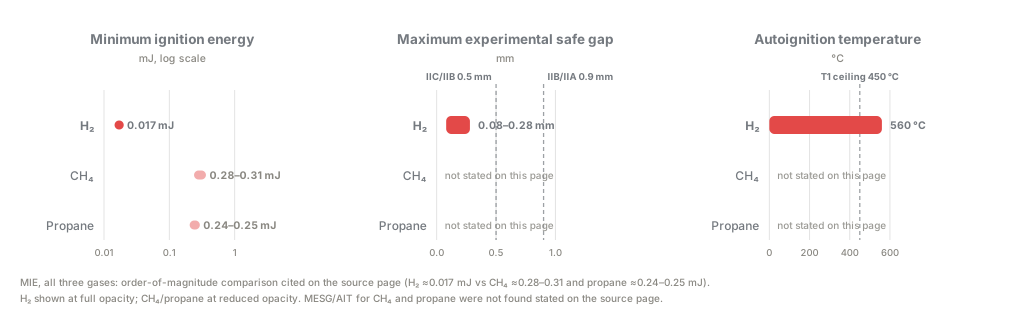
H2’s MIE and MESG are what put it alone, with acetylene, into Group IIC; CH4 and propane MESG/AIT values are not given on this page.
Open questions
Section titled “Open questions”The state of research here splits sharply by regime. The response-time gap between stationary and automotive expectations remains open: DOE’s own published hydrogen safety-sensor technical targets — response time <1 s, accuracy within 5% of full scale, 0.1–10% measuring range, −30 to 80 °C operating range, 10-year lifetime — were, as of the most recent review surveyed, still not comprehensively met by commercial sensors, particularly for long-term stability, humidity tolerance, and poisoning resistance in combination [36]. The automotive ≈300 ms verification-instrument target embedded in GTR 13 remains an “elusive target” for independently validated commercial sensors even a decade after adoption, with only manufacturer-claimed (unverified) sub-250 ms performance from a specialized thermal-conductivity device [23]. Standards convergence is underway on the North American/IEC seam: ISA12 committee work has been formally transferred to UL under UL STP 60079, aligning North American listing practice more closely with IEC 60079-29-1 [10]; national adoption of ISO 26142 with local modification (e.g. Australia’s AS 26142:2020) shows individual national bodies continuing to tune the base ISO text rather than the ISO text itself being revised to a second edition. Facility-code scope is actively expanding: NFPA 2’s 2026 edition now extends full scope over hydrogen requirements including blended fuel gases down to 95 vol% H₂ [34], and ISO 19880 continues to add parts (a dispensers/dispensing-systems part published 2025; a mobile-fueling-station part in committee-draft stage) [37]. Regulatory attention to natural/geologic hydrogen is arriving from the resource-assessment side well ahead of any hardware-certification side: USGS released its first Geologic Hydrogen Prospectivity Map in January 2025 [38], and state-level executive action (e.g. a Michigan geologic-hydrogen exploration and preparedness initiative dated January 2026) signals that policy infrastructure for the resource is beginning to form — but no parallel effort to define exploration-instrument performance standards, exploration-relevant calibration-gas standards, or a natural-H₂-specific safety-detector standard was located, leaving Hestia in the mixed regime described above for the foreseeable future.
Specific open items worth tracking:
- Obtain the full paywalled text of IEC 60079-29-1 (and its ISA 12.13.01 mirror) to extract the actual numeric %LEL accuracy tolerance by measuring-range band; this survey found only qualitative descriptions.
- Verify the precise GTR 13 clause and text for the “2% warning / 3% shutoff” onboard requirement against the primary UNECE regulation PDF; current sourcing relies on a secondary review plus a corroborating search snippet, consistent with but not identical to the primary-source-verified §5.2.2.2 post-crash limit.
- Determine whether any commercial H₂ sensor has since been independently validated at the sub-1-second (ideally ≈300 ms) GTR-13-implied response time using a validated protocol — the literature surveyed found none confirmed below ~1.8–2 s.
- Cross-check whether Hestia’s actual candidate downhole/wellsite sensor SKUs (see Catalytic pellistors, Work-function devices, Fiber-optic sensors vendor tables) carry Class I Division 1 Group B — not just Group C/D — certification line-by-line.
- Investigate whether any ISO 6142/6143-compliant calibration cylinder is commercially available at sub-10-ppm H₂-in-air levels with a documented uncertainty budget, versus the aluminum-cylinder drift problem documented on Calibration, drift & QA/QC.
- Monitor SPWLA/SPE proceedings for any move from individual conference papers toward a formal working group or ballot-track standard for natural/geologic-H₂ mud-gas logging — none was found in development, but the field is new enough that this could change quickly.
- Track ISO/TC 197 activity for a second-edition revision of ISO 26142:2010, and for any new work item scoped to non-stationary or exploration-context H₂ detection.
- Obtain a primary-source MESG/MIE/AIT comparison table (e.g. from IEC 60079-20-1 or NFPA 497 directly) to firm up the exact H₂-vs-CH₄-vs-propane values only loosely bracketed by secondary compilations here.
Related pages
Section titled “Related pages”- Why H₂ is a hard sensing target
- Reading the specs
- Sensor selection
- Calibration, drift & QA/QC
- Downhole deployment
- Environmental covariance
- Geologic context for H₂ exploration
- Soil-gas surveys
- Fiber-optic sensors
- Catalytic pellistors
- Work-function devices
- MOX (metal-oxide) chemiresistors
- Thermal conductivity & acoustic sensors
- Mud gas logging
- Glossary
- Vendor & SKU directory
References
Section titled “References”Full reference list (0 entries)
[1] ISO 26142:2010, “Hydrogen detection apparatus — Stationary applications,” ISO/TC 197 Hydrogen technologies, first edition. https://www.iso.org/standard/52319.html
[2] Hydrogen Tools (H2tools.org / PNNL), “ISO 26142 Hydrogen Detection Apparatus – Stationary Applications.” https://h2tools.org/fuel-cell-codes-and-standards/iso-26142-hydrogen-detection-apparatus-stationary-applications
[3] Hübert, T., Majewski, J., Banach, U., Detjens, M., Tiebe, C., “Response Time Measurement of Hydrogen Sensors,” BAM Federal Institute for Materials Research and Testing / Lublin University of Technology. https://hysafe.info/uploads/papers/2017/211.pdf
[4] Palmisano, V., Boon-Brett, L., Bonato, C., Harskamp, F., Buttner, W.J., Post, M.B., Burgess, R., Rivkin, C., “Evaluation of Selectivity of Commercial Hydrogen Sensors,” Proceedings, International Conference on Hydrogen Safety (ICHS) 2013, JRC-IET/NREL. https://hysafe.info/ichs2013/images/papers/134.pdf
[5] IEC, “IEC 60079-29-1:2016 (+AMD1:2020 CSV) — Explosive atmospheres — Part 29-1: Gas detectors — Performance requirements of detectors for flammable gases.” https://webstore.iec.ch/en/publication/66754
[6] H2tools, “IEC 60079-29-1 Explosive atmospheres – Part 29-1: Gas detectors – Performance requirements of detectors for flammable gases.” https://h2tools.org/fuel-cell-codes-and-standards/iec-60079-29-1-explosive-atmospheres-part-29-1-gas-detectors
[7] International Gas Detectors, “BS EN 60079-29-1 – Explosive Atmospheres.” https://www.internationalgasdetectors.com/services/standards/bs-en-60079-29-1-explosive-atmospheres/
[8] H2tools, “IEC 60079-29-2 Explosive atmospheres – Part 29-2: Gas detectors – Selection, installation, use and maintenance of detectors for flammable gases and oxygen.” https://h2tools.org/fuel-cell-codes-and-standards/iec-60079-29-2-explosive-atmospheres-part-29-2-gas-detectors
[9] ANSI / en-standard.eu, “IEC 60079-29-4 Ed.1.0 b:2009 — Explosive atmospheres — Part 29-4: Gas detectors — Performance requirements of open path detectors for flammable gases.” https://webstore.ansi.org/standards/iec/iec6007929ed2009
[10] ISA, “ISA12.13, Performance Requirements for Combustible Gas Detectors” (committee page); ANSI/ISA-12.13.01-2013 record. https://www.isa.org/standards-and-publications/isa-standards/isa-standards-committees/isa12-13
[11] H2tools, “UL Subject 2075 Standard for Gas and Vapor Detectors and Sensors.” https://h2tools.org/fuel-cell-codes-and-standards/ul-subject-2075-standard-gas-and-vapor-detectors-and-sensors
[12] Pumpport, “ATEX Directive 2014/34/EU – Equipment Categories and Ex Protection Types.” https://pumpport.com/en/atex-pump-guide/atex-directive/
[13] EXREG, “ATEX Categories 1, 2, 3 & EPL (Ga/Gb/Gc) Explained.” https://ex-reg.com/atex-categories-epl/
[14] HexlonEx, “What Is ATEX vs. IECEx? Key Differences, Zones, and When Each Applies.” https://www.hexlonex.com/news/atex-iecex-key-differences-zones-when-each-applies/
[15] MeasureMonitorControl, “Understanding ATEX Codes.” https://www.measuremonitorcontrol.com/resources/atex/atex-codes
[16] IECEx, “Certified equipment scheme.” https://www.iecex.com/certified-equipment-scheme/overview/
[17] HazlocDirectory, “Temperature class (T-class) VS Auto-ignition Temperature (AIT).” https://www.hazlocdirectory.com/technical-documents/temperature-class-t-class-vs-auto-ignition-temperature-ait; SST Sensing, “Hazardous Area Gas Groups and Temperature Classifications.” https://sstsensing.com/hazardous-area-gas-groups-and-temperature-classifications/
[18] IOPscience, “Measurement of minimum ignition energy in hydrogen-air mixtures,” Journal of Physics: Conference Series 301, 012039. https://iopscience.iop.org/article/10.1088/1742-6596/301/1/012039/pdf (title as given does not match the article at this DOI — actual title is Kumamoto et al., “Measurement of minimum ignition energy in hydrogen-oxygen-nitrogen premixed gas by spark discharge”; that paper supports the H₂ MIE ≈0.017 mJ figure but does not support the cited methane/propane MIE comparison values)
[19] Larson Electronics, “Understanding Class, Divisions, Groups and Zones in NEC and the CEC Hazardous Locations.” https://www.larsonelectronics.com/blog/2018/10/29/miscellaneous/understanding-class-divisions-groups-and-zones-in-nec-and-the-cec-hazardous-locations
[20] LegalClarity, “Class I Hazardous Locations: Divisions, Zones & Equipment.” https://legalclarity.org/class-i-hazardous-locations-divisions-zones-equipment/
[21] API, “API RP 500: 4th Edition” announcement; API RP 505 record. https://www.api.org/products-and-services/standards/important-standards-announcements/rp500
[22] IntrinsicallySafeStore, “Class 1 Division 1 Explained: Safety in Hazardous Locations.” https://intrinsicallysafestore.com/blog/what-is-class-1-div-1/ (page supports the general Class I Div 1 discussion but does not support the specific Group B seal-interval/listed-fittings claim in the crosswalk table — does not support the claim)
[23] Buttner, W., Rivkin, C., Burgess, R., Hartmann, K., Bloomfield, I., Bubar, M., Post, M., Boon-Brett, L., Weidner, E., Moretto, P., “Hydrogen Monitoring Requirements in the Global Technical Regulation on Hydrogen and Fuel Cell Vehicles,” NREL / EC Joint Research Centre, OSTI record 1353421. https://www.osti.gov/servlets/purl/1353421
[24] Frontiers in Energy Research, “Analysis of safety technical standards for hydrogen storage in fuel cell vehicles,” 2024, doi:10.3389/fenrg.2024.1376739. https://www.frontiersin.org/journals/energy-research/articles/10.3389/fenrg.2024.1376739/full
[25] SAE International, “J2578_202301: Recommended Practice for General Fuel Cell Vehicle Safety.” https://saemobilus.sae.org/standards/j2578_202301-recommended-practice-general-fuel-cell-vehicle-safety
[26] SAE International, “J2579_202301: Standard for Fuel Systems in Fuel Cell and Other Hydrogen Vehicles.” https://saemobilus.sae.org/standards/j2579_202301-standard-fuel-systems-fuel-cell-hydrogen-vehicles
[27] ISO, “ISO 6142-1:2015 — Gas analysis — Preparation of calibration gas mixtures — Part 1: Gravimetric method for Class I mixtures.” https://www.iso.org/standard/59631.html
[28] ISO, “ISO 6143:2001 / ISO 6143:2025 — Gas analysis — Comparison methods for determining and checking the composition of calibration gas mixtures.” https://www.iso.org/standard/24665.html
[29] Atmospheric Measurement Techniques, “Atmospheric H2 observations from the NOAA Cooperative Global Air Sampling Network,” AMT 17, 4803–4823, 2024. https://amt.copernicus.org/articles/17/4803/2024/
[30] NIST, “Traceable Calibration Gases: SRMs, NTRMs, and Protocol Gases.” https://www.nist.gov/programs-projects/traceable-calibration-gases-srms-ntrms-and-protocol-gases
[31] NPL, “Hydrogen primary reference gas mixtures.” https://www.npl.co.uk/products-services/gas/hydrogen-primary-reference-gas-mixtures
[32] OnePetro, “Key Role of Regearing Mud Gas Logging For Natural H2 Exploration,” SPWLA Annual Logging Symposium (SPWLA-2022); “Advanced Mud Gas Logging Techniques for Hydrogen Exploration,” SPE Middle East Oil & Gas Show and Conference (2025). https://onepetro.org/SPWLAALS/proceedings-abstract/SPWLA22/3-SPWLA22/D031S001R003/487788
[33] IEC, “Ingress Protection (IP) ratings.” https://www.iec.ch/ip-ratings; Industrial Scientific, “Gas Detector IP Ratings: Why do they Matter?” https://www.indsci.com/en/blog/gas-detector-ip-ratings-why-do-they-matter
[34] NFPA, “NFPA 2, Hydrogen Technologies Code (2026 edition).” https://www.nfpa.org/product/nfpa-2-hydrogen-technologies-code/p0002code
[35] CSA Group, “An overview of CSA Group standards, codes, and activities for the hydrogen ecosystem.” https://www.csagroup.org/article/an-overview-of-csa-group-standards-codes-and-activities-for-the-hydrogen-ecosystem/
[36] PMC (PubMed Central), “Recent Advances and Challenges of Nanomaterials-Based Hydrogen Sensors,” PMC8626019. https://pmc.ncbi.nlm.nih.gov/articles/PMC8626019/
[37] ISO, “ISO 19880-1:2020 — Gaseous hydrogen — Fuelling stations — Part 1: General requirements.” https://www.iso.org/standard/71940.html
[38] USGS, “Geologic Hydrogen.” https://www.usgs.gov/centers/central-energy-resources-science-center/science/geologic-hydrogen