Downhole & borehole H2 sensing
Measuring hydrogen a kilometer underground is a fundamentally different problem from measuring it in a field with a handheld sniffer. A borehole is hot — often well past the boiling point of water — under enormous pressure, and full of brine, drilling mud, and co-evolved gases like H2S and methane that can corrode, contaminate, or simply cook an instrument. Most electronics cannot survive down there for long: standard drilling and logging tools start to struggle above roughly 150 °C, and wrapping them in an insulated flask only buys hours before the flask itself heats through, not permanent protection.
That is why, today, there is no commercial device Hestia (or anyone) can lower into a well and get a live, continuously updating hydrogen-concentration reading the way a smoke detector gives a live smoke reading. Every real downhole hydrogen number published so far — from Mali to Colombia to France — was obtained either by physically hauling a sample of gas or fluid back to the surface for laboratory analysis, or by cleverly reinterpreting standard oilfield logging tools (built to sense water and porosity, not hydrogen specifically) for a secondary hydrogen signature.
This page works through the physics that make “no downhole electronics” the default engineering assumption, the handful of real-world architectures people have tried instead, and what a genuine downhole H2 sensor would still need to overcome.
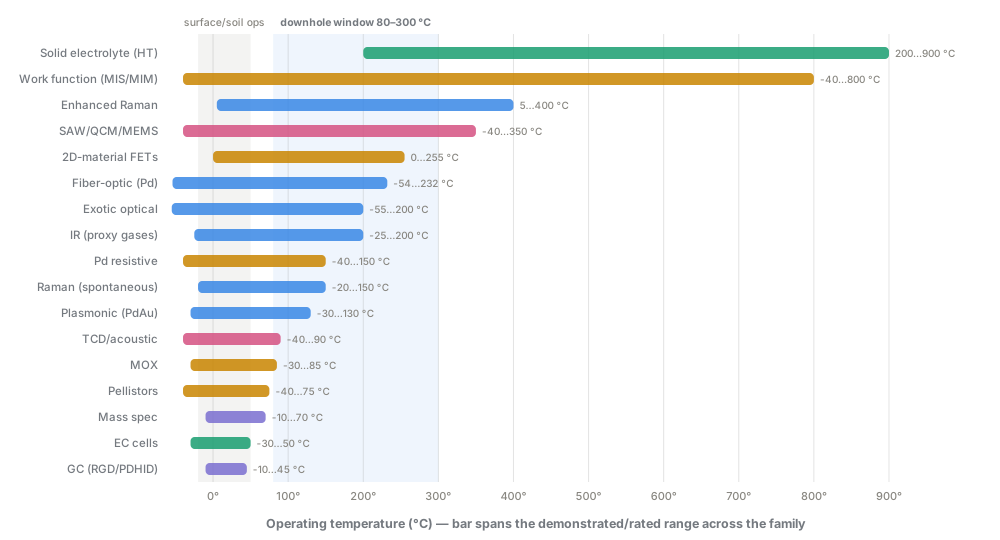
Rated/demonstrated operating temperature per family vs. the downhole window. The 100–200 °C stretch, where most target wells sit, is served by almost nothing off-the-shelf.
Mechanism & physics
Section titled “Mechanism & physics”Downhole H2 sensing is a systems problem rather than a single physical mechanism: getting a representative sample of formation gas (or a signal correlated with its H2 content) from depth and temperature to a measurement, without destroying the instrument, losing or contaminating the hydrogen en route, or mistaking a measurement artifact for a real formation signal. Four governing physical frameworks recur across every architecture below.
The thermal-survival problem
Section titled “The thermal-survival problem”Standard oilfield electronics (drilling and logging tools, gauges, telemetry) are qualified in temperature tiers set by commercial silicon reliability, not by physics:
| Temperature tier | Status |
|---|---|
| 125–150 °C | routine |
| 150–175 °C | ”high-temperature” and commercially available |
| 175–200 °C | requires specialized, often silicon-on-insulator (SOI), parts, with only a small number of specialized tools reaching ~200 °C for high-temperature gas reservoirs [2] |
Standard downhole sensor technology is “not reliable over 150 °C,” while anticipated geothermal drilling environments exceed 400 °C, motivating a distinct materials class — SiC, GaN, Ga2O3 wide-bandgap semiconductors with novel oxide/composite packaging — demonstrated to at least 250 °C and potentially to 400 °C in NREL’s geothermal-electronics program [3][4].
SOI construction is the standard bridge technology for the 175 °C+ tier, separating the active silicon device layer from the substrate with a buried oxide to suppress the leakage currents that dominate junction-isolated CMOS failure at high temperature [5]; wide-bandgap AlGaN/GaN electronics extend this further into the 200–300+ °C regime at the cost of process maturity and cost [6].
Where electronics cannot survive continuously, two mitigations exist, each with a hard characteristic-time limit. Dewar/flask packaging converts a continuous-exposure problem into a lumped-thermal-mass problem: treating the electronics package as a single thermal capacitance losing heat to the formation temperature through a flask of effective conductance ,
— an exponential approach to formation temperature with time constant set by the flask’s thermal mass and insulation quality. The flask does not stop heating, it only slows it, buying a finite logging-run duration before internal temperature crosses the electronics’ critical rating [7][8]. A combined vacuum-flask, phase-change-material, and heat-pipe system has been demonstrated experimentally to hold electronics below 125 °C for a 6-hour run in a 200 °C downhole environment [9][10][11].
The practical consequence is a hard trade: passive thermal packaging buys hours, not days, and once a flask has “charged” to critical temperature it must be pulled and cooled for a comparable duration before reuse — logging tools rated to 175 °C are commonly dewar-flasked to survive brief excursions into 200 °C wells, but this is a duration-limited workaround, not continuous monitoring [8][12].
No downhole electronics at all — the fiber-optic strategy, taken up in Variants below — sidesteps the thermal-survival problem entirely by putting only a passive optical element (grating, coating, fiber core) downhole and keeping every active component (laser, detector, digitizer) at surface, connected by a fiber that is itself dielectric and largely temperature-insensitive up to the softening point of silica (>1000 °C) [13][14]. A “no downhole electronics” design preference is the only architecture that removes the exponential-decay time limit of the equation above altogether.
Sampling and transport: Henry’s law, degassing, and lag time
Section titled “Sampling and transport: Henry’s law, degassing, and lag time”For every architecture that brings fluid — rather than a photon or a neutron count — to a measurement point, the governing relation is Henry’s law for the dissolved-gas equilibrium between formation brine and any free gas phase:
with the temperature- and salinity-dependent Henry constant. Hydrogen’s Henry constant passes through a minimum solubility near 330 K (~57 °C) — H2 is least soluble in that band and more soluble both above and below it — and the “salting-out” effect (higher-salinity brine holding less dissolved gas) weakens sharply above 187 °C and becomes negligible above ~460 K, so deep, hot, saline formation waters do not reject H2 as strongly as cooler brines might suggest [15].
Practically, H2 solubility increases roughly two orders of magnitude between surface conditions and ~1000 m depth, and below roughly 1300 m depth H2 becomes more soluble in brine than co-existing CH4 — meaning a naive gas-phase-only sampling strategy can systematically under-represent deep H2 relative to methane [15][16].
Any pressure drop between the formation and the sample container (bailer, PVT bottle, annular gas collector) risks flashing dissolved H2 out of solution before capture, or — for open, unsealed monitoring wells — continuous in-well degassing: field studies of dissolved-gas monitoring in groundwater wells found total dissolved-gas pressure rising from background <1.7 atm to >3.1 atm merely by sealing an open well with a packer, and to as high as 4.0 atm under active pumping, demonstrating that the act of sampling can add or strip gas relative to the true in-situ concentration by amounts comparable to the signal itself [18].
For gas-phase transport up a wellbore during drilling (mud-gas logging, below), the controlling relation is a simple advection/lag-time model: gas liberated at the bit at time reaches the surface analyzer at time , where
with the annular mud volume from bit to surface and the pump flow rate [19]. This lag both delays the signal (minutes to tens of minutes, growing with depth) and — because turbulent and laminar dispersion smears a sharp downhole gas pulse over the ascent — broadens a narrow gas “kick” into a longer, lower-amplitude surface peak, an effect explicitly flagged as a concern for resolving fine-scale H2 spikes against the surface analyzer’s own cycle time [20].
Neutron and NMR logging: hydrogen index is not hydrogen gas
Section titled “Neutron and NMR logging: hydrogen index is not hydrogen gas”A common point of confusion in this domain is that the two wireline logs most sensitive to “hydrogen” — neutron porosity and NMR — do not measure molecular H2 at all. They measure hydrogen index (HI), the concentration of hydrogen atoms per unit volume of material relative to the same quantity in pure water at surface conditions [21][22]:
A neutron-porosity tool emits fast neutrons and counts how efficiently they thermalize and are captured; because a hydrogen nucleus (a bare proton) is by far the most efficient neutron moderator among common formation nuclei, the tool’s raw physical observable is HI, converted to an “apparent porosity” only under the built-in assumption that all formation hydrogen resides in pore-filling water or oil at HI ≈ 1 [21][23][24].
NMR logging measures a distinct but related quantity: the amplitude of the free-induction/echo signal from precessing hydrogen nuclei is directly proportional to HI, so NMR “porosity” is likewise fundamentally a hydrogen-atom-counting measurement, not a compositional one [24][25].
Neither tool can directly detect “H2 gas” as a species — both respond identically to any hydrogen-bearing fluid (water, oil, hydrocarbon gas, or molecular H2) in proportion to its atomic hydrogen density, with no chemical selectivity between them. What they can do is register that free gas of any kind — including H2 — has a much lower HI than the liquid water or oil it displaces, because gas at reservoir pressure is far less dense than liquid and so has far fewer H atoms per unit volume even where every molecule contains hydrogen. Two corroborating signatures follow.
First, a neutron–density crossover: a density log’s apparent porosity increases when a low-density gas replaces denser water/oil, while the neutron log’s apparent porosity decreases because gas’s HI is much lower than 1 (methane gas is commonly cited with HI ≈ 0.2–0.6 depending on pressure and temperature) — plotted together, gas-bearing zones show density-porosity reading systematically higher than neutron-porosity, the classic “gas crossover” repurposed in the natural-hydrogen literature as a candidate H2 indicator [26][27][28].
Second, an NMR amplitude deficit and long-T1 signature: because HI(gas) < 1, an NMR log under-reports total porosity in a gas zone relative to an independent density/sonic porosity, and gas’s T1 relaxation time is typically several seconds versus much shorter T1 for bound/capillary water, so an anomalously long-T1 component of NMR signal is a classic tight-gas/free-gas diagnostic exploitable in principle for H2 [24][25][29].
At Mali’s Bourakebougou field — the only place these signatures have been documented for natural, economically significant H2 rather than hydrocarbon gas — the neutron tool was reported to become “overexcited” by the sheer quantity of hydrogen atoms in a near-pure-H2 gas column, producing an anomalous increase in apparent neutron porosity in the shallowest carbonate zone relative to what lithology alone would predict, while a coincident decrease in sonic P-wave velocity corroborated a gas phase [30][31].
This is subtly different from — and initially looks like the opposite of — the classical hydrocarbon-gas crossover, because the sign and magnitude of the neutron response to a given gas depends on that gas’s own HI and its pressure/temperature-dependent density; H2’s very low molecular weight (2 g/mol) is not identical to methane’s, and the Bourakebougou crossplot behavior required careful petrophysical reinterpretation rather than a template lookup [30].
Neutron, density, and NMR logs are a real, zero-incremental-hardware, deep, high-T/P-rated indirect H2 detector, but they are qualitative-to-semi-quantitative at best, require site-specific calibration against a known gas composition, and can be confounded by shale/clay-bound-water effects that also perturb neutron porosity independent of any gas [30][32].
Elastomer permeation: Fickian diffusion through a seal
Section titled “Elastomer permeation: Fickian diffusion through a seal”Any downhole tool that seals a sample chamber, an O-ring gland, or a cable penetrator with an elastomer is subject to steady-state Fickian permeation, , where is the molar flux through the seal, the material’s gas permeability coefficient, the partial-pressure differential across the seal, and the seal thickness.
Because H2 is the smallest, lowest-molecular-weight common gas, it permeates polymers faster than almost any co-evolved species (CH4, CO2, H2S; He excepted), meaning a downhole gas sample sealed with the wrong elastomer loses H2 preferentially, biasing the recovered sample toward heavier co-gases and yielding an underestimate of true formation H2/CH4 or H2/CO2 ratios.
Permeation is a continuous, time-and-temperature-accelerated leak — permeability itself rises with temperature per an Arrhenius law — not a one-time loss, so a sample held downhole or in transit longer, or at higher temperature, loses proportionally more H2 before it ever reaches a GC.
Variants & subtypes
Section titled “Variants & subtypes”| Architecture | Downhole electronics? | What is actually measured | Maturity for H2 |
|---|---|---|---|
| (a) Fiber-optic (Pd-FBG, gasochromic, Raman-immersion) | None — fiber only; laser/detector at surface | Wavelength/intensity/Raman-shift proxy for local H2 partial pressure, or dissolved-gas Raman spectrum | Lab/pilot-scale for concentration; T/P-hardened fiber and grating technology itself is field-proven for other measurands |
| (b) Fluid capture to surface (PVT bottles, positive-displacement samplers, Kuster-type, wellhead/annulus gas) | None in the sampler; GC/MS analysis is surface-side | A physical gas or liquid sample, analyzed off-line | Mature and field-proven — used in the only published direct downhole natural-H2 measurements to date |
| (c) High-T solid-state in-well sensors (SiC/GaN Schottky, YSZ/proton-ceramic electrochemical) | Yes — local sensing element plus at minimum a heater and simple readout | Direct electronic/electrochemical H2 signal at the sensor | Lab-proven at temperature; essentially undemonstrated in a real well for H2 |
| (d) Mud-gas logging while drilling | Surface only — degasser and analyzer at surface, nothing new downhole | H2 (and other gas) content of drilling-fluid returns, degassed and analyzed at surface, referenced to lagged depth | Actively being adapted specifically for natural-H2 exploration; the most mature “downhole-adjacent” technique available today |
| (e) Wireline formation testers / in-situ fluid analysis (optical) | Yes — full logging-tool electronics package, temporarily deployed | Optical absorption spectra of formation fluid at multiple NIR/visible channels — H2 itself is not seen, but GOR, water cut, and fluid contacts are, flagging zones worth sampling for H2 | Mature technology, zero-to-date direct application to H2 quantification |
| (f) Neutron/density/NMR petrophysical logs | Yes — but standard, off-the-shelf wireline tools already qualified for the environment | Hydrogen index (proxy), corroborating gas-crossover/long-T1 signatures | Mature hardware, novel interpretation for H2; retrospectively demonstrated at one field |
Fiber-optic sensing
Section titled “Fiber-optic sensing”Two sub-variants matter for downhole use. Pd/Pd-alloy-coated FBG or gasochromic point sensors transduce H2-induced strain or optical absorption into a wavelength or intensity shift, read out over the same fiber that could, in principle, share a wellbore with a distributed-temperature-sensing (DTS) or distributed-acoustic-sensing (DAS) fiber already run for other purposes [13][14].
Laboratory Pd-FBG hydrogen sensors have been demonstrated across roughly 30–200 °C in a 2024 review [33], and a study explicitly targeting downhole pressure/temperature monitoring found measurable, unwanted H2 sensitivity in FBGs used for that non-H2 purpose — evidence the strain-transduction mechanism is real and active at downhole-relevant conditions, even as an unwanted cross-sensitivity [34].
The fiber itself, independent of any Pd coating, separately survives far higher temperatures — regenerated Type-I FBGs in telecom fiber operate to ~600 °C [35], and sapphire-derived gratings to ~1000 °C [36] — so the optical half of a downhole Pd-FBG is not the limiting element; the Pd or Pd-alloy transduction film is, both because β-hydride-phase lattice expansion and re-crystallization accelerate at temperature and because thin-film Pd is prone to interdiffusion, dewetting, and embrittlement-driven cracking or spalling at sustained high temperature and high H2 concentration, degrading calibration stability well before the fiber itself is at risk [37]. No source retrieved reports a Pd-FBG hydrogen sensor validated above ~200 °C — an open gap short of the 200–300+ °C regime relevant to deep or high-enthalpy-geothermal-adjacent wells.
The second sub-variant, Raman-immersion fiber probes, is methodologically the most directly relevant published downhole-gas-fiber deployment found, even though it has not yet been applied to H2 specifically. A 2023 University of Lorraine/CNRS GeoRessources study deployed a Kaiser Optical Systems WetHead™ sapphire-windowed immersion Raman probe, connected by a 100 m optical fiber to a surface RXN2 spectrometer, directly into a 51 m, 10 cm-diameter flooded experimental borehole to quantify dissolved CO2, CH4, N2, O2 and H2O in situ, achieving dissolved-CO2 accuracy of ±0.003 mol·kg⁻¹ / ±0.05 bar and gas-phase accuracy under 1 mol% [38].
This is architecturally identical to what a downhole H2 Raman probe would need — an immersion head, sapphire windows for pressure/chemical isolation, all active electronics at surface — and the same institution independently led the campaign that first quantified dissolved natural H2 at depth at the Folschviller well, making it a natural point of technical contact [38][39][40].
H2’s own Raman scattering cross-section is weak — a symmetric, non-polar diatomic’s rotational-vibrational lines are its only allowed channel, and its Q-branch is intrinsically less scattering-efficient than, e.g., CO2’s asymmetric modes (full physics in Raman spectroscopy and Enhanced Raman) — the central reason a dedicated H2 Raman immersion probe, while architecturally straightforward, has not yet been demonstrated at exploration-relevant (ppm-to-percent) concentrations.
Fiber darkening under H2 matters even for fiber runs not trying to sense H2 at all: molecular H2 diffuses into germanium-doped silica core glass and forms OH-absorption centers in the 1000–2500 nm window, degrading the same DTS/DAS/communications fibers a well might share for other purposes [41][42]. Darkening can raise optical loss by up to ~1 dB/km at 1550 nm — a five-fold increase over a typical bare single-mode fiber’s ~0.2 dB/km intrinsic loss — shortening usable sensing range and degrading SNR [42].
Hermetic carbon coatings block H2 diffusion up to ~150 °C, and pure-silica-core fiber (avoiding the germanium doping where the OH-forming chemistry occurs) is markedly more resistant, motivating patented “hydrogen-resistant fiber” for geothermal-well DTS [41][43][44].
A 2024 aging study at 150–250 °C, 10–40 MPa total pressure, and 1–2 MPa H2 partial pressure for 48–288 hours measured attenuation increases of 0.21–0.89 dB (multimode) and 0.41–5.11 dB (single-mode) over 96 hours, worsening with temperature, H2 partial pressure, and exposure duration; a protective gel wrap reduced 24-hour losses by ~75% at 250 °C [45]. Any design sharing a fiber between DTS/DAS and future H2 sensing must budget for this degradation explicitly.
Fluid capture to surface
Section titled “Fluid capture to surface”PVT bottles and Kuster-type mechanical samplers. The classic Kuster tool is a sample chamber with an inlet valve, two non-return valves, and a wind-up mechanical clock; run into open hole on coring line, it opens on a preset timer (historically 60 or 150 minutes), fills as chamber pressure plus a spring bias reaches formation pressure, and the non-return valves seal the chamber for retrieval [46].
This design is entirely mechanical — no downhole electronics at all — which is attractive, but it captures a fixed grab sample rather than a continuous record, and its elastomer seals are the dominant risk to H2 fidelity during the trip to surface.
Positive-displacement samplers (PDS). Modern wireline PDS tools use an internal piston to separate captured reservoir fluid from a displacing fluid, avoiding contact with any material that could contaminate or react with the sample [47]; commercial units (Leutert’s PDSshort/PDSeven and a geothermal-rated variant) are offered for service rated to −20…250 °C, using chemically inert materials such as titanium and marketed as gas-tight, and Proserv offers an analogous bottom-hole sampling line in “exotic materials for use in harsh environments” [47][48][49].
None of the datasheets reviewed advertise a specific H2-loss spec, elastomer-free construction, or an H2-tightness test — a real, un-quantified vendor-disclosure gap worth closing directly when qualifying a sampler for H2 service.
Degassing, lag artifacts, and wellhead/annulus monitoring. A sample or mud-gas stream reaching surface must typically be degassed (vacuum, centrifugal, or heated) before GC/MS analysis; H2 extraction efficiency has been reported comparable to methane’s in oil-based mud in one field study [50], but degassing timing and completeness are themselves poorly standardized bias sources — the same total-dissolved-gas-pressure shift described above [18].
Where downhole sampling is unavailable or too costly, a periodic wellhead or annulus-gas sample (the space between casing strings, already instrumented for well-integrity surveillance) gives an easier, lower-fidelity proxy: it sacrifices depth resolution but needs no special downhole hardware and can be continuously monitored with the same analyzers covered in Electrochemical cells and Geologic context [51].
High-T solid-state in-well sensors
Section titled “High-T solid-state in-well sensors”SiC/GaN wide-bandgap work-function and Schottky-diode devices. Pd(-alloy)-gated AlGaN/GaN Schottky diodes have been characterized for H2 sensing from 200 °C up to 800 °C, with PdAg-gated diodes showing markedly higher sensitivity than Pt- or IrPt-gated devices specifically in the 200–300 °C band [52].
On SiC substrates, a Pd/Ta2O5/SiC Schottky diode has been reported with an optimum H2-sensing operating point near 300 °C and fast response/recovery (7 s rise / 18 s fall) [53].
These devices are, in principle, exactly the “high-T solid-state, minimal packaging” architecture a no-electronics-downhole preference would still tolerate if the electronics package itself is minimal — full device physics in Work-function devices — and 200–300 °C matches a meaningful slice of real downhole conditions, but every device in this literature is a laboratory-characterized chip, not a well-qualified, HPHT-housing-rated, H2S/brine-corrosion-tested product; none of the sources retrieved report field deployment in an actual well.
YSZ and proton-ceramic (mixed-potential/amperometric) solid-electrolyte cells. These are covered in depth in Solid-electrolyte high-T sensors; the downhole-relevant summary is that YSZ mixed-potential H2 sensors (e.g., a CdWO4/YSZ/Pt cell) are demonstrated at 500 °C over 0.5–3 vol% H2 [54], and proton-conducting perovskite-electrolyte amperometric sensors (BaCe0.6Zr0.3Y0.1O3-α and Sr(Ce0.9Zr0.1)0.95Yb0.05O3-α) have been evaluated at 500–600 °C with sensitivities of 0.61–2.5 µA/ppm for the BaCeZrY sensor and 0.013–0.055 µA/ppm for the SrCeZrYb sensor (over an order of magnitude lower), and response times of 4–15 minutes over a 40–800 ppm linear range, for industrial (nuclear-fusion tritium) monitoring rather than oilfield use [55].
This illustrates a “100–300 °C gap”: solid-oxide/proton-ceramic electrolytes need ≳400–500 °C for useful ionic conductivity, while typical deep-well/geothermal-adjacent downhole temperatures of 100–250 °C sit below that regime — too hot for Pd-film/electrochemical-liquid devices, too cold for YSZ/proton-ceramic devices to perform as characterized.
SiC/GaN Schottky diodes are the only device class whose demonstrated sweet spot (200–300 °C) overlaps the gap, making them, despite zero field validation in a well, the most promising near-to-medium-term high-T solid-state candidate.
Mud-gas logging while drilling
Section titled “Mud-gas logging while drilling”Conventional mud-gas logging degasses drilling-fluid returns at surface and analyzes the extracted gas — historically by gas chromatography, increasingly for H2-specific work by direct quadrupole mass spectrometry (SLB’s DQ1000 wellsite analyzer, portable, ~61 lb, 15 sec–6 min cycle time, quantifying H2 from roughly 50 ppm to 15–20 vol% once specifically calibrated and QC’d for that target) [56]. A dedicated 2022 SPWLA paper argues that natural-H2 exploration requires re-engineering petroleum-oriented mud-gas logging practice — comparing direct-mass-spectrometry-while-drilling against laboratory GC-TCD, and proposing cavity-enhanced Raman spectroscopy as a future dedicated H2 mud-log analyzer — precisely because standard oilfield mud logging is tuned for hydrocarbons, not H2 [20][57].
A 2023 SLB patent application (WO2023192219A1) formalizes the method: extract gas, measure it with a calibrated mass spectrometer (the DQ1000 is named explicitly), then correct the raw H2 reading for drill-bit metamorphism (DBM) — H2 generated mechanochemically at the bit face by friction and fresh-mineral-surface reactions, not the formation — using co-measured CO, ethylene, or propylene as DBM tracers [57][58]. This correction is essential: soil-gas surveys near exploration boreholes have measured drilling-induced H2 artifacts up to several hundred ppm at a majority of tested locations, dominating over genuine seepage signal especially in ultramafic/iron-rich lithologies [59][60], and the same mechanism operates at the bit during any H2-exploration well.
Mud-gas logging’s advantages are that it needs no new downhole hardware and is depth-referenced via the lag-time relation above — but it inherits every DBM artifact and only samples formations actually being penetrated, giving no post-completion monitoring. Full treatment in Mud gas logging and Mass spectrometry.
Wireline formation testers and in-situ fluid analysis
Section titled “Wireline formation testers and in-situ fluid analysis”Tools such as SLB’s MDT (Modular formation Dynamics Tester) family and its InSitu Fluid Analyzer / Live Fluid Analyzer (LFA) module extract a formation-fluid flow stream downhole and pass it through an optical flow-line cell, using a grating or filter-array spectrometer to measure absorbance across visible-to-near-infrared channels, from which the tool infers gas-oil ratio (GOR), water cut, fluid contacts, CO2 content, and — via the well-characterized S–H combination-band absorption near 1590 nm — dissolved H2S concentration [61][62][63][64].
H2 itself is invisible to this measurement. As established independently in UV/EUV and fluorescence, H2 is a homonuclear diatomic with no permanent dipole moment, so it has no allowed fundamental vibrational IR absorption band in the near- or mid-IR windows these tools scan, and its lowest electronic transitions (the Lyman and Werner band systems) lie at 90–115 nm — deep in the vacuum ultraviolet, nowhere near the 400–2100 nm range a downhole optical-absorption cell operates in [65].
This is the same “optically dark” property that rules out NDIR and most UV/visible spectroscopic techniques for H2 more generally (see IR absorption and proxies), and it applies directly to MDT/LFA-class tools.
What these tools can do is indirect but genuinely useful: identify a candidate gas-bearing zone worth targeting with a dedicated PVT sample for off-line GC/MS H2 quantification, and their optical channels are already well-proven for H2S, a co-evolved gas of direct safety and process relevance [61][62].
Related patented architectures extend the same “extract flowline fluid, analyze locally” concept to semi-permeable-membrane sampling into a vacuum-chamber residual-gas-analyzer for real-time C1–C5/H2S/CO2/N2 classification [66] and to NIR-based downhole methane quantification [67] — none claim H2 sensitivity, but the membrane-extraction/RGA architecture is conceptually adaptable to a dedicated H2 channel if a vendor built one; no such product exists in the sources retrieved.
Neutron/density/NMR logging
Section titled “Neutron/density/NMR logging”Repeated here only to complete the taxonomy: this is the one “downhole H2 sensing” approach that requires zero new hardware, running on standard oilfield wireline tools already qualified to relevant HPHT conditions, but it is an indirect hydrogen-index proxy, not a compositional measurement, and its one field validation (Bourakebougou) required bespoke petrophysical reinterpretation rather than a template answer [30][31].
Performance envelope
Section titled “Performance envelope”| Technique/product | LOD / range | Response time | T rating | P rating | Selectivity for H2 | Power/electronics | Cost class | Ref |
|---|---|---|---|---|---|---|---|---|
| Pd-FBG (lab) | ppm-to-% range reported across literature | s–min | to ~200 °C demonstrated | not separately rated in sources found | Cross-sensitive to T (needs compensation); Pd film also responds to any H-active species | None downhole; laser+detector at surface | High (custom interrogator) | [33][34] |
| Raman immersion probe (borehole dissolved-gas, non-H2-validated) | CO2: ±0.003 mol·kg⁻¹, ±0.05 bar; gas-phase <1 mol% (H2 not yet calibrated) | Seconds-scale, spectrometer-limited | Ambient (~10 °C) in the one deployment found; sapphire-windowed head rated for higher T/P by design intent | 3–5 bar hydrostatic in the one deployment found | Multi-species simultaneous (CO2, CH4, N2, O2, H2O); H2’s own weak Raman cross-section not yet demonstrated at trace levels | None downhole; fiber to surface spectrometer | High (dedicated Raman spectrometer + immersion probe) | [38] |
| DQ1000 wellsite mass spectrometer (mud gas) | ~50 ppm to 15–20 vol% H2 once QC’d for H2 target | 15 sec–6 min cycle | Surface instrument; not downhole-rated | N/A (surface) | Species-resolved by m/z; background at m/z=2 requires careful calibration | Standard AC power, portable (61 lb) | Medium-high | [56][20] |
| Kuster mechanical PVT sampler | Grab sample; downstream GC sets LOD | Single-point capture; retrieval adds minutes–hours before analysis | Mechanical design tolerant of typical wellbore T; specific rating not found | Rated to formation pressure by design | None — whole-fluid capture, selectivity is downstream GC’s job | None (fully mechanical) | Low–moderate | [46] |
| Geothermal-rated positive-displacement sampler (Leutert) | Not specified; compositional LOD set by downstream lab | Grab sample | −20…250 °C | Not specified | None — whole-fluid capture | None downhole | Moderate | [47][48] |
| MDT/LFA optical fluid analyzer | H2S ppm-level via 1590 nm band; H2 not detectable (optically dark) | Real-time (seconds) for optical channels | MDT Forte-HT: to ~410 °F (~210 °C) | to ~31,500 psi (Forte-HT gauge) | High for H2S, GOR, water cut; zero for H2 | Full downhole electronics package | Very high (wireline job cost) | [61][63][64] |
| AlGaN/GaN Pd-gated Schottky diode (lab) | Sensitive across ppm–% range in cited studies | Fast (ms–s typical of Schottky sensors) | Characterized 200–800 °C; best H2 sensitivity 200–300 °C for PdAg gate | Ambient/lab only | Catalytic-metal dependent; H2S/sulfur poisoning risk not characterized | Requires local heater + bias electronics | Low component cost, high qualification cost | [52] |
| Pd/Ta2O5/SiC Schottky diode (lab) | Not separately quantified in ppm | Rise 7 s / fall 18 s at ~300 °C optimum | ~300 °C optimum operating point | Lab/ambient | Not characterized for H2S/brine | Requires local heater + bias electronics | Low–moderate component; high qualification cost | [53] |
| YSZ mixed-potential (CdWO4/YSZ/Pt) | 0.5–3 vol% H2 demonstrated | Not specified | 500 °C | Ambient/lab | Empirical/multi-gas response; selectivity vs CH4/CO not characterized | Requires heater to 500 °C + potentiometric readout | Moderate | [54] |
| Proton-ceramic perovskite (BaCeZrY, SrCeZrYb) | 40–800 ppm linear range | 4–15 min | 500–600 °C | Ambient/lab | Designed for tritium/H-isotope monitoring; oilfield H2S/CO2 cross-sensitivity not characterized | Requires heater to 500–600 °C + amperometric bias | Moderate–high | [55] |
| Elastomer seal — Viton A (FKM) | H2 permeability ≈1–2 (×10⁻⁸ sccm·cm/s·cm²·atm) | N/A — passive, continuous | Standard oilfield-rated to high T; H2-permeation T-dependence not separately given | Rated to seal-design pressure | Lowest H2 permeability of common elastomers tested | N/A | Low | [68] |
| Elastomer seal — EPDM | H2 permeability ≈16–18 (×10⁻⁸ sccm·cm/s·cm²·atm); ~5× more permeable than Viton A | N/A | Good for steam/hot water, poor H2 barrier | — | Notably worse than FKM for H2 | N/A | Low | [68][69] |
| Elastomer seal — Silicone | H2 permeability ≈75–450 (×10⁻⁸ sccm·cm/s·cm²·atm) | N/A | — | — | Worst H2 barrier of the materials compared | N/A | Low | [68] |
| Fiber darkening (bare telecom SM fiber, no mitigation) | N/A — loss metric, not H2 LOD | Continuous, T/P/time-accelerated | Tested 150–250 °C | Tested 10–40 MPa total, 1–2 MPa H2 partial | N/A | N/A | N/A | [45] |
Across these methods, the full dynamic range of interest (0.53 ppm background to percent-level accumulations, per the note above) is covered only by combining several of these rows; no single downhole-adjacent technique spans it alone. Mud-gas mass spectrometry and physical sampling-plus-lab-GC currently anchor the ppm-to-percent range with field validation; every solid-state electronic candidate is laboratory-characterized only.
Environmental covariance & cross-sensitivity
Section titled “Environmental covariance & cross-sensitivity”Temperature. Every downhole architecture above has a temperature-dependent failure or degradation mode: standard electronics above ~150–175 °C without SOI/wide-bandgap design [2][5]; Pd-film transduction (fiber or Schottky) degrading via accelerated interdiffusion and embrittlement well before the fiber or semiconductor substrate itself is at risk [37]; YSZ/proton-ceramic devices requiring 400–600 °C to reach useful ionic conductivity, i.e., failing “cold” below that regime rather than “hot” [54][55]; and elastomer permeability itself rising with temperature (Arrhenius-activated diffusion), so a seal qualified against H2 loss at 25 °C will leak faster at 150 °C even with an unchanged pressure differential.
Pressure. High pore pressure increases dissolved-gas solubility and shifts the phase envelope for any gas/liquid-phase sample, meaning a sample brought to surface at atmospheric pressure will spontaneously exsolve dissolved gas unless captured in a pressure-compensated bottle — exactly the failure mode pressure-compensated sampling is designed to avoid in the one published downhole natural-H2 sampling campaign [50].
Rapid gas decompression (RGD) during a fast trip out of hole is a known elastomer failure mode in oilfield seals generally: dissolved gas nucleates and expands within the polymer bulk faster than it can permeate out, causing internal blistering or rupture — the sources reviewed discuss RGD for general oilfield service rather than H2-specific blistering, but the mechanism is physically analogous for any highly permeable, high-diffusivity gas like H2 [70].
H2S. Present in many of the same reducing, deep, or geothermal-adjacent settings targeted for natural H2, H2S is independently detected by the same MDT/LFA optical channels (1590 nm S–H combination band) that cannot see H2 [61][62][63] — a wireline job can quantify H2S with confidence in the same run that returns nothing on H2. H2S is also corrosive to many downhole metallurgies and can accelerate elastomer degradation, adding a materials-compatibility constraint on top of the pure-H2-permeation numbers above (sources reviewed did not separately quantify H2S’s effect on H2 permeability — a genuine open gap).
CH4, CO2, He, N2. These are the dominant co-evolved gases in most natural-H2 occurrences documented in this literature (Bourakebougou: ~98% H2, ~1% each N2 and CH4 at the historic discovery well [31]; Regalor/Folschviller: 15% H2 measured at 1093 m depth alongside unspecified co-gases, with ~98% estimated — not directly measured — at 3000 m [71][72]).
For mass-spectrometry-based mud-gas logging, m/z = 2 (H2⁺) background/interference requires dedicated calibration against multi-concentration H2 standards before a well can be reliably logged for H2 [56].
For neutron/NMR logs, CH4 and CO2 both have their own HI values distinct from H2’s, and a mixed-gas column’s net HI (and hence its neutron/density/NMR signature) is a composition-weighted average — a log crossover diagnostic alone cannot distinguish “high-H2, low-CH4” from “moderate-H2, moderate-CH4” without independent compositional ground truth from a physical sample or mud-gas log [24][26].
Drill-bit metamorphism (DBM), introduced above under Mud-gas logging, is a dominant artifact rather than an environmental cross-sensitivity, and a major confound in downhole and near-wellbore H2 measurement: mechanochemical and frictional-oxidation reactions at the bit face generate H2 independent of any natural formation source, with documented soil-gas artifact levels up to several hundred ppm dominating over natural signal at a majority of tested near-borehole locations, especially in ultramafic/iron-rich, low-moisture lithologies [59][60]. The CO/ethylene/propylene tracer-correction procedure used to subtract it [20][57][50] itself introduces additional calibration uncertainty and is not yet standardized across vendors or labs.
Elastomer/material poisoning and long-term degradation. Sustained high-H2-partial-pressure exposure embrittles Pd and Pd-alloy hydride films through repeated α↔β lattice-volume cycling (documented ~10% volumetric swing per cycle in the broader Pd-hydride literature covered in Palladium-resistive sensors and Fiber-optic sensors), and independently degrades optical fiber via OH-defect formation — both cumulative, duty-cycle-dependent failure modes rather than instantaneous cross-sensitivities, meaning a device or fiber run continuously for months in a hot, H2-rich well will drift or fail on a timescale a short qualification test will not reveal [37][45].
Use for geologic H2
Section titled “Use for geologic H2”Downhole, during drilling and single-point logging runs. Today’s real, field-proven capability stack is:
- mud-gas logging with mass-spectrometric H2 quantification and DBM correction, run continuously while drilling with zero new downhole hardware [20][56][57]
- neutron/density/NMR petrophysical logs run as standard wireline jobs, reinterpreted for H2’s gas-crossover/HI signature as a corroborating indicator [30][31]
- wireline formation-tester-guided physical sampling (PVT bottle or positive-displacement sampler) of zones flagged by (1)/(2)/GOR anomalies, analyzed by surface GC/MS
This is precisely the workflow used in the only published direct downhole natural-H2 measurement campaign to date, at a Llanos Basin well in Colombia, which combined DQ1000 mud-gas logging, pulsed-neutron wireline spectroscopy, NMR pore-size logging, and wireline MDT-type sampling to measure ~1.1 vol/vol dissolved H2 in formation water at surface conditions (~0.9 g/m³ mass basis), cross-checked against a comparable ~1.3 vol/vol normalized mud-gas reading at the same depth [50]. No dedicated downhole H2 sensor, electronic or optical, has been field-validated in a real well in any source retrieved for this page.
Continuous downhole monitoring. This is the largest genuine gap: every technique above is either a one-time logging run (wireline, neutron/NMR) or a while-drilling technique that ends when drilling stops (mud-gas logging), and no source reviewed describes a continuously operating, long-duration downhole H2 monitoring installation analogous to a permanent downhole pressure/temperature gauge.
Two architectures have a plausible path to continuous, long-duration, no-downhole-electronics monitoring: (a) a permanently installed Pd-FBG or gasochromic fiber string, sharing a well with DTS/DAS fiber already run for other purposes, subject to the ≲200 °C Pd-transduction ceiling and to fiber-darkening degradation over the monitoring lifetime; and (b) periodic wellhead/annulus gas sampling on a fixed cadence, mature and cheap but sampling only whatever gas has migrated to the surface/annulus by the time of sampling, with the same lag, dilution, and mixing caveats as any surface proxy.
Medium-term path and blockers. The 3–7 year R&D bet worth tracking (consistent with the conclusion reached independently for soil-gas work in Geologic context) is fiber-optic Pd-FBG or Raman-immersion continuous monitoring, contingent on extending Pd-transduction thermal stability past ~200 °C — or accepting that ceiling for shallower/cooler targets — and on demonstrating quantitative trace-level H2 Raman retrieval rather than the qualitative/near-pure-H2 regime demonstrated to date.
Until then, a downhole H2 program should be built entirely on sampling-plus-surface-analysis and log-proxy reinterpretation, not on a downhole “H2 sensor” product that does not yet exist. Soil-gas surveying is out of scope for this page (see Geologic context and Soil-gas surveys), but the drill-bit-metamorphism discussion above applies with equal force near any exploration borehole collar and should inform near-wellbore sampling protocol too.
Vendors & products
Section titled “Vendors & products”| Vendor | Product/service | Relevant spec | Notes | Ref |
|---|---|---|---|---|
| SLB (Schlumberger) | DQ1000 wellsite mass spectrometer | H2 quantification ~50 ppm–15/20 vol% once QC’d; 15 s–6 min cycle; 61 lb portable | Surface mud-gas analyzer; central to both the SPWLA 2022 H2-mud-logging methodology and the 2023 SLB “mud logging of natural hydrogen” patent application | [56][20][57] |
| SLB | MDT / MDT Forte, MDT Forte-HT wireline formation tester + InSitu Fluid Analyzer / LFA | Forte-HT gauge to ~410 °F (~210 °C), ~31,500 psi; optical H2S detection via 1590 nm band; H2 not detectable | Mature HPHT wireline platform; used for sampling-target selection, not H2 measurement itself | [61][62][63][64] |
| SLB | Downhole spectroscopic H2S detection (US Patents 8,518,702; 6,939,717) | Near-IR S–H combination band ~1590 nm | Evidence base for what MDT-class optical tools can and cannot see | [61][62] |
| Leutert | PDSshort / PDSeven positive-displacement samplers; dedicated Geothermal Fluid Sampler | Geothermal sampler: −20…250 °C, titanium construction, gas-tight, multi-sample capable | No published H2-specific tightness spec found; ask directly when qualifying | [47][48] |
| Proserv | Downhole/bottom-hole sampling tool line (PDS and single-phase samplers) | Standard and “exotic” materials, harsh-environment and non-reactive-coating options available | Datasheet reviewed did not yield extractable specs; vendor contact recommended | [49] |
| Kuster-type (generic/legacy design) | Mechanical timed-clock PVT sampler | Fully mechanical, no downhole electronics; opens on preset timer (historically 60/150 min) | Still the reference architecture for “no downhole electronics” grab sampling | [46] |
| Kaiser Optical Systems (Endress+Hauser) | RXN2 Raman spectrometer + WetHead™ sapphire immersion probe | Deployed via 100 m fiber into a 51 m flooded borehole for dissolved-gas Raman (CO2/CH4/N2/O2/H2O demonstrated; H2 not yet) | Direct architectural precedent for a future downhole H2 Raman probe | [38] |
| INFICON | Micro GC Fusion® gas analyzer | MEMS-based, portable, rapid multi-gas GC | Surface/wellsite gas-analysis vendor; not downhole-rated in sources reviewed | [73] |
| Marco Rubber & Plastics | O-Ring Permeation reference data (Viton/FKM, EPDM, NBR, silicone) | H2 permeability table (Performance envelope, above) | Reference/technical-data source, not a downhole product, but essential for seal material selection | [68] |
| National K Works | Vacuum-flask downhole tool housings | Passive thermal protection for electronics above rated temperature | Represents the mature “buy hours, not days” dewar-flask product category | [12] |
| Precise Downhole Solutions | PureLight™ Fiber Optic Pressure Gauge (FOPG); sapphire/quartz downhole gauges | Advertised explicitly for “high temperature/hydrogen rich” downhole environments; up to 30,000 psi, 10 samples/s | Pressure/temperature, not H2-concentration, sensing — but demonstrates fiber is already qualified and deployed in H2-rich wells for other measurands, lowering the integration barrier for a co-located H2 fiber channel | [74] |
| GeoRessources (Université de Lorraine / CNRS) | Academic group; led both the Folschviller/Regalor downhole dissolved-H2 measurement and the flooded-borehole Raman-immersion dissolved-gas methodology | Not a commercial vendor | Best-positioned academic partner identified for a downhole H2 Raman feasibility collaboration | [38][71][72] |
| Koloma (exploration company, for context) | Proprietary geologic-hydrogen exploration technology stack (seismic, analytics/AI, sensors) | $403M raised across 8 rounds; actively developing exploration sensors | Competitor/peer context; no public technical disclosure of a downhole H2 sensor product found | [75][76] |
Open questions
Section titled “Open questions”Three landmark field papers anchor this literature and are worth knowing by name:
- the Bourakebougou (Mali) characterization, the only published case where neutron/density/sonic logs were retrospectively shown to corroborate a near-pure (~98%) H2 accumulation across 13 wells, with the discovery well sustaining ~1500 m³/day and rising pressure over 11 years [30][31]
- the 2024 Colombia campaign (Patiño et al., Ecopetrol/SLB), the field’s first purpose-built direct downhole sampling program, combining DQ1000 mass spectrometry, pulsed-neutron spectroscopy, NMR, and MDT-type sampling with explicit DBM correction [50]
- the Lorraine-basin/Regalor discovery, the clearest published downhole dissolved-H2 concentration-vs-depth profile (15% at 1093 m, ~98% estimated at 3000 m), though its underlying instrumentation was not extractable from the press-release-level sources reviewed [71][72]
GeoRessources (Université de Lorraine/CNRS, Nancy) is the standout academic group at the intersection of downhole fluid-analysis methodology and direct natural-H2 discovery experience [38][71][72]; SLB’s mud-logging/formation-testing R&D groups are the most active industrial group re-engineering oilfield practice for H2 [20][57]; and NREL’s geothermal-electronics program and the historical Sandia dewarless-logging-tool/SOI program are the most relevant national-lab efforts on downhole-electronics survivability, though neither targets H2 sensing specifically [3][4][7][8].
Open items for a Hestia field program, roughly in priority order:
- Re-confirm annually that no dedicated downhole H2 sensor product exists. This is a fast-moving space — SLB’s 2023 mud-gas-logging patent application shows active industrial R&D [57] — and the negative finding above should not be assumed permanent.
- Obtain the actual Folschviller/Regalor downhole measurement instrumentation directly from the GeoRessources/CNRS group rather than relying on press-release-level sources [71][72].
- Quantify H2S’s effect on elastomer H2-permeability and on Pd/SiC/GaN sensor poisoning in a downhole brine/H2S matrix — solid clean-condition Viton/EPDM/silicone numbers exist [68], but nothing on H2S co-exposure or on H2S poisoning of Schottky catalytic-metal gates.
- Commission a direct vendor quote on H2-tightness for Leutert/Proserv-class positive-displacement samplers — no datasheet reviewed gives an H2-specific leak/permeation spec, and this is a low-cost, near-term fix.
- Pursue the GeoRessources (Nancy) collaboration for a downhole H2 Raman-immersion-probe feasibility study — the architecture is validated for CO2/CH4/N2/O2/H2O in a real flooded borehole [38]; extending it to trace-to-percent H2 is a natural, well-scoped R&D project with a group that has direct natural-H2 field experience.
- Push SiC/GaN Schottky-diode vendors or academic groups on oilfield qualification. Their 200–300 °C sweet spot is the only demonstrated technology genuinely inside the “100–300 °C gap,” but every source is a laboratory characterization aimed at combustion-engine or industrial-process markets, not oilfield HPHT/H2S/brine service [52][53].
- Build a proper thermal/duration model for any dewar-flasked downhole H2 instrument, using the lumped-capacitance relation above with vendor-supplied and values, rather than relying on generic “hours not days” guidance.
- Independently verify DBM correction factors (CO, ethylene, propylene tracer ratios) against Hestia’s own planned drilling mud system and bit metallurgy before trusting any absolute downhole/mud-gas H2 number — the methodology is real and published [57][59][60] but was calibrated on other operators’ mud systems and formations.
- Track the SPWLA/SLB “dedicated natural H2 logging analyzer” roadmap — cavity-enhanced Raman spectroscopy was explicitly proposed as a future mud-gas analyzer technology [20] — since a commercial instrument reaching market would materially upgrade the near-term column of the verdict above.
- Treat continuous downhole monitoring as a genuine R&D commitment, not an off-the-shelf procurement, and scope and budget it accordingly from the outset — no evidence of a continuous, multi-month or multi-year downhole H2 concentration monitoring installation exists anywhere in the literature reviewed.
Related pages
Section titled “Related pages”- Why H2 is hard — the selection-rule and transduction-physics framing behind why H2 is “optically dark” and chemically awkward for every architecture on this page
- Geologic context — the soil-gas transport physics and drilling-artifact literature this page’s DBM discussion draws on
- Soil-gas surveys — near-wellbore sampling protocol, where the same drill-bit-metamorphism artifact applies
- Calibration, drift & QA/QC — the traceability and uncertainty-budget discipline that applies equally to any downhole sensor once one exists
- Environmental covariance — temperature, pressure, and co-gas covariates in fuller depth
- Fiber-optic sensors — full physics of Pd-FBG, gasochromic, and distributed fiber approaches
- Raman spectroscopy — why H2’s Raman cross-section is weak, and the physics behind the immersion-probe architecture
- Enhanced Raman — surface/tip-enhanced routes that could someday push Raman immersion probes to trace-level H2
- IR absorption and proxies and UV/EUV and fluorescence — the full “optically dark” argument for why MDT/LFA-class optical tools cannot see H2
- Palladium-resistive sensors and Work-function devices — the Pd-hydride and Schottky-diode physics underlying fiber and solid-state downhole candidates
- Thermal conductivity & acoustic sensors — the percent-level wellhead/reservoir-gas regime relevant to annulus and wellhead monitoring
- Electrochemical cells and Solid-electrolyte high-T sensors — room-temperature and high-temperature electrochemical H2 transduction, the latter directly relevant to the YSZ/proton-ceramic downhole candidates
- Gas chromatography and Mass spectrometry — the surface-side analysis behind every physical-sampling architecture on this page
- Mud gas logging — the deepest treatment of the mud-gas-logging method summarized above
References
Section titled “References”Full reference list (0 entries)
[1] Industrial Monitor Direct. “Hydrogen LEL Limits & Exposure Safety: Industrial Guide.” https://industrialmonitordirect.com/blogs/knowledgebase/hydrogen-gas-lel-limits-and-exposure-safety-for-industrial-facilities
[2] “Start-up breaks temperature barrier in directional drilling, a challenge pursued for years.” World Oil, 2026. https://www.worldoil.com/magazine/2026/march/special-focus-sustainability/start-up-breaks-temperature-barrier-in-directional-drilling-a-challenge-pursued-for-years/
[3] National Renewable Energy Laboratory. “High-Temperature Electronics and Packaging.” NREL Geothermal Research. https://www.nrel.gov/geothermal/high-temp-electronics.html
[4] “Sensing Electronics for Downhole Drilling in Extreme Environments.” LPS Labpartnering. https://labpartnering.org/technologies/3f72efda-2142-450a-aa56-547d82b5ed4b
[5] US Patent 8,276,459. “High temperature transducer using SOI electronics.” https://image-ppubs.uspto.gov/dirsearch-public/print/downloadPdf/8276459
[6] US Patent 11,680,476. “High temperature and high pressure AlGaN/GaN electronics.” https://image-ppubs.uspto.gov/dirsearch-public/print/downloadPdf/11680476
[7] OSTI. “Dewarless Logging Tool – 1st Generation” (Technical Report, Sandia National Laboratories). https://www.osti.gov/biblio/763144; https://www.osti.gov/servlets/purl/763144
[8] UNT Digital Library / OSTI. “Elimination of Heat-Shielding for Geothermal Tools Operating Up To 300 Degrees Celsius.” https://digital.library.unt.edu/ark:/67531/metadc628318/ ; https://www.osti.gov/biblio/14093
[9] “Experimental Study on Active Thermal Protection for Electronic Devices Used in Deep−Downhole−Environment Exploration.” Energies 16(3), 1231 (2023). https://www.mdpi.com/1996-1073/16/3/1231
[10] “Thermal management of downhole electronics cooling in oil & gas well logging at high temperature.” IEEE Conference Publication. https://ieeexplore.ieee.org/document/7583211
[11] “Thermal management systems for electronics using in deep downhole environment: A review.” Applied Thermal Engineering (ScienceDirect), 2022. https://www.sciencedirect.com/science/article/abs/pii/S0735193322005723
[12] National K Works. “Vacuum Flask | Downhole Tools.” https://www.nationalkworks.com/products/vacuum-flask-down-hole.html
[13] Fibercore/Humanetics Group. “Fiber Optic Sensing for Downhole Monitoring in Oil & Gas.” https://fibercore.humaneticsgroup.com/perspectives/fiber-optic-sensing-downhole-monitoring-oil-gas
[14] “A Review of Distributed Fiber–Optic Sensing in the Oil and Gas Industry.” IEEE Journals & Magazine. https://ieeexplore.ieee.org/document/9652039/
[15] Lopez-Lazaro, C., Bachaud, P., Moretti, I., Ferrando, N. “Predicting the phase behavior of hydrogen in NaCl brines by molecular simulation for geological applications.” BSGF - Earth Sciences Bulletin, 2019. DOI: 10.1051/bsgf/2019008. https://www.bsgf.fr/articles/bsgf/full_html/2019/01/bsgf190003/bsgf190003.html
[16] “Hydrogen solubility in water and brine: A simplified Henry’s law method verified against experimental data.” ScienceDirect. https://www.sciencedirect.com/science/article/pii/S0016236126011257
[17] “Solubility of H2-CH4 mixtures in brine at underground hydrogen storage thermodynamic conditions.” Frontiers in Energy Research, 2024. DOI: 10.3389/fenrg.2024.1356491. https://www.frontiersin.org/journals/energy-research/articles/10.3389/fenrg.2024.1356491/full
[18] “In-Well Degassing Issues for Measurements of Dissolved Gases in Groundwater.” PubMed. https://pubmed.ncbi.nlm.nih.gov/20456503/
[19] “Lag Time for Drilling Business and How to Calculate Theoretical Lag Time.” Drilling Formulas. https://www.drillingformulas.com/lag-time-for-drilling-business-and-how-to-calculate-theoretical-lag-time/ ; “Lag Time In Drilling | Actual & Calculations.” Drilling Manual. https://www.drillingmanual.com/drilling-lag-time-calculations-calculator/
[20] Strapoc, D., Ammar, M., Abolins, N., Gligorijevic, A. “Key Role of Regearing Mud Gas Logging For Natural H2 Exploration.” SPWLA 63rd Annual Logging Symposium, SPWLA-2022-0008 (2022). https://onepetro.org/SPWLAALS/proceedings-abstract/SPWLA22/3-SPWLA22/D031S001R003/487788
[21] SLB Energy Glossary. “hydrogen index.” https://glossary.slb.com/en/terms/h/hydrogen_index
[22] SLB Oilfield Glossary. “hydrogen index.” https://glossary.oilfield.slb.com/Terms/h/hydrogen_index.aspx
[23] SLB Energy Glossary. “neutron porosity.” https://glossary.slb.com/en/terms/n/neutron_porosity
[24] AAPG Wiki. “Density-neutron log porosity.” https://wiki.aapg.org/Density-neutron_log_porosity
[25] Google Patents. US5498960A. “NMR logging of natural gas in reservoirs.” https://patents.google.com/patent/US5498960A/en
[26] “Density-Neutron Log Porosity Guide.” Infinita Lab. https://infinitalab.com/blog/density-neutron-log-porosity-insights-guide/
[27] Wikipedia. “Formation evaluation neutron porosity.” https://en.wikipedia.org/wiki/Formation_evaluation_neutron_porosity
[28] “Estimation of Porosity and Fluid Constituents from Neutron and Density Logs Using an Interactive Matrix Scale.” SPWLA Annual Logging Symposium, OnePetro. https://onepetro.org/SPWLAALS/proceedings/SPWLA13/SPWLA13/SPWLA-2013-T/28394
[29] “Application of Advanced Mud Gas Logging for Improved Hydrocarbon Phase Determination in a Highly Depleted Reservoir.” IPTC, OnePetro. https://onepetro.org/IPTCONF/proceedings-abstract/12IPTC/All-12IPTC/IPTC-17088-MS/152696
[30] Maiga, O., Deville, E., Laval, J., Prinzhofer, A., Diallo, A.B. “Characterization of the spontaneously recharging natural hydrogen reservoirs of Bourakebougou in Mali.” Scientific Reports 13, 11876 (2023). DOI: 10.1038/s41598-023-38977-y. https://pmc.ncbi.nlm.nih.gov/articles/PMC10363119/
[31] Prinzhofer, A., Cissé, C.S.T., Diallo, A.B. “Discovery of a large accumulation of natural hydrogen in Bourakebougou (Mali).” International Journal of Hydrogen Energy, 2018. https://www.sciencedirect.com/science/article/abs/pii/S0360319918327861
[32] “Hydrogen signatures in the Bourakebougou field, Mali: A petrophysical log analysis.” ScienceDirect. https://www.sciencedirect.com/science/article/pii/S3117577526000059
[33] “Palladium-based optical fiber Bragg grating hydrogen sensors: A comprehensive review.” Optics & Laser Technology (ScienceDirect), 2024. https://www.sciencedirect.com/science/article/abs/pii/S0030399224003086
[34] “Effect of hydrogen gas on FBG-based optical fiber sensors for downhole pressure and temperature monitoring.” ResearchGate / Academia.edu. https://www.researchgate.net/publication/331109181_Effect_of_hydrogen_gas_on_FBG-based_optical_fiber_sensors_for_downhole_pressure_and_temperature_monitoring; https://www.academia.edu/144118053/
[35] “Arrays of Regenerated Fiber Bragg Gratings in Non-Hydrogen-Loaded Photosensitive Fibers for High-Temperature Sensor Networks.” PMC. https://www.ncbi.nlm.nih.gov/pmc/articles/PMC3292112/
[36] “Sapphire-Derived Fiber Bragg Gratings for High Temperature Sensing.” Crystals 11(8), 946 (2021), MDPI. https://www.mdpi.com/2073-4352/11/8/946
[37] “Synergistic multicomponent Pd alloy films for high-performance hydrogen detection.” ScienceDirect. https://www.sciencedirect.com/science/article/abs/pii/S0360319926022639
[38] Le, V-H., Caumon, M-C., Pironon, J., de Donato, P., Piedevache, M., Randi, A., Lorgeoux, C., Barres, O. “Quantitative monitoring of dissolved gases in a flooded borehole: calibration of the analytical tools.” Science and Technology for Energy Transition 78, 21 (2023). DOI: 10.2516/stet/2023017. https://www.stet-review.org/articles/stet/full_html/2023/01/stet20220205/stet20220205.html
[39] La Française de l’Énergie. “FDE Announces the Discovery of Natural Hydrogen in the Lorraine Mining Basin.” 2023. https://www.francaisedelenergie.fr/en/blog/2023/05/15/fde-announces-the-discovery-of-natural-hydrogen-in-the-lorraine-mining-basin/
[40] Businesswire. “FDE Announces the Discovery of Natural Hydrogen in the Lorraine Mining Basin.” 2023. https://www.businesswire.com/news/home/20230515005833/en/FDE-Announces-the-Discovery-of-Natural-Hydrogen-in-the-Lorraine-Mining-Basin
[41] distributedsensing.net. “Hydrogen Darkening.” http://www.distributedsensing.net/hydrogen-darkening
[42] Wikipedia. “Hydrogen darkening.” https://en.wikipedia.org/wiki/Hydrogen_darkening
[43] US Patent 6,853,798. “Downhole geothermal well sensors comprising a hydrogen-resistant optical fiber.” https://image-ppubs.uspto.gov/dirsearch-public/print/downloadPdf/6853798
[44] US Patent 8,646,968. “Method for performing optical distributed temperature sensing (DTS) measurements in hydrogen environments.” https://image-ppubs.uspto.gov/dirsearch-public/print/downloadPdf/8646968
[45] Xu, F., Li, L., Jing, P., Yu, Z., Zhang, J., Liu, S. “Experimental Study on the Characterization of Aging Resistance Properties of Optical Cables in the Hydrogen-Containing Downhole Environment.” Sensors 24(5), 1655 (2024). DOI: 10.3390/s24051655. https://pmc.ncbi.nlm.nih.gov/articles/PMC10934691/
[46] Ocean Drilling Program (Texas A&M). “C. Borehole Fluid Sampling with WSTP and Kuster Tools.” Technical Note 10. https://www-odp.tamu.edu/publications/tnotes/tn10/10iic.html
[47] Leutert. “Positive Displacement Sampler PDSshort.” https://www.leutert.com/oil-gas-division/en/products/fluid-sampling/downhole-sampling/positive-displacement-sampler.php
[48] Leutert. “Geothermal Fluid Sampler.” https://www.leutert.com/core-fluid-sampling/en/products/fluid-sampling/downhole-sampling/geothermal-fluid-sampler.php
[49] Proserv. “Downhole Sampling.” https://www.proserv.com/products/downhole-sampling/ ; Proserv Downhole Sampling Equipment Catalog. https://s3.us-west-1.wasabisys.com/proserv/uploads/2021/09/Proserv-Downhole-Sampling-Equipment-Catalog-1.pdf
[50] Patiño, C. et al. (Ecopetrol); Strąpoć, D. (corresponding, SLB) et al. “First downhole sampling of a natural hydrogen reservoir in Colombia.” Frontiers in Energy Research, 19 December 2024. DOI: 10.3389/fenrg.2024.1443269. https://www.frontiersin.org/journals/energy-research/articles/10.3389/fenrg.2024.1443269/full
[51] “Best Practices and Operational Excellence of Well Integrity Surveillance in Oil and Gas Fields.” SPE Middle East Oil and Gas Show and Conference, OnePetro. https://onepetro.org/SPEMEOS/proceedings-abstract/25MEOS/25MEOS/789975
[52] “AlGaN/GaN Schottky diode hydrogen sensor performance at high temperatures with different catalytic metals.” ScienceDirect. https://www.sciencedirect.com/science/article/abs/pii/S0038110105001474
[53] “Highly Fast Response of Pd/Ta2O5/SiC and Pd/Ta2O5/Si Schottky Diode-Based Hydrogen Sensors.” PMC. https://www.ncbi.nlm.nih.gov/pmc/articles/PMC7913499/
[54] “Potentiometric hydrogen sensors based on yttria-stabilized zirconia electrolyte (YSZ) and CdWO4 interface.” ScienceDirect. https://www.sciencedirect.com/science/article/abs/pii/S0925400515304172
[55] Hinojo, R., Soriano, L., Abellà, J., Colominas, S. “Evaluation of High-Temperature Hydrogen Sensors Based on BaCe0.6Zr0.3Y0.1O3-α and Sr(Ce0.9Zr0.1)0.95Yb0.05O3-α Perovskites for Industrial Applications.” Sensors 20(24), 7258 (2020). DOI: 10.3390/s20247258. https://pmc.ncbi.nlm.nih.gov/articles/PMC7766507/
[56] SLB. “DQ1000 Wellsite Mass Spectrometer Gas Analyzer.” https://www.slb.com/products-and-services/innovating-in-oil-and-gas/drilling/surface-and-downhole-logging/mud-logging-services/dq1000-spectrometer; “dq1000 – Mass Spectrometer Wellsite Gas Analyzer.” Continental Laboratories. http://www.continentallabs.com/upload/services/Continental-Labratories-Mass-Spectrometry-Geochemical-Profiling.pdf
[57] WO2023192219A1. “Mud logging of natural hydrogen.” Google Patents (SLB / Strapoc, Abolins, Ammar et al.). https://patents.google.com/patent/WO2023192219A1/en
[58] US Patent 8,536,524. “Fast mud gas logging using tandem mass spectroscopy.” https://image-ppubs.uspto.gov/dirsearch-public/print/downloadPdf/8536524
[59] “Drilling-induced hydrogen: A challenge for natural hydrogen exploration.” International Journal of Hydrogen Energy 149 (2025). https://www.sciencedirect.com/science/article/pii/S0360319925030885
[60] Davies, K., Josse, R., Frery, E., Esteban, L., Keshavarz, A., Iglauer, S. “Distinguishing drilling-induced artifacts from naturally occurring hydrogen in soil gas surveys: Insights from sub-circular depressions.” International Journal of Hydrogen Energy 109, 1230–1240 (2025). https://www.sciencedirect.com/science/article/pii/S0360319925006597
[61] US Patent 8,518,702. “Downhole spectroscopic hydrogen sulfide detection.” Schlumberger Technology Corporation. https://www.freepatentsonline.com/8518702.html
[62] US Patent 6,939,717. “Hydrogen sulphide detection method and apparatus.” Schlumberger Technology Corporation. https://www.freepatentsonline.com/6939717.html
[63] SLB. “InSitu Fluid Analyzer System.” https://www.slb.com/products-and-services/innovating-in-oil-and-gas/reservoir-characterization/surface-and-downhole-logging/wireline-openhole-logging/insitu-fluid-analyzer-system
[64] SLB. “MDT Forte and MDT Forte-HT Testers.” https://www.slb.com/products-and-services/innovating-in-oil-and-gas/reservoir-characterization/surface-and-downhole-logging/wireline-openhole-logging/wireline-formation-testing/mdt-forte-and-mdt-forte-ht-testers
[65] Internal cross-reference: UV/EUV and fluorescence (H2 Lyman/Werner electronic bands at 90–115 nm; no permanent dipole ⇒ no allowed fundamental IR band); general principle confirmed via LibreTexts Chemistry, “4.1: Introduction to Infrared Spectroscopy.” https://chem.libretexts.org/Bookshelves/Analytical_Chemistry/Molecular_and_Atomic_Spectroscopy_(Wenzel)/4:_Infrared_Spectroscopy/4.1:_Introduction_to_Infrared_Spectroscopy
[66] US Patent 7,219,541. “Method and apparatus for downhole fluid analysis for reservoir fluid characterization.” https://image-ppubs.uspto.gov/dirsearch-public/print/downloadPdf/7219541
[67] US Patent 7,173,239. “Method and apparatus for downhole quantification of methane using near infrared spectroscopy.” https://image-ppubs.uspto.gov/dirsearch-public/print/downloadPdf/7173239
[68] Marco Rubber & Plastics. “O-Ring Permeation Chart.” https://www.marcorubber.com/o-ring-permeation.htm/
[69] Global O-Ring and Seal. “Viton® O-Rings: Extreme Durability.” https://www.globaloring.com/blog/viton-o-rings-extreme-durability/
[70] Global O-Ring and Seal. “Viton® O-Rings: Extreme Durability” (rapid gas decompression context). https://www.globaloring.com/blog/viton-o-rings-extreme-durability/
[71] La Française de l’Énergie. “FDE Announces the Discovery of Natural Hydrogen in the Lorraine Mining Basin” (15% H2 at 1,093 m; ~98% estimated at ~3,000 m; downhole measurement program led by P. de Donato and J. Pironon, GeoRessources/CNRS/Université de Lorraine). https://www.francaisedelenergie.fr/en/blog/2023/05/15/fde-announces-the-discovery-of-natural-hydrogen-in-the-lorraine-mining-basin/
[72] Businesswire, 15 May 2023. “FDE Announces the Discovery of Natural Hydrogen in the Lorraine Mining Basin.” https://www.businesswire.com/news/home/20230515005833/en/FDE-Announces-the-Discovery-of-Natural-Hydrogen-in-the-Lorraine-Mining-Basin
[73] INFICON. “Micro GC Fusion® Gas Analyzer.” https://www.inficon.com/en/products/gas-analysis/micro-gc-fusion-gas-analyzer
[74] Precise Downhole Solutions. “Technologies” (PureLight™ Fiber Optic Pressure Gauge; sapphire/quartz gauges). https://www.precisedhs.com/technologies
[75] Koloma. Company homepage. https://www.koloma.com/ ; “Koloma raises $50M more in quest to find natural hydrogen underground.” Canary Media. https://www.canarymedia.com/articles/hydrogen/koloma-raises-50m-more-in-quest-to-find-natural-hydrogen-underground
[76] “Mitsubishi Heavy Industries Invests in Koloma, a US-Based Geologic Hydrogen Exploration Startup.” Mitsubishi Heavy Industries, 2024. https://www.mhi.com/news/241015.html