Electrochemical cells (amperometric & potentiometric)
Summary
Section titled “Summary”An electrochemical hydrogen sensor is, underneath the packaging, a tiny hydrogen fuel cell that has been built to report an electrical signal instead of usable power. Hydrogen gas diffuses in through a small opening, reacts at a catalyst-coated electrode, and the reaction either drives a small current (in the common “amperometric” design) or produces a small voltage (in the rarer “potentiometric” design), and either signal scales with how much hydrogen is present.
Because the chemistry is simple, cheap, and genuinely proportional to concentration, this is the sensor inside most handheld gas detectors and the buried soil probes used today in natural-hydrogen exploration — it is fast, linear, low-power, and inexpensive enough to deploy in numbers. It needs a wet or gel-like electrolyte and free atmospheric oxygen to work at all, both of which fail well before the temperatures found at depth in a borehole, and its readings can be distorted by humidity swings, temperature transients, and drilling itself, while it can in turn distort other gas channels like carbon monoxide.
For Hestia, this is the right default tool for surface soil-gas surveying, a workable tool for buried continuous-monitoring stations, and not a candidate for downhole logging with any commercially available technology today.
At a glance — published performance envelope
- Detection limit
- 0.5–2 ppm
- Range
- 0–50,000 ppm
- Response t90
- 10–90 s
- Recovery
- 15–120 s
- Selectivity
- medium
- Drift
- medium
- Operating T
- −30 … 50 °C
- Humidity
- 15–95 % RH
- Power
- 1–500 mW
- Unit cost
- $20–$300
- TRL
- 9
Main interferents: O₂, CO, NO, H₂S · poisons: siloxane, high-concentration H2S, strong oxidizing gases. Ranges span the published devices/variants covered below — per-claim citations are in the body; data: src/data/modalities/electrochemical-cells.yaml.
Mechanism & physics
Section titled “Mechanism & physics”The electrochemical cell as a miniature fuel cell
Section titled “The electrochemical cell as a miniature fuel cell”Room-temperature electrochemical H₂ sensors are, mechanistically, tiny hydrogen/oxygen fuel cells (or electrolyzers, depending on bias) built to report current or voltage rather than deliver power. The sensing (working) electrode oxidizes hydrogen:
while the counter electrode reduces ambient oxygen to close the circuit:
so that the net cell reaction is simply — the same reaction as a PEM fuel cell. This is why most designs need ambient air (oxygen) at the counter electrode to function, and why the historical lineage runs directly through fuel-cell electrode technology.
Leland Clark’s 1953–56 membrane-covered noble-metal electrode for dissolved O₂ in blood is usually credited as the first practical electrochemical gas/liquid sensor, establishing the membrane + electrolyte + noble-metal-electrode motif that every device on this page still uses.
Leonard Niedrach and Sheldon Bergman then built an amperometric O₂ sensor for NASA spacecraft using the three-electrode (working/counter/reference) architecture that is now standard, growing out of the “Grubb–Niedrach fuel cell” catalyst work; Blurton et al. adapted gas-diffusion-electrode fuel-cell hardware for gas sensing; and A. G. LaConti and H. J. R. Maget published the foundational description of electrochemical detection of H₂, CO, and hydrocarbons in the Journal of the Electrochemical Society in 1971 [3].
Amperometric operation: diffusion-limited current
Section titled “Amperometric operation: diffusion-limited current”In the amperometric (constant-potential) mode that dominates commercial H₂ sensors, a potentiostat biases the working electrode at a fixed potential versus the reference electrode — far enough past the formal potential of the H₂/H⁺ couple (by roughly , about 60 mV/decade at room temperature for n = 1) that every hydrogen molecule reaching the electrode is oxidized essentially instantly [1].
Under these conditions the electrode reaction is no longer rate-limiting; the measured current is limited purely by how fast H₂ molecules can diffuse from the outside atmosphere, through a capillary or a porous/hydrophobic membrane, to the electrode surface. Applying Fick’s first law of diffusion, , across a diffusion barrier of length and cross-sectional area , and Faraday’s law to convert molecular flux to current, gives the classic capillary-limited-current expression used across the patent and sensor-engineering literature [4]:
where is electrons transferred per molecule (n = 2 for H₂), is the Faraday constant, is the diffusion coefficient of H₂ in the barrier medium, is the bulk (ambient) H₂ concentration, and is the effective diffusion path length. Because everything except is a fixed device geometry/material constant, is linear in concentration.
This is the basis for electrochemical sensors’ good linearity over 2–4 decades and for datasheets quoting sensitivity as a single nA/ppm (or µA/ppm) constant. Manufacturers manipulate (capillary bore and length) and catalyst loading to trade sensitivity against upper range: a “1000 ppm” sensor and a “40,000 ppm” sensor from the same vendor family are frequently the same electrochemistry with a different capillary restrictor [5][8].
Two consequences follow directly from the diffusion picture and matter for field use:
- Temperature dependence enters through . Gas-phase and membrane diffusion coefficients scale roughly as to depending on the diffusion medium, so raw sensor output has an intrinsic multi-%/°C temperature coefficient that must be compensated (see Environmental covariance).
- Response time is set by the diffusion transient, with a characteristic time for the capillary/membrane stack to reach steady state, plus an RC-like contribution from the double-layer capacitance and charge-transfer resistance at the electrode (, the same Randles-circuit elements probed by electrochemical impedance spectroscopy) [1].
Potentiometric operation and the Nernst equation
Section titled “Potentiometric operation and the Nernst equation”Potentiometric sensors instead measure an open-circuit (zero-current) potential between two electrodes at equilibrium. For a single, well-defined redox couple the Nernst equation gives the electrode potential as
which for the hydrogen electrode reaction reduces to
— the defining relation of the Standard Hydrogen Electrode ( at atm, ). At room temperature this predicts a ~29.6 mV shift per decade change in (n = 2), which is a workable but comparatively coarse transduction compared to the linear-in-concentration amperometric current, and is one reason true Nernstian potentiometry is rarer for room-temperature ppm-level H₂ sensing than amperometry.
Mixed-potential operation
Section titled “Mixed-potential operation”Most “potentiometric” gas sensors operate as mixed-potential devices rather than true Nernstian ones. When more than one electrochemical reaction proceeds simultaneously and irreversibly at an electrode (e.g., H₂ oxidation and O₂ reduction occurring on the same electrode rather than being spatially separated), no single reaction reaches equilibrium; instead the electrode settles at whatever potential makes the net anodic and cathodic partial currents cancel:
The resulting depends on the kinetics (Butler–Volmer exchange currents, Tafel slopes) of both half-reactions and on the electrode material’s relative catalytic activity for each — not on a simple thermodynamic ratio — so mixed-potential response is empirical/calibration-based rather than strictly Nernstian [35,36,37].
Mixed-potential sensors are the dominant architecture for high-temperature solid-electrolyte (YSZ, proton-conducting perovskite) H₂ sensors used in combustion and process monitoring, and are mentioned here as the conceptual sibling of room-temperature amperometric cells, but they are not room-temperature, liquid/polymer-electrolyte devices and are outside the core envelope this page scopes for soil-gas and downhole work (see Variants & subtypes and Use for geologic H₂).
Characteristic numbers worth carrying forward
Section titled “Characteristic numbers worth carrying forward”- Sensitivity — vendor-quoted as nA/ppm or µA/ppm; typically 3–30 nA/ppm across the sampled datasheets (Performance envelope).
- Selectivity ratio — the ratio of a sensor’s sensitivity to the target gas versus an interferent; one geo-H₂ field evaluation reports for its electrochemical H₂ cell (i.e., <0.1% cross-response) under the tested conditions, with baseline stability better than 1 ppm/day [25].
- Diffusion Péclet-type response time , empirically manifesting as vendor-quoted T90 values of 10–90 s (Performance envelope).
- Warburg impedance and Randles circuit elements (, , , ) are the standard EIS-derived descriptors of cell health and are used in research settings to diagnose electrolyte drying and electrode fouling before they show up as calibration drift [1].
Research lineage and current frontiers
Section titled “Research lineage and current frontiers”Contemporary reviews frame where this technology is headed. Saunders & Horrocks (2025), ECS Sensors Plus, give a current, detailed treatment of amperometric/potentiometric theory, EIS/Randles-circuit characterization, and cross-sensitivity mitigation strategies (KMnO₄ scaffolds, filtered electrodes), with an explicit hydrogen case study using room-temperature ionic liquids and Pt–Pd electrodes [1]. Gorbova et al. (2022), Catalysts, review high-temperature electrochemical H₂ sensors and the >400 °C/<400 °C mixed-potential device classification that frames how the room-temperature amperometric cell relates to its high-temperature solid-electrolyte cousins [33].
Geologic-hydrogen field studies
Section titled “Geologic-hydrogen field studies”On the geologic-hydrogen side specifically, the Grenoble ISTerre group (Truche, Lefeuvre, Donzé, Auclair, and collaborators) has published a dedicated metrological assessment of the GA5000’s electrochemical H₂ cell under controlled temperature/pressure/humidity/CO conditions [23], while a Université de Pau (UPPA) team (Adjie, Bordes, Brito, Nasri, and Normandin) developed the MONHyTOR continuous soil-probe instrument [24]; Mainson, Heath, Pejcic, and Frery evaluated a commercial electrochemical H₂ sensor’s sensitivity, selectivity, and stability specifically for subsurface hydrogen-seep sensing [25]; and a 2025 Western Australian study quantified drilling-induced hydrogen artifacts in soil-gas surveys [26] — a methodological rather than sensor-physics contribution, but directly load-bearing for how electrochemical readings should be interpreted in the field.
Current frontiers
Section titled “Current frontiers”Current frontiers include:
- solid-polymer- and ionic-liquid-electrolyte cells that eliminate liquid-electrolyte failure modes,
- 4-electrode auto-compensation architectures that suppress both baseline drift and H₂↔CO cross-talk in situ, and
- purpose-built humidity/temperature-managed enclosures for long-duration unattended soil deployment.
The methodological work on separating drilling/sampling artifacts from true geologic signal is arguably advancing faster than the underlying sensor electrochemistry itself.
Variants & subtypes
Section titled “Variants & subtypes”| Variant | Electrode count | Electrolyte | Distinguishing physics | Typical use |
|---|---|---|---|---|
| 2-electrode galvanic (self-powered) | 2 (WE + combined CE/RE) | Aqueous acid | No external bias; cell spontaneously generates current like a micro fuel cell; simplest and cheapest, but zero and sensitivity drift more with electrolyte state because there is no reference electrode to hold WE potential fixed | Low-cost handheld/disposable detectors |
| 3-electrode amperometric (potentiostatic) | 3 (WE + CE + RE) | Aqueous acid (commonly H₂SO₄) or solid polymer | Potentiostat actively clamps WE potential vs. RE, keeping operation on the diffusion-limited plateau regardless of small electrolyte/temperature changes; RE carries no current so its potential stays stable | Majority of vendor SKUs surveyed here (Membrapor, Winsen ME-series/ZE-series, EC Sense ES1/ES4, Alphasense, Honeywell CiTiceL, Dräger XXS) [5–20] |
| 4-electrode (with auxiliary/compensation electrode) | 4 | Aqueous acid | Adds a shielded auxiliary electrode that senses only baseline/temperature-driven zero current (no target gas access), which is subtracted from the WE signal — used both for zero-drift auto-compensation and, notably, for H₂ cross-compensation of CO channels (Membrapor’s MEM6 application note is dedicated to exactly this) | High-stability instruments; multi-gas analyzers needing a “true CO” reading uncontaminated by co-located H₂ |
| Solid-polymer-electrolyte (SPE) amperometric | 3 | Proton-exchange (Nafion-type) membrane, no free liquid | Conduction is via a hydrated ion-exchange polymer rather than a bulk liquid electrolyte; eliminates leakage/orientation sensitivity and is explicitly marketed by EC Sense as reducing failure modes associated with liquid electrolytes | EC Sense ES1-/ES4-/TB-series H₂ modules [12,13] |
| Titanium-foam / novel gas-diffusion-electrode amperometric | 3 | SPE | Research variant using a Ti-foam current collector instead of conventional carbon-supported catalyst layers to improve mass transport and durability at the three-phase boundary | Early-stage academic work (ACS Omega, 2022) |
| Ionic-liquid-electrolyte amperometric | 2–3 | Room-temperature ionic liquid (RTIL) | RTILs have negligible vapor pressure, so they cannot dry out or freeze the way aqueous electrolytes can; used experimentally with carbon-nanocomposite/Pt–Pd electrodes for H₂ | Research prototypes reviewed in [1,2] |
| Enzymatic (hydrogenase) chronoamperometric | Bio-electrode | Aqueous, enzyme-mediated | Uses a hydrogenase enzyme and a benzyl-viologen electron mediator dissolved in the aqueous gas-collection medium instead of a bare metal catalyst; room-temperature, exotic/research stage | Academic demonstration only [2] |
| Potentiometric (true Nernstian) | 2 | Solid electrolyte (proton or O²⁻ conductor) | Zero-current potential follows Nernst equation for a single, reversible H₂/H⁺ (or O²⁻) couple; requires high enough temperature for adequate ionic conductivity | Not room-temperature; industrial process/combustion monitoring |
| Mixed-potential solid-electrolyte | 2 | YSZ or proton-conducting perovskite | Non-equilibrium mixed potential set by competing electrode reactions; classified in the literature as “Type A” (>400 °C) or “Type B” (<400 °C) devices [33] | Combustion exhaust, hydrogen-economy process monitoring; adjacent technology, not the soil-gas workhorse |
The room-temperature, liquid/SPE-electrolyte, 3- or 4-electrode amperometric cell is overwhelmingly the variant actually deployed for geologic-H₂ field work, and is the focus of the sections below.
Performance envelope
Section titled “Performance envelope”Every commercial datasheet reviewed reports current output that is linear with concentration to within a few percent up to the stated overload point, consistent with the diffusion-limited-current model above. The table compiles as-published numbers; entries are marked “(unverified)” where only a partial spec could be confirmed from an accessible source.
| Vendor / model | Range | Resolution / sensitivity | T90 response | Operating T | Humidity | Lifetime | Notes | Ref |
|---|---|---|---|---|---|---|---|---|
| Membrapor H2/CA-1000 | 0–1000 ppm (2000 ppm overload) | 28 ± 11 nA/ppm | <40 s | (unverified) | (unverified) | (unverified) | Compact housing family | [5] |
| Membrapor H2/M-1000 (miniature) | 0–1000 ppm | 25 ± 10 nA/ppm | <35 s | (unverified) | (unverified) | (unverified) | Miniature form factor | [6] |
| Membrapor H2/CB-1000 | 0–1000 ppm (2000 ppm overload) | 28 ± 11 nA/ppm | <40 s | (unverified) | (unverified) | (unverified) | Built-in CO filter on inlet | [7] |
| Membrapor H2/C-40000 | 0–40,000 ppm (4 vol%, = LEL) | 4 ± 3 nA/ppm | <45 s | (unverified) | (unverified) | (unverified) | Full-scale reaches H₂ LEL | [8] |
| Winsen ME3-H2 | 0–1000 ppm (2000 ppm overload) | 2 ppm resolution; (0.010 ± 0.005) µA/ppm | ≤90 s | Storage −20…50 °C | Storage 15–90 %RH | 2 y | Zero drift ≤20 ppm (−20…40 °C); sensitivity drift <2%/month; load 10 Ω | [9] |
| Winsen ME4-H2 | 0–1000 ppm | (unverified — page states “refer to manual”) | (unverified) | (unverified) | (unverified) | (unverified) | Constant-potential-electrolysis architecture confirmed | [10] |
| Winsen ZE07-H2 (module) | 0–30,000 ppm | High resolution (exact ppm unverified) | (unverified) | (unverified, built-in T compensation) | (unverified) | (unverified) | UART + analog output module, onboard T compensation | [11] |
| EC Sense ES4-H2-1000-01 (SPE) | 0–1000 ppm (2000 ppm overload) | 0.1 ppm resolution; 9 ± 4 nA/ppm; zero ±100 nA | (unverified) | (unverified) | (unverified) | (unverified) | Solid polymer electrolyte | [12] |
| EC Sense ES4-H2-5000-01 (SPE) | 0–5000 ppm (20,000 ppm overload) | 1 ppm resolution; 3 ± 2 nA/ppm; zero ±5 nA | T50 <10 s; T90 <30 s | (unverified) | (unverified) | (unverified) | Solid polymer electrolyte | [13] |
| DD-Scientific GS+7H2 | 0–1000 ppm | 20 ± 10 nA/ppm | <90 s | (unverified) | (unverified) | 12-month warranty | 0 V bias, “low CO cross-sensitivity” marketed | [14] |
| Alphasense H2-AF | 0–2000 ppm (warranted) | 10–25 nA/ppm at 400 ppm; noise-equivalent resolution <0.7 ppm RMS | <45 s (0→400 ppm) | −30…50 °C | 15–90 %RH | (unverified) | Filtered design; marketed as “most selective H₂ sensor on the market” (low CO sensitivity) | [15,16] |
| Alphasense H2-BF | up to 5000 ppm | (unverified) | (unverified) | −30…50 °C (family spec) | (unverified) | (unverified) | B-series, fixed/high-range systems | [15] |
| Honeywell CiTiceL 4HYT | (unverified — PDF not machine-readable in this session) | (unverified) | (unverified) | (unverified) | (unverified) | (unverified) | Confirmed as Honeywell’s dedicated H₂ sensor in the 4-Series line | [17] |
| SemeaTech 4H2-1000 | 0–1000 ppm (2000 ppm overload) | (unverified — pin-compatible with standard 4-series H₂ cells) | (unverified) | (unverified) | (unverified) | (unverified) | Marketed as drop-in replacement for 4-series H₂ sensors | [18] |
| Industrial Scientific (Ventis MX4 “CO/H2-low” channel) | 0–2000 ppm | (unverified) | (unverified) | (unverified) | (unverified) | (unverified) | H₂-specific channel used to null H₂ interference on the CO channel | [19] |
| Dräger XXS H2 (X-am 5000/5600) | 0–2000 ppm | (unverified) | (unverified) | (unverified) | (unverified) | 6-month calibration interval typical | Miniature 3-electrode cell for the X-am platform | [20] |
| Geotech/QED GA5000 (internal EC H₂ cell) | 0–1000 ppmv (vendor); ±2.5% FS precision (vendor spec, also referenced in independent field assessment) | ±1% FS (vendor, CO/H2-comp channel) to ±2.5% FS (vendor spec; also cited in independent field assessment) | (unverified) | Field-tested across ambient ranges | Field-tested across ambient ranges | (unverified) | The most field-validated instrument in the geo-H₂ literature; see Use for geologic H₂ | [21,22,23] |
| MONHyTOR soil probe (Geo Numeric) | 0–1000 ppm | 0.1 ppm display resolution; ±5% FS accuracy | (unverified) | Internally regulated | Internally regulated/logged | (unverified) | Non-pumping, buried at ~950 mm; cross-sensitive to CO only | [24] |
Generic performance envelope (rolled up across the sample above):
| Parameter | Typical range across surveyed devices | Comment |
|---|---|---|
| LOD / resolution | 0.1–2 ppm display resolution; realistic noise floor closer to 1–5 ppm in the field | The 0.53 ppm atmospheric background is at or below the display resolution of the best units (MONHyTOR, EC Sense) but is within or below the noise floor of most field deployments once T/RH drift is included — treat single-digit-ppm anomalies against a 0.53 ppm background with skepticism unless the instrument’s drift and cross-sensitivity have been independently bounded |
| Full-scale range | 1000 ppm (portable safety-class) up to 40,000–50,000 ppm (percent-level, LEL-adjacent) | Same electrochemistry, different capillary restrictor |
| T90 response | 10–90 s | SPE designs (EC Sense) trend faster than liquid-electrolyte capillary designs |
| Linearity | Typically specified/claimed ±2–5% of reading or FS | Consequence of the linear diffusion-current relation |
| Operating temperature | Commonly −20…50 °C to −30…50 °C | Well below anything encountered downhole; some vendors quote 0–50 °C |
| RH range | 15–90/95 %RH non-condensing | Ideal point commonly cited near 20 °C / 60 %RH [31] |
| Lifetime | 1–3 years typical vendor warranty/expected life (2 years common) | Governed mostly by electrolyte loss/contamination, not catalyst poisoning, under normal conditions |
| Drift | Sensitivity drift ~2%/month typical vendor spec; best-case field stability <1 ppm/day reported for a well-conditioned unit | Two very different regimes: bench/vendor spec vs. a controlled field deployment |
| Power | Sensor element itself: passive/µW-scale in galvanic mode; instrument-level potentiostat + readout: tens to hundreds of mW | Negligible compared to optical/NDIR alternatives |
| Cost class | Bare sensor element: tens to ~$150 (Winsen/EC Sense low end; Alphasense/Membrapor mid); packaged module with electronics: ~$100–400; full portable/fixed instrument (GA5000, Dräger X-am, Ventis): low thousands of USD | Dominant reason this remains the default choice for field survey budgets |
Figures of merit
Section titled “Figures of merit”The universal figures of merit — sensitivity, LOD, selectivity, response time, drift, and the rest — are defined once on the Figures of merit page; this table specializes them to the diffusion-limited amperometric cell and pulls its numbers from Performance envelope and Environmental covariance & cross-sensitivity above. Concentration units (ppm, vol%) follow the conventions on the Concentration units page.
Figures-of-merit table for this modality (11 rows)
| Figure of merit | Symbol / formula | What it means here | Typical value for this technology | How to read it |
|---|---|---|---|---|
| Sensitivity | (nA/ppm or µA/ppm) | The diffusion-limited current per ppm of H₂ — the calibration slope converting a raw current reading into a concentration. | 3–30 nA/ppm across surveyed datasheets: Membrapor H2/CA-1000 28 ± 11 nA/ppm [5], H2/C-40000 4 ± 3 nA/ppm [8]; Winsen ME3-H2 10 ± 5 nA/ppm [9]; EC Sense ES4-H2-1000-01 9 ± 4 nA/ppm [12]; Alphasense H2-AF 10–25 nA/ppm at 400 ppm [15,16]. | A higher nA/ppm number is not automatically better: capillary geometry () trades sensitivity against full-scale range, so a high-sensitivity/low-range SKU and a low-sensitivity/high-range SKU are frequently the same electrochemistry with a different restrictor. |
| Diffusion-limited current | ( for H₂) | The physical basis for sensitivity above — the steady-state current once transport through the capillary/membrane, not electrode kinetics, is rate-limiting. | Not a standalone spec; implied magnitude at typical sensitivities/ranges is nA–µA scale (e.g. ~10–30 µA at 1000 ppm for a 10–30 nA/ppm cell). | Because every term but is a fixed device constant, should trace a straight line vs. concentration; a curve bending away from linear signals electrode fouling, O₂ starvation at the counter electrode, or membrane damage rather than a real concentration effect [4]. |
| Zero / baseline current | Baseline output with zero target gas present | The offset ( in the general FoM model) that must be tared and that zero drift erodes over time. | EC Sense ES4-H2-1000-01 zero ±100 nA; ES4-H2-5000-01 zero ±5 nA [12,13]. | Divide by sensitivity to express baseline offset in ppm-equivalent terms; this offset directly sets the practical floor against a sub-ppm signal like the ~0.53 ppm atmospheric background. |
| Limit of detection (LOD) | , IUPAC | The smallest H₂ change reliably told apart from a stable zero, given the cell’s own baseline noise. | 0.1–2 ppm display resolution; realistic field noise floor closer to 1–5 ppm once T/RH drift is folded in; Alphasense H2-AF noise-equivalent resolution <0.7 ppm RMS [15,16]. | Only meaningful for a stated averaging/integration time; no datasheet surveyed here reports an Allan-deviation-style noise floor vs. dwell time (unverified), so treat single-digit-ppm anomalies against the 0.53 ppm background with skepticism unless drift and cross-sensitivity are independently bounded. |
| Selectivity / CO cross-sensitivity | ; selectivity | How much a CO exposure fools the H₂ channel (and vice versa) — the dominant real-world interference axis for this modality. | H₂ channel’s response to CO: 22% of an equal-ppm CO reading uncompensated, down to 3% on an H₂-low compensated channel [28]; one geo-H₂ field evaluation reports selectivity (<0.1% cross-response) under tested conditions [25]. Reciprocal direction — CO sensors’ false response to H₂ — is large and vendor-dependent, commonly 20–60% and reported as high as 30–100% [29,39]. | Geologic H₂ is routinely co-located with CO and H₂S in soil gas, so the worst-case interferent, not the average, sets the real selectivity; filtered/compensated SKUs (Alphasense’s marketed low-CO design, Membrapor’s 4-electrode MEM6 auxiliary-electrode compensation) close this gap at a cost premium that uncompensated 2/3-electrode cells don’t pay. |
| Response time () / recovery | (diffusion time constant) | Time to reach 90% of final reading after a concentration step, set by the diffusion transient through the capillary/membrane plus the electrode’s RC time constant. | 10–90 s across surveyed devices; SPE designs trend faster (EC Sense ES4-H2-5000-01: T50 <10 s, T90 <30 s [13]) than liquid-electrolyte capillary designs (Winsen ME3-H2: ≤90 s [9]). | Recovery (return to baseline once gas clears) is desorption-governed and not reported on any datasheet surveyed here (unverified) — a quoted T90 alone is the easier half of the throughput story. |
| Dynamic range / linear range | How wide a span the sensor covers, and how much of that span sits on the single linear sensitivity slope above. | Full-scale from 1000 ppm (portable safety-class) up to 40,000–50,000 ppm (percent-level, LEL-adjacent); linearity typically specified/claimed to ±2–5% of reading or FS, spanning roughly 2–4 decades. | This breadth follows directly from the diffusion-limited-current physics — sensitivity stays genuinely constant across the whole span, unlike the log-linear behavior of MOX or FET sensors, so a single calibration point is usually trustworthy across the full range. | |
| Zero & span drift | ; | Slow creep in baseline (zero drift) and in calibration slope (span/sensitivity drift) over deployment time. | Winsen ME3-H2: zero drift ≤20 ppm over −20…40 °C, sensitivity drift <2%/month [9]; one controlled field deployment reports baseline stability better than 1 ppm/day [25]. No vendor surveyed here reports a clean annualized (%/yr) zero-and-span figure — (unverified), and the 2%/month vendor spec and the <1 ppm/day field figure are not obviously reconcilable without knowing each test’s conditions. | Uncorrected drift compounds fast: at 2%/month for 24 months, sensitivity falls to roughly of its original value — a reading would need multiplying by , a correction a factory calibration curve doesn’t know to apply. Budget periodic re-zero/span checks rather than trusting a day-one number. |
| Lifetime | Time to X% signal / warranty period | How long the electrolyte/catalyst stack stays within spec before replacement. | 1–3 years typical vendor warranty/expected life (2 years common): Winsen ME3-H2 2-year life [9]; DD-Scientific GS+7H2 12-month warranty [14]; Dräger XXS H2 ~6-month calibration interval typical [20]. | Dominant failure mode is electrolyte loss/contamination from humidity extremes, not catalyst poisoning, under normal service [31,32] — budget a 1–3 year sensor-replacement cadence for any continuous deployment. |
| Power | N/A (passive vs. potentiostat-driven) | Energy draw of the sensing element and its readout electronics. | Sensor element itself passive/µW-scale in 2-electrode galvanic mode; instrument-level potentiostat + readout draws tens to hundreds of mW. | Negligible next to heated (MOX/catalytic) or laser-based alternatives — power is essentially never the limiting design constraint for this modality. |
| Operating envelope | The temperature/humidity/pressure domain over which stated accuracy actually holds — not just where the sensor keeps producing a number. | Operating T commonly −20…50 °C to −30…50 °C [9,15,16]; RH 15–90/95 %RH non-condensing, ideal point ~20 °C/60 %RH [31]; pressure tested 500–1400 mbar, with depressurization causing an overestimation of the H₂ reading [23]. | This is the decisive FoM for downhole use: every vendor surveyed tops out near 50 °C, roughly 100–150 °C short of typical downhole temperatures, and the aqueous/SPE electrolyte plus O₂-consuming counter-electrode chemistry cannot be re-engineered around that ceiling with current commercial technology. |
What dominates. For a geologic-H₂ job, selectivity (specifically CO cross-sensitivity) and drift/stability decide whether a reading can be trusted, rather than sensitivity or LOD, which the diffusion-limited-current physics already makes cheap across 2–4 decades. Because natural-H₂ soil gas is routinely co-located with CO and H₂S, an uncompensated 2/3-electrode cell can misread a real seep or produce a false one, and periodic recalibration is required given vendor-spec sensitivity drift on the order of a few percent per month. This is the sensitivity–selectivity–stability triangle for this modality.
The LOD–response–power triangle, by contrast, is barely a constraint here: response is fast (T90 typically under a minute) and power is negligible, so LOD is set almost entirely by baseline noise and drift rather than by any deliberate averaging-time or power trade-off.
For downhole work the operating envelope dominates the other figures of merit: every device surveyed tops out near 50 °C, so the sensitivity–selectivity–stability triangle is never exercised at depth, because the aqueous/SPE electrolyte fails before selectivity or drift would matter.
Environmental covariance & cross-sensitivity
Section titled “Environmental covariance & cross-sensitivity”Cross-sensitivity table (H₂-calibrated sensor’s response to other gases)
Section titled “Cross-sensitivity table (H₂-calibrated sensor’s response to other gases)”Industrial Scientific publishes a cross-interference table (tested at 20 °C, 50 %RH, 1 atm, “new sensors only, may vary with time and sensor type”) giving the H₂ sensor’s response as a fraction of an equal-ppm exposure to each interferent [28]:
| Interferent | Response as % of equivalent H₂ reading |
|---|---|
| H₂ (self) | 100% |
| NO | 30% |
| CO | 22% |
| CO (H₂-low compensated channel) | 3% |
| SO₂ | 0.5% |
| H₂S (Ventis-class sensor) | 0.3% |
| H₂S (Tango/MX6-class sensor) | 0.08% |
| NO₂, Cl₂, ClO₂, HCN, HCl, PH₃, NH₃ | ~0% |
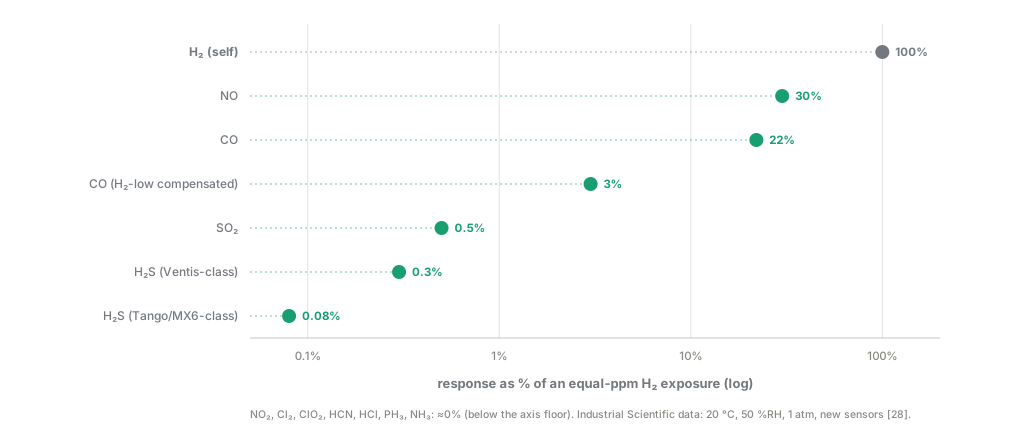
Two important nuances sit on top of this single table:
- The reciprocal cross-sensitivity — CO sensors’ false response to H₂ — is large and vendor-dependent, commonly cited at 20–60% and reported as high as 30–100% across commercially available CO sensors: a CO channel co-located with an H₂ source can over-read CO unless it carries hydrogen compensation [29,39]. This is precisely the failure mode Membrapor’s “MEM6: Hydrogen-compensated 4-Electrode Sensors” application note addresses via an auxiliary compensation electrode — existence and purpose of the note confirmed, quantitative table not machine-readable in this session (unverified specifics).
- Cross-sensitivity is temperature-dependent. One documented low-H₂-interference CO sensor shows H₂-driven CO-equivalent readings of 18 ppm at 10 °C, 36 ppm at 20 °C, and 54 ppm at 30 °C for a fixed 900 ppm H₂ exposure — a 3× change in apparent interference across a 20 °C span [39]. The mechanism reported across sources is that small, relatively unreactive H₂ molecules pass through selective filters more readily than larger interferents and then oxidize easily at the platinum working electrode.
For the geologic-H₂ use case, the practically important cross-sensitivity is the other direction — what interferes with the H₂ channel — and here the situation is comparatively good: the MONHyTOR field probe’s electrochemical H₂ sensor is reported to be cross-sensitive to CO only, with no other significant interferents identified in that deployment [24], and a separate evaluation of a commercial electrochemical H₂ cell for hydrogen-seep work reports selectivity against the mixed gas background it was tested in [25].
Because CH₄ is essentially electro-inert at the potentials and catalysts used in these cells, electrochemical H₂ sensors generally do not show significant cross-sensitivity to methane, an advantage in geologic settings where CH₄ is a common co-migrating gas, and consistent with the multi-gas (CH₄/CO₂/O₂/H₂) GA5000 field assessment [23].
Temperature
Section titled “Temperature”Per the diffusion-current model above, the diffusion coefficient (and hence sensitivity) is intrinsically temperature-dependent, and vendors build in either analog temperature compensation networks or firmware lookup tables (Winsen ZE07-H2 has an onboard temperature sensor specifically for this [11]). Zero-current drift is also T-dependent: Winsen specifies zero drift ≤ 20 ppm over −20…40 °C for the ME3-H2 [9]. Rapid temperature transients — not just absolute temperature — are flagged repeatedly in the geo-H₂ literature as a source of spurious spikes in electrochemical H₂ readings, distinct from the slower, compensable steady-state T dependence.
Relative humidity
Section titled “Relative humidity”RH affects the sensor through the physical state of the electrolyte rather than through the electrochemistry itself. The thermodynamics/kinetics are treated directly in a dedicated ACS Sensors paper on RH effects on the electrolyte of electrochemical toxic-gas sensors [30], and the practical consequences are summarized consistently across manufacturer/applications literature: the electrolyte is in vapor-pressure equilibrium with ambient water vapor, so sustained low RH dries and concentrates the electrolyte (raising internal resistance, slowing response, and shifting zero/sensitivity), while sustained very high RH (>90–95%) can dilute, swell, and in extreme cases leak the electrolyte through seals or the diffusion membrane [31,32].
“Humidity shock” — a step change in ambient RH, as happens when a probe is inserted into moist soil, or when a handheld unit is moved from a dry vehicle cabin into humid ground-level air — produces a transient spike or dip in output distinct from the true gas signal, because the outer diffusion layer’s water content changes faster than the bulk electrolyte re-equilibrates.
Ideal long-term operating conditions are commonly cited as ~20 °C and ~60 %RH [31]; sensors are rated across roughly 15–90/95 %RH non-condensing, but rated tolerance is not the same as artifact-free operation at the extremes of that range.
Pressure
Section titled “Pressure”A direct field test of the GA5000’s internal electrochemical H₂ cell found that pressure in the 500–1400 mbar range has only a minor effect when below atmospheric, but that depressurization causes an overestimation of the H₂ reading — a mechanism consistent with a diffusion-limited device (lower ambient pressure changes the effective concentration gradient and can transiently increase apparent flux before re-equilibration) [23]. This matters directly for pumped soil-gas sampling, where the pump itself creates a local pressure transient at the sensor.
Oxygen availability
Section titled “Oxygen availability”Because the counter-electrode reaction consumes ambient O₂, standard 2/3-electrode designs assume normal atmospheric O₂ availability. In O₂-depleted headspace (e.g., a sealed sample bag, a saturated/anoxic soil pore space, or a downhole annulus) the counter reaction can become oxygen-starved, degrading response — a consideration for headspace-style sampling methods increasingly used in natural-H₂ work.
Poisoning and long-term degradation
Section titled “Poisoning and long-term degradation”The dominant failure mode reported across vendor lifetime literature is electrolyte loss/contamination driven by humidity extremes, not catalyst poisoning, for normal ambient service [31,32].
Genuine catalyst poisoning risks for Pt/Pd-based working electrodes include high concentrations of sulfur species (H₂S, SO₂) and siloxane/silicone vapors, which are well-documented catalyst poisons for platinum-group-metal electrodes generally; strong oxidizing gases can also permanently damage the electrode or electrolyte.
Use for geologic H₂
Section titled “Use for geologic H₂”Soil-gas surveys
Section titled “Soil-gas surveys”This is the setting the entire published geo-H₂ sensor literature is built around. The GA5000 (Geotech/QED), built around an internal electrochemical H₂ cell, is the most-cited field instrument for hydrogen soil-gas surveying [21,22,23], and purpose-built research probes such as MONHyTOR embed the same class of amperometric cell directly in the soil at ~1 m depth for continuous, non-pumping monitoring [24].
A rigorous, independently published assessment of the GA5000’s electrochemical H₂ cell under controlled T/P/RH/CO conditions found it reliable across the diversity of field conditions tested, while explicitly cautioning that H₂ concentration data from soil surveys still need careful interpretation [23].
The largest confound reported in recent literature is the sampling method, not the sensor itself: a 2025 study drilling 83 holes across 24 sub-circular depressions in the Yilgarn Craton and Perth Basin (Western Australia) found drilling-induced hydrogen artifacts up to 464 ppm at 85% of locations, with only 15% of measured concentrations representing genuinely natural hydrogen — attributed to drill-bit metamorphism and mechanochemical generation during hole creation, not to any electrochemical-sensor artifact [26].
Downhole / borehole logging
Section titled “Downhole / borehole logging”No datasheet reviewed here rates continuous operation meaningfully above ~50 °C, and the aqueous or hydrated-polymer electrolyte that makes these cells work at room temperature is precisely the component that cannot survive typical downhole temperatures (150–200+ °C in deep oil/gas or geothermal contexts; even “low-temperature” downhole electronics packages are commonly rated only to ~120–175 °C) [34].
Separately, standard amperometric operation requires an active potentiostat and current-to-voltage readout electronics at the sensor — fundamentally incompatible with a “no downhole electronics” design preference, since there is no passive/optical-fiber analog of a three-electrode amperometric cell.
High-temperature solid-electrolyte mixed-potential/potentiometric H₂ sensors exist in the literature and operate by a related but distinct physical mechanism, with device classes reported for both above and below 400 °C [33], but these are ceramic, ion-conducting-membrane devices, not the liquid/SPE amperometric cells that dominate the geo-H₂ field literature, and they still require local electronics for signal conditioning. Verdict: not recommended for downhole deployment with current commercial room-temperature electrochemical technology; if hydrogen must be measured downhole, look to fiber-optic or other passive-transduction modalities.
Continuous monitoring stations
Section titled “Continuous monitoring stations”Electrochemical cells are demonstrably usable for continuous, unattended, multi-month deployments — MONHyTOR is explicitly designed as a buried, non-pumping continuous monitor that logs H₂, temperature, and humidity together, using internal humidity regulation specifically to protect the electrochemical sensor’s stability [24].
The trade-offs to budget for are the same drift and lifetime numbers noted in the performance envelope:
- a 1–3 year sensor-replacement cadence,
- periodic recalibration against a known standard, and
- enclosure design that damps humidity and temperature transients rather than exposing the cell directly to ambient swings.
The pumping-vs-non-pumping design choice also matters at the station level: non-pumping designs like MONHyTOR avoid pump-induced pressure artifacts and additionally let the diffusive ingress rate itself serve as a soil-gas-diffusivity proxy [24].
Vendors & products
Section titled “Vendors & products”| Manufacturer | Product line / SKU | Key specs (as available) | Price class | Datasheet / link |
|---|---|---|---|---|
| Membrapor AG (Switzerland) | H2/CA-1000, H2/M-1000, H2/CB-1000, H2/C-2000, H2/C-20000, H2/C-40000 | 0–1000 to 0–40,000 ppm family; 4–28 nA/ppm depending on range variant; T90 35–45 s | Sensor element, low-to-mid hundreds USD (class estimate) | membrapor.ch H2 datasheets [5,6,7,8] |
| Winsen Electronics (China) | ME3-H2, ME4-H2, ZE03-H2, ZE07-H2 | 0–1000 ppm (ME-series) to 0–30,000 ppm (ZE07 module); ME3-H2: 2 ppm resolution, ≤90 s T90, 2 y life | Low-cost, tens to ~$50 USD sensor element class | winsen-sensor.com/sensors/h2-sensor [9,10,11,38] |
| EC Sense (Easy Gas Sensor Solutions, USA) | ES1-H2-1000/5%, ES4-H2-1000-01, ES4-H2-5000-01, TB200B/TB600C modules | Solid-polymer electrolyte; ES4-H2-5000: T50 <10 s, T90 <30 s, 1 ppm resolution | Sensor element ~$50–150; module with electronics ~$150–400 (class estimate) | ecsense.com datasheets [12,13] |
| DD-Scientific | GS+7H2 | 0–1000 ppm, 20 ± 10 nA/ppm, T90 <90 s, 0 V bias, 12-month warranty, low CO cross-sensitivity marketed | Sensor element, mid-tens to ~$100 USD class | ddscientific.com [14] |
| Alphasense (AMETEK, UK) | H2-AF (A-series, portable), H2-BF (B-series, up to 5000 ppm), IST variants | H2-AF: 2000 ppm warranted range, 10–25 nA/ppm at 400 ppm, T90 <45 s, −30…50 °C, 15–90 %RH; marketed as low-CO-sensitivity/most selective on market | Premium sensor element class, ~$80–200 (class estimate) | alphasense.com ; store.alphasense.com/h2-af [15,16] |
| Honeywell (City Technology / CiTiceL / SureCell, 4-Series) | 4HYT | Confirmed as Honeywell’s dedicated 4-series H₂ sensor; detailed specs unverified in this session (PDF not machine-readable) | Mid-to-premium, ~$100–250 class (industry-typical for 4-series) | automation.honeywell.com 4-Series [17] |
| SemeaTech Inc. | 4H2-1000, 4H2-2000S, 4H2-40000A, 7-Series H2-1000 | 0–1000 ppm (2000 ppm overload) for 4H2-1000; marketed as pin-compatible drop-in replacement for standard 4-series H₂ cells | Value/replacement-part class | semeatech.com [18] |
| Industrial Scientific | Ventis MX4 / Ventis Pro / Tango / MX6 platforms, CO/H₂-low sensor option | H₂ measuring range to ~2000 ppm on the platform’s CO/H₂-low configuration; publishes the cross-interference table used above | Instrument-level, low-thousands USD class | indsci.com Ventis MX4 [19,28] |
| Dräger | XXS H2 sensor (X-am 5000/5600 platform) | 0–2000 ppm, ~6-month calibration interval | Instrument-level, low-thousands USD class | isssafety.com Dräger XXS H2 [20] |
| Geotech / QED (Thermo Fisher distributed) | GA5000 portable landfill/contaminated-land gas analyzer | Internal electrochemical H₂ cell, 0–1000 ppmv vendor range, ±2.5% FS precision (vendor spec, also cited in independent field assessment); the most field-validated instrument in the geo-H₂ literature | Full instrument, several thousand USD class | documents.thermofisher.com GA5000 [21,22,23] |
| Geo Numeric / academic build | MONHyTOR soil probe | Purpose-built buried probe, 0–1000 ppm, 0.1 ppm display resolution, ±5% FS, non-pumping, internally humidity-regulated | Research-instrument class (not a mass-market SKU) | adgeo.copernicus.org [24] |
Open questions
Section titled “Open questions”- Honeywell 4HYT full datasheet could not be machine-parsed in this session (PDF binary defeated the fetch tool repeatedly). Someone with direct PDF access should pull range/resolution/T-range/RH-range/cross-sensitivity numbers and update the performance envelope and vendor tables.
- Membrapor’s MEM6 hydrogen-compensation application note (4-electrode H₂-compensated sensors) is directly relevant to the CO↔H₂ cross-talk problem in mixed CH₄/CO/H₂ soil gas, but its quantitative content did not survive PDF extraction here — worth a manual pull, since it may contain the cleanest published number for “how much H₂ fools a CO channel” and vice versa for our specific vendor ecosystem.
- No head-to-head, apples-to-apples bake-off of the vendor SKUs above against a common calibration gas standard and a common environmental chamber was found in the literature search; the closest thing (the GA5000 assessment [23]) tests only one instrument. A Hestia-commissioned bench comparison (Membrapor vs. Alphasense vs. EC Sense vs. Winsen, same T/RH/CO protocol) would materially improve field procurement confidence.
- Resolving 0.53 ppm background against 1–5 ppm field noise floors is an open measurement-science problem, not just a spec-sheet number: several instruments display sub-ppm resolution (MONHyTOR: 0.1 ppm; EC Sense ES4-H2-1000: 0.1 ppm) but no source reviewed here reports an Allan-variance-style noise floor or long-term stability curve that would let us say with confidence whether atmospheric background is resolvable in practice under field T/RH swings. Recommend requesting Allan deviation data from EC Sense/Alphasense/Membrapor directly.
- Quantify the H₂S poisoning risk for Pt-based working electrodes under sustained (weeks-months) exposure at the H₂S concentrations typical of co-evolved gas in candidate geologic-H₂ sites — vendor lifetime specs assume clean-air service, not H₂S-rich soil gas.
- Track drift under real field duty cycles (diurnal T/RH cycling, intermittent power) rather than bench-constant conditions; the <1 ppm/day figure from Mainson et al. [25] and the 2%/month vendor figure [9] are not obviously reconcilable without knowing the test conditions behind each, and the gap matters for how often continuous-monitoring stations need recalibration.
- Get a real cost table. Every price above is a class estimate from general market knowledge, not a sourced quote; before this feeds a procurement decision, get current quotes from Membrapor, Alphasense, EC Sense, and Winsen distributors.
Related pages
Section titled “Related pages”- Why H₂ is a hard sensing target
- Geologic context for H₂ exploration
- MOX (metal-oxide) chemiresistors
- Palladium resistive / work-function hydrogen sensors
- Catalytic pellistors
- Fiber-optic sensors — the leading downhole alternative once liquid/SPE electrochemistry is ruled out
- Thermal conductivity & acoustic sensors
References
Section titled “References”Full reference list (0 entries)
[1] Saunders, L. & Horrocks, B. R. “Review—Aspects of Electrochemical Gas Sensor Technologies.” ECS Sensors Plus 4(3), 034601 (2025). https://doi.org/10.1149/2754-2726/adf2b9
[2] “Electrochemical Sensors” (biennial fundamental-reviews article covering potentiometric, voltammetric, and gas sensors), Analytical Chemistry; hosted at NIH PMC2883720. https://pmc.ncbi.nlm.nih.gov/articles/PMC2883720/
[3] LaConti, A. G. & Maget, H. J. R. “Electrochemical Detection of H₂, CO and Hydrocarbons in Inert or Oxygen Atmospheres.” Journal of the Electrochemical Society 118(3), 1971.
[4] “Methods of operation of electrochemical gas sensors” (patent document containing the capillary-limited diffusion current derivation, ). https://image-ppubs.uspto.gov/dirsearch-public/print/downloadPdf/8317998
[5] Membrapor AG. “Hydrogen Gas Sensor H2/CA-1000” datasheet. https://membrapor.ch/sheet/Hydrogen-Gas-Sensor-H2-CA-1000.pdf
[6] Membrapor AG. “Hydrogen Gas Sensor H2/M-1000” datasheet. https://www.membrapor.ch/sheet/Hydrogen-Gas-Sensor-H2-M-1000.pdf
[7] Membrapor AG. “Hydrogen Gas Sensor H2/CB-1000” datasheet. https://www.membrapor.ch/sheet/Hydrogen-Gas-Sensor-H2-CB-1000.pdf
[8] Membrapor AG. “Hydrogen Gas Sensor H2/C-40000” datasheet. https://www.membrapor.ch/sheet/Hydrogen-Gas-Sensor-H2-C-40000.pdf (link corrected — original URL 404s; verified specs: 0–40,000 ppm range, 80,000 ppm overload, 4 ± 3 nA/ppm, T90 < 45 s)
[9] Winsen Electronics. “ME3-H2 Electrochemical Hydrogen Gas Sensor.” Product page / manual. https://www.winsen-sensor.com/sensors/h2-sensor/me3-h2.html
[10] Winsen Electronics. “ME4-H2 Hydrogen Gas Sensor.” Product page. https://www.winsen-sensor.com/sensors/h2-sensor/me4-h2.html
[11] Winsen Electronics. “Electrochemical Hydrogen Sensor Module ZE07-H2.” Product page. https://www.winsen-sensor.com/product/ze07-h2.html
[12] EC Sense (Easy Gas Sensor Solutions). “ES4-H2-1000-01 Hydrogen Gas Sensor Datasheet V1.4” (2025-02-28). https://ecsense.com/wp-content/uploads/2024/07/ES4-H2-1000-01-Hydrogen-Gas-Sensor_Datasheet_V1.4_20250228.pdf
[13] EC Sense (Easy Gas Sensor Solutions). “ES4-H2-5000-01 Hydrogen Gas Sensor Datasheet V1.4” (2025-02-28). https://ecsense.com/wp-content/uploads/2024/07/ES4-H2-5000-01-Hydrogen-Gas-Sensor_Datasheet_V1.4_20250228.pdf
[14] DD-Scientific. “GS+7H2 Hydrogen (H2) Sensor.” Product page. https://ddscientific.com/products/gs-7h2-electrochemical-sensor-hydrogen-h2s
[15] Alphasense (AMETEK). “Hydrogen Sensors (H2).” Product page. https://www.alphasense.com/products/view-by-target-gas/hydrogen-h2
[16] Alphasense (AMETEK). “Hydrogen sensor H2-AF.” Store/spec page. https://store.alphasense.com/h2-af/
[17] Honeywell. “4 Series Gas Sensors” (CiTiceL 4HYT hydrogen sensor). https://automation.honeywell.com/us/en/products/sensing-solutions/sensors/gas-sensors/4-series; datasheet PDF (fetch unsuccessful in this session): https://prod-edam.honeywell.com/content/dam/honeywell-edam/sps/siot/ja/products/sensors/gas-sensors/4-series/documents/sps-siot-citytech-4hyt-sensor-datasheet.pdf
[18] SemeaTech Inc. “4-Series H2-1000 Sensor” datasheet. https://eoc-inc.com/wp-content/uploads/2018/07/SemeaTech/4H2-1000-Sensor-datasheet.pdf
[19] Industrial Scientific. “Ventis® MX4” product page (CO/H2-low electrochemical sensor option). https://www.indsci.com/en/gas-detectors/multi/ventis-mx4
[20] Industrial Safety Services. “Dräger XXS Electrochemical Sensor — Hydrogen H2” product page. https://www.isssafety.com/products/drager-xxs-electrochemical-sensor-hydrogen-h2
[21] Geotech / QED (distributed via Thermo Fisher Scientific). “GA5000 Portable Gas Analyser” datasheet. https://documents.thermofisher.com/TFS-Assets/ANZ/Datasheets/qed-geotech-ga5000-portable-gas-analyser.pdf
[22] Chromservis. “GA5000 analyser for measurement of CH4/CO2/O2/H2 (1000 ppm), bluetooth.” Product page. https://www.chromservis.eu/en/ga5000-analyser-for-measurement-of-ch4-co2-o2-h2-1000-ppm-bluetooth
[23] Auclair, S., Lefeuvre, N., Dutoit, H., Donzé, F.-V., & Truche, L. “Assessing the Portable Gas Analyzer GA5000 for Accurate H₂ Monitoring in Geological Exploration.” HAL preprint hal-04861335, ISRN GEONUM-NST—2024-01—ENG (2024). https://hal.science/hal-04861335; https://www.researchgate.net/publication/385938959
[24] Adjie, D., Bordes, R., Brito, D., Nasri, S., & Normandin, S. “In-soil hydrogen concentration monitoring using MONHyTOR: application for natural hydrogen exploration.” Advances in Geosciences 67, 57–67 (2025). https://adgeo.copernicus.org/articles/67/57/2025/
[25] Mainson, M., Heath, C., Pejcic, B., & Frery, E. “Sensing Hydrogen Seeps in the Subsurface for Natural Hydrogen Exploration.” Applied Sciences 12(13), 6383 (2022). https://doi.org/10.3390/app12136383
[26] Davies, K., Josse, R., Frery, E., Esteban, L., Keshavarz, A., & Iglauer, S. “Distinguishing drilling-induced artifacts from naturally occurring hydrogen in soil gas surveys: Insights from sub-circular depressions.” International Journal of Hydrogen Energy 109, 1230–1240 (2025). https://doi.org/10.1016/j.ijhydene.2025.02.094
[27] Paulot, F., Pétron, G., Crotwell, A. M., & Bertagni, M. B. “Reanalysis of NOAA H₂ observations: implications for the H₂ budget.” Atmospheric Chemistry and Physics 24, 4217–4229 (2024). https://doi.org/10.5194/acp-24-4217-2024
[28] Industrial Scientific. “Electrochemical Gas Sensor Cross Interference Table.” https://www.indsci.com/en/blog/electrochemical-sensor-cross-interference-table
[29] Crowcon Detection Instruments. “Knowing Cross Sensitivities.” https://www.crowcon.com/us-en/article/knowing-cross-sensitivities/
[30] “Considerations of Thermodynamics and Kinetics for the Effects of Relative Humidity on the Electrolyte in Electrochemical Toxic Gas Sensors.” ACS Sensors (2021). https://doi.org/10.1021/acssensors.1c01339
[31] Critical Environment Technologies. “Electrochemical Gas Sensors & Factors Affecting Life Expectancy.” https://www.critical-environment.com/news/cet-blog/expert-insights/electrochemical-gas-sensors-factors-affecting-life-expectancy
[32] Analog Devices. “Overcoming the Technical Challenges of Electrochemical Gas Sensing.” https://www.analog.com/en/resources/technical-articles/overcoming-the-technical-challenges-of-electrochemical-gas-sensing.html
[33] Gorbova, E., Balkourani, G., Molochas, C., Sidiropoulos, D., et al. “Brief Review on High-Temperature Electrochemical Hydrogen Sensors.” Catalysts 12(12), 1647 (2022). https://mdpi.com/2073-4344/12/12/1647/htm
[34] “Thermal management of downhole electronics cooling in oil & gas well logging at high temperature.” IEEE Conference Publication. https://ieeexplore.ieee.org/document/7583211
[35] “Solid electrolyte gas sensors based on mixed potential principle – A review.” https://www.sciencedirect.com/science/article/abs/pii/S092540052300223X
[36] “Mixed potential type hydrogen sensor.” Ionics, Springer. https://link.springer.com/article/10.1007/BF02375962
[37] “Sensing mechanism of non-equilibrium solid-electrolyte-based chemical sensors.” Journal of Solid State Electrochemistry, Springer. https://link.springer.com/article/10.1007/s10008-010-1046-4
[38] Winsen Electronics. “H2 sensor” product-line overview (ME3-H2 / ZE03-H2 / ZE07-H2). https://www.winsen-sensor.com/h2-sensor/
[39] MSA Safety. “Carbon Monoxide Sensor Cross-Sensitivities: Alcohols, VOCs & Hydrogen” technical bulletin. http://s7d9.scene7.com/is/content/minesafetyappliances/0800-81-MC_COSensor_InfluenceofAlcohols_VOCsHydrogen