Thermal conductivity & acoustic (speed of sound) sensors
Summary
Section titled “Summary”Hydrogen is the lightest molecule found in the field. It carries heat away from a hot surface roughly seven times faster than air, and sound travels through it nearly four times faster than through air. Both properties convert directly into a sensor: a heated wire or membrane read for its cooling rate (thermal-conductivity, or katharometer, sensing), or a path or cavity read for the speed of sound passing through it (acoustic sensing). Neither needs a catalyst, oxygen, or any chemistry, so the family resists poisoning and drift, and has been used this way since 1915 in hydrogen-cooled generator purity meters and industrial safety sensors.
Both methods report a single scalar, a bridge voltage or a resonance frequency, and convert it to concentration assuming a fixed two-gas background. Real soil gas, mud gas, and generator housings routinely carry five or six gases at once. Helium, a common geologic companion of natural hydrogen, pushes that same number in the same direction hydrogen does, so a helium-rich, hydrogen-free sample can read as a large hydrogen anomaly.
For Hestia: strong for percent-level safety monitoring and mud-gas-return analysis at surface. Weak for the ppm-level soil-gas reconnaissance surveys, against a ~0.5 ppm atmospheric background, where most exploration decisions get made.
At a glance — published performance envelope
- Detection limit
- 1–2,000 ppm
- Range
- 500–1,000,000 ppm
- Response t90
- 1–60 s
- Recovery
- 1–60 s
- Selectivity
- low
- Drift
- low
- Operating T
- −40 … 90 °C
- Humidity
- 0–100 % RH
- Power
- 0.05 mW – 5 W
- Unit cost
- $10–$10k
- TRL
- 9
Main interferents: CO₂, CH₄, He, H2O vapor · poisons: . Ranges span the published devices/variants covered below — per-claim citations are in the body; data: src/data/modalities/thermal-conductivity-acoustic.yaml.
How it works
Section titled “How it works”Hydrogen’s low molar mass (2.016 g/mol) pushes two transport properties, thermal conductivity and speed of sound, to extremes at once. No other common exploration gas (air, N₂, O₂, CO₂, CH₄, H₂S) comes close on either axis except helium, which shares hydrogen’s light-molecule character and is the chief interferent for both modalities [1][2].
Thermal conductivity. For a dilute gas, ; the more practical Eucken-type relation for polyatomic gases is , where is viscosity [3]. Hydrogen’s low mass drives a high mean molecular speed and low viscosity-normalized momentum transfer, giving it roughly seven times air’s thermal conductivity:
| Gas | λ (W·m⁻¹·K⁻¹), ≈290–300 K | Source |
|---|---|---|
| H₂ | 0.180–0.187 | [1][3][4] |
| He | ~0.142–0.151 | [5] |
| Air | 0.024–0.026 | [1][3] |
| N₂ | 0.0234–0.0258 | [1] |
| CH₄ | 0.030–0.033 | [1] |
| CO₂ | 0.0146–0.0166 | [1][3] |
| H₂S | ~0.0146 (approx., low-T value; unverified at 300 K) | [6] |
This is the largest thermal-conductivity contrast of any common exploration gas relative to air, which is why G. A. Shakespear invented the katharometer in 1915 specifically to detect hydrogen in air mixtures [7][8].
Sensor equation. A thermal-conductivity element (wire, thermistor, or MEMS membrane) held at above ambient loses heat mainly by conduction through the gas, plus usually-small convection, radiation, and lead conduction:
Two matched elements in a Wheatstone bridge, one in sample gas and one in reference gas, give a bridge output . This differential architecture makes classical TCDs binary-mixture instruments: the physics cleanly resolves only a two-component system, analyte plus one known balance gas, which breaks down in real multi-gas soil gas (see Cross-sensitivity below).
Transient and 3ω variants. The transient hot-wire method reads the time constant of a heating step, inversely related to . The 3ω method drives the heater with an AC current at frequency and reads the 3ω harmonic via lock-in, extracting both and thermal diffusivity from the amplitude and phase versus [9][10]. Because and do not scale identically across gases, 3ω partially discriminates interferents (H₂ vs. CO₂ against N₂) that a single DC bridge cannot [9][10].
Speed of sound. , where [11]. Hydrogen’s molar mass sits a factor of ~14.4 below air’s (2.016 vs. ~28.97 g/mol); with close to , the speed-of-sound ratio works out to . Concretely, m/s at 20 °C versus –1320 m/s depending on temperature and ortho-para composition [11][12]; a 2024 metrology paper still refines for industrial flow-measurement accuracy [13].
For a binary mixture, , so a single sound-speed or resonance-frequency measurement of a known two-gas system yields the molar mixing ratio directly, no chemistry, catalyst, or optical absorption line needed [14][15][16]. Two acoustic transducers a known distance apart give transit time and ; differencing upstream/downstream time of flight also yields flow velocity, which is why ultrasonic flow meters often report hydrogen purity alongside flow [17][18]. A resonant cavity’s standing-wave frequencies track , and hence composition, via a phase-locked loop without needing absolute-timing precision. Steven Garrett’s sonic gas analyzer used a self-resonant tube (2 cm diameter × 3 cm long) capped by two small speakers, deriving mean molecular weight six times per minute from resonance frequency; ~0.02 Hz frequency stability corresponds to ~30 ppm concentration resolution, with overall system stability better than 350 ppm [14][19].
Ratios and limits worth carrying forward:
| Quantity | Value | Note | Ref |
|---|---|---|---|
| Thermal-conductivity contrast, H₂/air | ≈7 | Largest of any common exploration gas | [1][3] |
| Speed-of-sound ratio, H₂/air | ≈3.7–3.8 | — | [11][12] |
| Knudsen-regime crossover | — | Pirani-style thermal sensors: once mean free path approaches the sensor-to-wall gap , becomes pressure-dependent, so uncompensated thermal sensors are implicitly barometric | [20] |
| Forced convection (King’s Law term) | — | Ambient flow across a hot wire adds a velocity-dependent heat-loss term that can swamp the composition signal; practical sensors are housed to minimize it or correct for it | [9] |
Device classes
Section titled “Device classes”- Classical katharometer / hot-wire TCD. Four matched filaments (tungsten, platinum, platinum-alloy, or thermistor beads) in a Wheatstone bridge, two in sample flow and two sealed in reference gas. The architecture behind GC-TCD detectors, hydrogen-purity katharometers (Eaton/MTL K522, ABB 6517), and Baker Hughes/Panametrics process analyzers [21][22][23][24].
- MEMS hot-plate / suspended-membrane thermopile. A heater or thermopile pair on a thin SiN/SiO₂ membrane over a micromachined cavity, reducing thermal mass and substrate losses versus a free-standing wire. Differential designs add a matched reference thermopile on an unexposed membrane for common-mode temperature rejection. Examples: Xensor XEN-TCG3880 [25][26], Sensirion STC31/STC31-C [27][28], Posifa PGS1000/PGS4100 [29][30], SGX/Neroxis TC-1326/MTCS-2601 [31][32], and a research Pt/Al₂O₃-catalyst thermopile pair reaching 1 ppm LOD [33][34].
- Transient hot-wire / 3ω sensors. AC or pulsed heater excitation, using a helix-wound 8 µm tungsten microwire or a suspended microheater bridge, extracts both and as a second, partially independent discrimination axis [9][10][35].
- MEMS Pirani-style / thermal-flow variants. Same structure as the MEMS TC sensor, operated where molecular-flow (Knudsen-regime) heat transfer dominates, a vacuum gauge rather than a gas-composition sensor. Recent work uses porous-silicon thermal isolation to reach the fine/rough vacuum range [20][36][37]; the commercial Neroxis MTCS-2601 covers 10⁻⁴–1000 mbar at <6 mW [32]. Thermal-flow (hot-wire anemometry) sensors use the same physics to read mass flow instead, often on the same die.
- Multi-property sensors (NevadaNano MPS). Combines a resistive-heater thermal measurement with other thermodynamic properties (heat capacity, thermal diffusivity) and onboard classification to report %LEL across ~14 combustible gases including H₂ from one factory calibration, marketed as non-cross-sensitive and immune to drift, poisoning, and decay [38].
- Ultrasonic time-of-flight (ToF) analyzers. Paired piezoelectric or MEMS (CMUT/FBAR) transducers a fixed path apart measure transit time; used in industrial ultrasonic flow meters that report gas velocity, volumetric flow, and, as an optional derived variable, hydrogen purity for hydrogen-natural-gas blends [17][18][39][40].
- Acoustic resonator / standing-wave analyzers. A closed cavity (tube, Helmholtz resonator, or piezoelectric tube) driven at its natural resonance; resonance-frequency shift tracked with a phase-locked loop yields mean molecular weight and hence composition. Implemented in hydrogen-cooled turbogenerator purity meters and demonstrated as a compact sonic gas analyzer for hydrogen/methane leak and mine-safety detection [14][19][41].
- MEMS ultrasonic (CMUT/FBAR) sensors. Capacitive micromachined ultrasonic transducers and film bulk acoustic resonators as chip-scale acoustic transducers; uncoated CMUTs operated broadband have measured sound velocity and attenuation together to discriminate H₂, CO₂, and CH₄ against N₂, a candidate solid-state, non-thermal acoustic gas sensor on a chip [17][42][43].
- GC-TCD. The standard laboratory and wellsite (mud-gas logging) reference method for quantifying H₂ alongside CH₄, CO₂, He, and N₂. Chromatographic separation ahead of the TCD cell sidesteps the multi-component binary-mixture problem, at the cost of a carrier gas, a column, minutes-not-seconds cycle time, and a carrier-gas choice that must avoid a thermal conductivity too close to H₂’s (see Cross-sensitivity, below) [21][44][45][46].
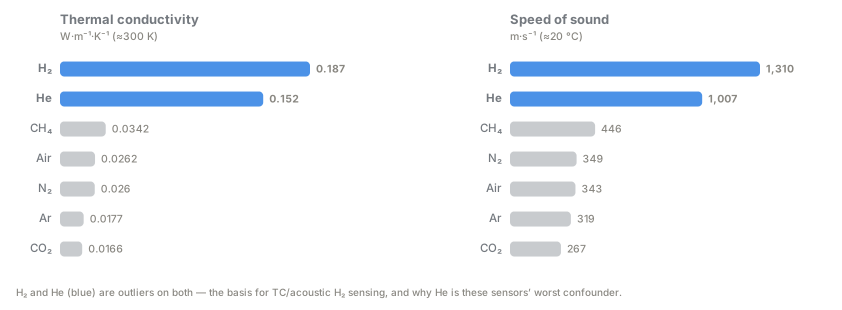
H₂ and He are the only two gases far from the rest on both transport properties, so a thermal-conductivity or acoustic cell reads them strongly but cannot tell them apart (see helium & co-tracers).
Performance envelope
Section titled “Performance envelope”Every cell keeps its source citation; entries without a directly verifiable number are marked “(unverified)” rather than invented.
| Parameter | Classical katharometer (industrial TCD) | MEMS TC (Xensor/Sensirion/Posifa/SGX class) | 3ω / transient thermal | Acoustic resonator / ToF |
|---|---|---|---|---|
| Practical LOD (H₂ in air) | ~0.1–1 vol% typical process use; some lab TCDs to low-ppm with chromatographic pre-separation | 1 ppm demonstrated in research thermopile design [33][34]; ~10 ppm analog / 2 ppm digital resolution, ~1200 ppm accuracy floor in commercial PGS4100 [47]; SAW-augmented TC design ~6 ppm [48] | 0.062% (620 ppm) H₂ at 1 Hz in a robust tungsten-microwire design [9]; suspended-microheater theoretical floor ~1400 ppm at reduced uncertainty [35] | ~30 ppm concentration resolution demonstrated in a resonant-tube sonic analyzer [14][19]; ±30 ppm H₂ accuracy quoted for the same device [49] |
| Measurement range | 0–100 vol% (full binary range) [22][23] | 0–4 vol% (PGS4100) [47] to 0–100 vol% (Xensor XEN-5310/5320, STC31 CO₂ mode 0–100 vol%) [26][27] | Demonstrated to ~1% H₂ (safety-limited in testing), 100% CO₂ [9] | 0–100% H₂ in binary systems (turbogenerator purity meters); up to 30–40% H₂ blends in NG pipelines for flow meters [17][40] |
| Response time (t90) | Seconds to ~1 min depending on cell volume/flow | 1 s (PGS4100) [47]; ~9 ms thermal time constant, chip-level (XEN-TCG3880 in air) [26]; 1.9 s (research thermopile) [34] | ~28 s response / 23 s recovery (tungsten 3ω design) [9] | Sub-100 ms reported for some ultrasonic ToF hydrogen-sensor demonstrations (unverified precise figure); resonant sonic analyzer samples composition ~6×/min [14] |
| Recovery time | Seconds–minutes | 1.4 s (research thermopile) [34] | ~23 s [9] | Comparable to response time (no chemical desorption step) |
| Selectivity | Low: bulk property, responds to any Δλ from reference gas [8][21] | Same physical limitation; compensated variants (STC31-C) add RH/O₂ correction [28] | Improved via λ+D dual read [9][10] | Low: responds to mean molar mass, not gas identity |
| Operating temperature | Typically −20 to +85 °C sensor head; katharometer analyzer cabinets to ~−40 to +60 °C ambient (process-analyzer class) | −40 to +85/90 °C (Posifa PGS4100 op/storage) [47]; −40 to +85 °C (Xensor integrated systems) [26] | Demonstrated near ambient / ~137 °C heater DC operating point [9] | Ambient-rated for most commercial units; no fundamental barrier to higher T with appropriate transducer materials |
| RH range | 0–100% RH with compensation (PGS4100 has onboard RH+P compensation) [47] | 0–100% RH nominal, accuracy budget affected [27][47] | Not well characterized (unverified) | Humidity changes local sound speed and must be compensated (handled electronically in the Garrett design via a local temperature sensor) [19] |
| Long-term drift | Katharometer/E-One GGA: <0.2%/month (best-in-class, drift-corrected design) [24] | Xensor XEN-5310: ~1200 ppm/yr typical transfer drift [26]; Posifa PGS4100: 1200 ppm over 5 years long-term stability spec [47] | Not yet established at commercial maturity (unverified) | Garrett design: <350 ppm total system stability [19] |
| Power | Watts (heated filament, continuously powered) for classical katharometers | ~5–8 mA at 5 V (Xensor XEN-5310, room temp) [26]; 50 µA average / 5 mA peak (Sensirion STC31, pulsed) [27]; 8 mA (Posifa PGS1000) [50]; <6 mW (Neroxis Pirani-regime MTCS-2601) [32] | mW-range heater drive, higher than ultra-low-power NDIR alternatives (unverified precise number) | mW-class electronics; acoustic driver power small but nonzero |
| O₂ required | No: purely physical, non-catalytic [8][21][51] | No | No | No |
| Poisoning susceptibility | None: no catalyst, no chemisorption step; “intrinsically immune to chemical poisoning” [51] | None | None | None |
| Lifetime | Effectively unlimited (no consumable, no catalyst degradation), years to decades in process service [21][24] | Years (no reported wear-out mechanism beyond membrane/heater electromigration at extremes) | Not yet field-proven at scale (unverified) | Years; no consumable |
| Cost class | Industrial process analyzer (katharometer + cabinet + electronics): low-thousands to ~$10⁴ USD class (qualitative, no verified list price found) | Chip/die level: $10–70 USD (Xensor XEN-TCG3880 ~$10–20 on distributor listings [52]; Sensirion STC31-C-R3/R5 $24–65 depending on distributor/qty [53]; Posifa PGS1004 $35–45 in small qty [54]) | Research/prototype stage, not yet a commercial line item (unverified) | Sonic/resonator analyzer modules: research-grade prototypes to industrial purity-meter systems (E/One GGA, Panametrics XMTCpro); cost class not independently verified |
| TRL (qualitative) | 9, mature industrial product line (GC-TCD since 1950s–60s; turbogenerator purity meters decades in service) [7][8][22][24] | 7–9, Sensirion STC31/Posifa PGS4100 are shipping commercial parts; research thermopile/SAW variants at TRL 3–5 | 3–4, laboratory demonstrations only [9][35] | 6–9, turbogenerator/flow-meter purity applications mature; MEMS CMUT/FBAR gas-discrimination variants at TRL 2–4 |
Figures of merit
Section titled “Figures of merit”Specializations of the universal definitions on the Figures of merit page; units follow Concentration units.
Figures-of-merit table for this modality (12 rows)
| Figure of merit | Symbol / formula | What it means here | Typical value for this technology | How to read it |
|---|---|---|---|---|
| Thermal-conductivity contrast | How far H₂’s thermal conductivity sits above the air/N₂ reference a Wheatstone-bridge or MEMS TC cell is balanced against, the raw signal-generating quantity for the entire TC sensor family | –0.187 W·m⁻¹·K⁻¹ vs. –0.026 W·m⁻¹·K⁻¹ → ratio ≈ 7, the largest contrast of any common exploration gas [1][3] | Bigger ratio means a bigger raw bridge signal per ppm H₂, but the same physics gives helium (λ≈0.15) a large signal on the same side, which is why this ratio alone says nothing about selectivity | |
| Speed-of-sound ratio (acoustic variant) | ; ratio | The acoustic analog of the row above: how far H₂’s sound speed is shifted from the air/N₂ baseline a resonator or ToF cell is calibrated against | m/s (20 °C) vs. –1320 m/s → ratio ≈ 3.7–3.8 [11][12] | The same trade-off as thermal contrast: a large, easily-measured raw shift, but molar-mass-driven, so light helium produces a comparably large, indistinguishable shift without a second (e.g., attenuation) measurement axis |
| Sensitivity | (bridge) or (resonator) | Signal moved per unit Δλ or Δc, the general sensitivity definition specialized to a bridge voltage or resonance-frequency slope rather than a chemical current | No single vendor-quoted nA/ppm-style figure exists for this family; effective sensitivity is expressed indirectly through resolution, e.g. 10 ppm (analog) / 2 ppm (digital) per count on the Posifa PGS4100 [47] | Because and are smooth, nearly linear functions of composition over most of the binary range, sensitivity is close to constant across decades, unlike log-linear MOX sensors, which is why this family’s dynamic range (below) is so wide |
| Limit of detection (LOD) | (see definitions page) | Smallest ΔH₂ the bridge or resonance readout can distinguish from a zero-gas baseline | Classical katharometer ~0.1–1 vol%; commercial MEMS ~few hundred ppm to ~1200 ppm accuracy floor (Posifa PGS4100) [47]; 3ω tungsten-microwire 620 ppm at 1 Hz [9]; research thermopile 1 ppm (not yet commercial) [33][34]; acoustic resonator ~30 ppm resolution in a lab demonstration [14][19] | Every one of these numbers implicitly assumes a specific, often-unstated integration time and bandwidth (1 Hz for the 3ω figure, ~6 measurements/min for the acoustic resonator), per the Allan-deviation caveat on the definitions page, a faster reading rate on the same hardware will show a worse LOD, so these are not directly comparable without matching dwell time |
| Selectivity / cross-sensitivity | ; overall selectivity | Both families measure one scalar bulk property and cannot distinguish which gas produced a given Δλ or Δc | Low by construction: “responds to any Δλ from reference gas,” not to H₂ specifically [8][21]; even the 3ω method’s λ+D dual read only partially discriminates interferents [9][10] | This is the family’s structural weak point: unlike an electrochemical cell’s CO cross-sensitivity (a few percent, correctable), a TC/acoustic sensor has no chemistry to make selective in the first place |
| Interferent equivalent-ppm (He/CH₄/CO₂) | Converts a percent-level co-present gas into how many ppm of false H₂ signal it produces on an uncompensated bridge, the field-relevant, quantified form of the row above | First-order estimates: 1% CO₂ ≈ −650 ppm H₂-equivalent (masks a real anomaly); 1% CH₄ ≈ +350 ppm H₂-equivalent (false-high); 1% He ≈ +7,700 ppm H₂-equivalent (dominant risk), order-of-magnitude illustrative, not vendor-published (unverified) [1][3] | Helium is the most dangerous interferent because it sits on the same high-conductivity, high-sound-speed side as H₂ and is frequently co-generated with it geologically, exactly the exploration targets of interest; CO₂ biases readings low, CH₄ and He bias them high | |
| Binary-mixture validity | Wassiljewa/Mason-Saxena mixing rule vs. a real n-component gas | Both families’ inversion from Δλ or Δc to concentration assumes exactly two gases are present; this row quantifies the error when that assumption breaks | <3–4% error for nonpolar-nonpolar binary pairs; >5–8% error once three or more gases (or a polar species like H₂O or CO₂) are present [57][58]; real soil gas is essentially never binary [55][56] | Not a spec-sheet number but a structural validity bound: treat any TC/acoustic reading in real multi-gas field air as carrying this extra, uncorrectable error on top of the interferent bias above; GC-TCD sidesteps this problem by separating gases in time before they reach the detector |
| Response / recovery time | (first-order) | How fast the bridge voltage or resonance frequency settles after a concentration step, and returns to baseline after | MEMS ~1 s (Posifa PGS4100) [47], ~9 ms chip-level thermal time constant (Xensor XEN-TCG3880) [26]; classical katharometer seconds to ~1 min; 3ω ~28 s response / 23 s recovery [9]; acoustic resonator samples composition ~6×/min [14] | Among the fastest-responding H₂ sensor families in this wiki because there is no diffusion-limited chemistry or catalytic surface step, and, unlike MOX/catalytic sensors, recovery is comparably fast to response since there is no desorption tail |
| Dynamic / linear range | How wide a concentration span one sensitivity slope covers | 0–100 vol% (full binary range) for classical katharometers and many acoustic resonators [22][23]; MEMS commonly 0–4 vol% (PGS4100) [47] up to 0–100 vol% (Xensor XEN-5310/5320, STC31) [26][27] | One of the widest, most genuinely linear ranges of any H₂ sensor family covered in this wiki, a real strength for percent-level and LEL work, but irrelevant to the ppm-level floor (LOD row) that actually limits soil-gas use | |
| Drift / long-term stability | ; | Baseline and slope creep over months to years | Best-in-class katharometer/E-One GGA <0.2%/month [24]; MEMS ~1200 ppm/yr (Xensor XEN-5310) [26] or 1200 ppm over 5 yr (Posifa PGS4100) [47]; acoustic resonator <350 ppm total system stability [19] | This is the family’s main strength: no catalyst and no chemisorption step to degrade, so drift is close to instrumentation-only, roughly an order of magnitude better than catalytic or MOX competitors, and the main reason this modality is trusted for unattended safety monitoring |
| Power | Continuous vs. pulsed heater/driver draw | Electrical power needed to hold the sensing element at temperature (TC) or drive the transducer (acoustic) | Watts, continuously, for classical hot-wire katharometers; MEMS ~5–8 mA at 5 V (Xensor XEN-5310) [26], 50 µA avg/5 mA peak pulsed (Sensirion STC31) [27], <6 mW in Pirani-regime devices (Neroxis MTCS-2601) [32]; acoustic driver electronics mW-class | MEMS variants are compatible with battery-powered field stations; classical hot-wire katharometers are not, which is why they show up as powered process/safety analyzers rather than portable survey instruments |
| Operating envelope | The nested storage ⊃ operating ⊃ compensated domains from the definitions page, applied to a bulk-property sensor whose governing equations (, and especially ) have temperature baked in directly | −40 to +85/90 °C operating for MEMS parts [47][26]; 0–100% RH with onboard compensation on RH/P-equipped parts (PGS4100) [47]; acoustic sensors require real-time temperature (and often humidity) compensation because depends explicitly on and local [19] | A 60 °C ambient swing changes air’s own thermal conductivity enough to compete with a 1,000 ppm H₂ signal in an uncompensated design (unverified precise multiplier; not confirmed in the underlying 3ω source; see dossier), outside the compensated range, both families keep producing numbers with no signal that the correction has stopped applying |
Cross-sensitivity & environment
Section titled “Cross-sensitivity & environment”Both families measure one scalar bulk property and invert it to concentration assuming a fixed two-gas background. Real soil gas, mud gas, and generator atmospheres carry N₂, O₂, CO₂, CH₄, H₂S, He, and water vapor at once [55][56], so any co-present gas outside the assumed balance gas folds into the reported concentration, undetected. This is the family’s central limitation, quantified in the table below using with , W/m·K; treat the figures as order-of-magnitude estimates from cited pure-gas conductivities, not vendor error-budget numbers.
The Wassiljewa/Mason-Saxena mixing rule is the standard engineering approximation for real (three-plus gas) mixtures. It runs under 3–4% error for nonpolar-nonpolar binary pairs but over 5–8% once a polar species (H₂O, CO₂) is present [57][58], which is the normal soil-gas case.
| Interferent | Effect on TC sensor | Effect on acoustic sensor | Effect on GC-TCD |
|---|---|---|---|
| CO₂ | Negative bias, ≈−650 ppm H₂-equivalent at 1% CO₂: λ_CO2 < λ_air, opposite sign from H₂, masks real anomalies [1][3] | Lowers apparent sound speed if misattributed to H₂ | Resolved chromatographically, but co-elution / peak overlap possible |
| CH₄ | Positive bias, ≈+350 ppm H₂-equivalent at 1% CH₄: λ_CH4 > λ_air, same sign as H₂, false-high risk [1][3] | Positive bias (lower molar-mass increase vs. air, though far smaller effect than H₂) | Resolved chromatographically |
| He | Large positive bias, ≈+7,700 ppm H₂-equivalent at 1% He: dominant risk, and geologically co-occurring with H₂ [1][3] | Very large positive bias (light monatomic gas) | Can require carrier-gas change (below); often the actual carrier gas |
| H₂S | Small, uncertain-sign bias (λ lower than air; unverified magnitude) | Minor (heavier molecule, small effect at typical soil-gas ppm levels) | Resolved chromatographically; TCD not poisoned by H₂S unlike some electrochemical cells |
| RH/H₂O vapor | Moderate positive bias, worsens with T | Directly changes local , of sampled gas, must be compensated | Managed via sample conditioning/drying upstream |
| Temperature | Can dominate signal by ~100× if uncompensated (unverified; not confirmed in [9]) | Directly enters ; must be measured/compensated in real time | Column/detector thermostatting standard practice |
| O₂ | None required, no cross-sensitivity mechanism | None | Carrier-gas dependent |
| Pressure/elevation | Matters for Knudsen-regime (Pirani) devices; compensated in modern MEMS parts | Enters via density/real-gas effects; managed by calibration envelope | Standard GC pressure control |
Oxygen and poisoning. Neither family needs oxygen, unlike pellistors, which need ~10%+ O₂ for complete catalytic oxidation (see catalytic pellistors) [51]. With no catalyst and no chemisorption step, they cannot be poisoned by silicones, sulfur compounds, lead, or halogens the way catalytic and some electrochemical/semiconductor sensors can, an advantage in H₂S-co-evolving geologic settings [51]. One exception: strongly halogenated compounds can attack the passivation layer of classical hot-wire TCD filaments over long exposure, a GC-TCD operational note rather than a field soil-gas concern [8].
GC-TCD carrier-gas trap. Using helium as GC carrier gas is a documented failure mode directly relevant to wellsite mud-gas-logging GC systems. H₂ and He have similar, both very high, thermal conductivities, and the mixture’s conductivity-vs-mole-fraction curve is non-monotonic, so high H₂ concentrations with a He carrier can produce signal inversion, s-shaped, or negative chromatographic peaks; H₂ typically cannot be quantified reliably above roughly 1% with He carrier [59][60][61]. Standard mitigations: switch carrier gas to argon or nitrogen (at some cost to overall TCD sensitivity for other analytes), or dope the He carrier itself with ~8.5% H₂ so the analyte peak stays on the linear side of the crossover, a technique specifically validated for Agilent Micro-GC hydrogen analysis [59][62][63].
Use for geologic H₂
Section titled “Use for geologic H₂”Soil-gas surveys. Weakest use case. Atmospheric H₂ background is ~0.53 ppm (530 ppb) [64][65], and “anomalous” near-surface soil-gas readings at many reported natural-seep sites range from a few ppm to a few thousand ppm, with point surveys showing 0 to >1,000 ppm variability across sampling days [56]. Every realistic TC-based LOD sits at ≥1–500 ppm at best: commercial MEMS parts read a few hundred ppm to low-thousands-ppm accuracy floor [47], and the best research thermopile designs reach 1 ppm but are not yet commercial [33][34]. Acoustic/resonant methods show ~30 ppm resolution in a controlled lab demonstration [14][19] but have no demonstrated field soil-gas deployment. TC and acoustic sensors can resolve the upper end of soil-gas anomalies (hundreds of ppm to percent level) but cannot reliably distinguish 1–10 ppm anomalies from atmospheric background, and the cross-sensitivity quantified above can bias even in-range readings in either direction from gases routinely present at exactly the sites of interest. The portable analyzer most commonly cited in the natural-hydrogen soil-gas literature, the Geotech GA5000, uses an electrochemical, not thermal-conductivity, cell for its H₂ channel [66][67][68] (see electrochemical cells), independent confirmation that the field-standard instrument has already moved away from TC sensing for low-ppm soil-gas work.
Downhole / mud-gas logging. Surface mud-gas logging is established practice: post-degassing concentrations are frequently well above the percent-level range where TC/acoustic sensing is strong, and GC-TCD is the standard method, including a 2025 SPE paper specifically on mud gas logging for hydrogen exploration [21][44][45][46][69]. True downhole (in-borehole, at the bit or on wireline) sensing has no path yet: heated-wire and MEMS thermopile elements are active electronic devices needing continuous power and signal conditioning, and standard downhole logging electronics (Si- or SiC-based) are qualified only to ~175 °C against a ~400 °C target for deeper wells [70][71]. No literature surveyed describes a purely passive downhole TC or acoustic hydrogen sensor. Fiber-optic sensing is the established all-optical alternative for HTHP wells because it avoids downhole electronics entirely [71][72][73], though hydrogen-darkening of the fiber core is itself a known failure mode there [72].
Continuous monitoring stations. Strongest fit. Near or above the 4 vol% LEL, TC sensors offer no O₂ requirement, immunity to H₂S/silicone/lead poisoning, minimal drift (<0.2%/month best-in-class [24]), effectively unlimited service life, and mature certified (ATEX/IECEx-class) hardware from multiple vendors, Eaton/MTL, ABB, Baker Hughes/Panametrics [22][23][24]. Acoustic/ultrasonic composition sensing is likewise mature for hydrogen-blended natural-gas pipeline metering and hydrogen-cooled generator purity monitoring, with commercial ultrasonic flow meters certified for custody-transfer-grade H₂ measurement up to 30% blends [39][40].
See why H₂ is hard for why ppm-level H₂ sensing is hard in general, and electrochemical cells for the alternative that fills the soil-gas reconnaissance role.
Vendors & products
Section titled “Vendors & products”| Vendor | Product / line | Technology | Key specs found | Price class | Source |
|---|---|---|---|---|---|
| Xensor Integration (NL) | XEN-TCG3880 (die) / XEN-5310 (RS-232/analog readout) / XEN-5320 (USB/WiFi readout) | MEMS SiN-membrane thermal conductivity gauge | Time constant 9 ms (air); 1–3% FS inaccuracy; −40 to +85 °C; ~1200 ppm/yr drift; 5–8 V, ~20 mA | Die ~$10–20 (distributor listings) [52]; module pricing not independently verified | [25][26][52] |
| Sensirion (CH) | STC31 / STC31-C | CMOS-integrated thermal conductivity, binary CO₂-in-air or CO₂-in-N₂ (designed and marketed for CO₂, not H₂, quantification; included because it is the same physical sensing principle and is sometimes proposed for H₂ use by analogy) | 0–100 vol% range; accuracy ±(0.5 vol%+3% MV); response <2 s; 2.7–5.5 V, 50 µA avg / 5 mA peak; I²C | $24–65 (Digikey, qty-dependent) [53] | [27][28][53] |
| Posifa Technologies (US) | PGS1000 / PGS1004 / PGS4100 | MEMS thermal-conductivity H₂ sensor w/ onboard RH + barometric compensation | PGS4100: 0–4 vol% range, 10 ppm (analog)/2 ppm (digital) resolution, ~1200 ppm accuracy 0–20,000 ppm, 1 s response, −40 to 85/90 °C, long-term stability 1200 ppm/5 yr [47]; PGS1004: ±6% accuracy, 8 mA, −25 to 85 °C, ~$35–45 [50][54] | $35–45 (small qty, PGS1004) [54] | [29][30][47][50][54] |
| SGX Sensortech / Neroxis (CH/UK) | VQ series (katharometer beads), TC-1326/TC-1326-A MEMS, Neroxis MTCS-2601 | Matched-element katharometer beads (VQ) and MEMS Ni-Pt four-resistor Pirani/TC die (TC-1326, MTCS-2601) | VQ: 0–100 vol% H₂/He/CH₄ vs. sealed reference [74]; MTCS-2601: Pirani range 10⁻⁴–1000 mbar, <6 mW [32] | Not independently verified | [31][32][74] |
| Eaton / MTL (Crouse-Hinds) | K522 katharometer / K1550 gas analyser | Classical hot-wire katharometer, DIN-rail electronics + remote flameproof sensor head | 0–100% range (programmable), 4–20 mA + RS-232 output | Process-analyzer class; not independently verified | [22][75] |
| ABB | Katharometer Series 6517 | Classical katharometer for continuous industrial use | Title/series confirmed; detailed specs not extracted | Not verified | [76] |
| Baker Hughes / Panametrics | XMTCpro | Online thermal-conductivity transmitter for binary mixtures (H₂, CO₂, CH₄, He, etc.) | SIL-certified, contamination-resistant, no moving parts | Industrial process-analyzer class; not independently verified | [23][77] |
| E/One Utility Systems (GE lineage) | Generator Gas Analyzer (GGA) | Triple-range online TCD for H₂-cooled turbogenerators | 70–100% H₂ in air (±0.5% FS); 0–100% H₂/air in CO₂ (±1.0% FS); linearity ±1.0% FS; drift <0.2%/month; 4–20 mA + relay outputs; 500 cc/min flow | Industrial capital-equipment class; not independently verified | [24] |
| NevadaNano | MPS (Molecular Property Spectrometer) Flammable Gas Sensor | Multi-property thermal MEMS sensor (extends TC concept), 0–100% LEL, 14 gases incl. H₂ | No field recalibration claimed; immune to drift/poisoning per vendor | Not independently verified | [38] |
| GC vendors (Agilent et al.) | Micro-GC with TCD, mixed-carrier-gas H₂ method | GC-TCD, chromatographic separation ahead of TC detection | Mixed-carrier-gas method resolves H₂/He crossover artifact (above) | Lab/wellsite capital-instrument class | [21][59][62] |
| Research (Zhang et al., SIMIT/CAS) | Differential P⁺/N⁺ single-crystalline Si thermopile pair | Differential MEMS thermopile with Pt@Al₂O₃ catalyst | 1 ppm LOD; 1 ppm–2% linear range; response 1.9 s / recovery 1.4 s; ~40 mW/thermopile; 120 °C optimum | Research prototype (not yet commercial) | [33][34] |
| Research (3ω tungsten-microwire group) | Helix-wound 8 µm tungsten wire 3ω sensor | Transient AC thermal conductivity + diffusivity | 0.062% (620 ppm) H₂, 0.62% CO₂ LOD at 1 Hz; response 28 s / recovery 23 s | Research prototype | [9][10][35] |
| Research (Garrett, Penn State) | Resonant-tube sonic gas analyzer | Acoustic resonance / mean molecular weight | ~30 ppm concentration resolution; <350 ppm system stability; 6 measurements/min | Research/demonstration device | [14][19][49] |
| Industrial ultrasonic flow/purity | Endress+Hauser FLOWSIC610/Prosonic Flow G300; Emerson; general ultrasonic flow meters | ToF ultrasonic, optional H₂ purity/composition output | Certified for custody-transfer H₂ measurement up to 30% blends; ≤±0.2–0.5% accuracy classes | Industrial flow-meter capital-cost class | [39][40] |
Open questions
Section titled “Open questions”- No downhole-viable architecture exists. No literature describes a passive or minimal-electronics TC/acoustic hydrogen sensor rated for HTHP borehole deployment. Worth scoping: a fiber-optic-coupled remote thermal-conductivity cell (heater/readout at surface, only a passive optical or capillary-sampling element downhole), given fiber hydrogen-darkening constraints [72].
- The CO₂/CH₄/He ppm-equivalent derivation needs vendor validation. The cross-sensitivity numbers above are first-order linear estimates from cited pure-gas thermal conductivities, not manufacturer-published interference tables. Requesting Sensirion/Posifa interference/error-budget tables directly would let those estimates be replaced with vendor-verified ones [28].
- H₂S thermal conductivity at 300 K is unverified. The value used above (~0.0146 W/m·K) was only confirmed near 100 K in the source compilation retrieved; a verified 300 K value is still needed [6].
- The field “gold standard” (GA5000) is not TC-based; it uses electrochemical sensing for H₂ [66][67]. TC/acoustic sensors should be positioned internally as a complementary confirmatory/safety layer, not a replacement, for soil-gas reconnaissance.
- Pricing gaps for process-analyzer-class instruments. MTL K522, ABB 6517, Panametrics XMTCpro, and E/One GGA have no independently verified public pricing; direct vendor quotes are needed for realistic capital-cost benchmarking against electrochemical/optical alternatives.
- 3ω and SAW-hybrid devices are not yet purchasable. Worth tracking the 2026 SAW/thermal-conductivity hybrid sensor [48] and the 3ω tungsten-microwire design [9] for commercialization; either reaching TRL 7+ would materially close the ppm-level gap that is this modality’s core weakness.
- The Wassiljewa-based multicomponent error bound (3–8%) needs validation against a real 4+ component soil-gas standard (H₂/CH₄/CO₂/N₂/H₂O) in a controlled lab test before trusting any TC sensor’s readout on real multi-gas field samples.
- Confirm Hestia’s contracted mud-logging vendors’ carrier-gas practice. Whether their GC-TCD systems use He or N₂/Ar carrier gas matters given the crossover artifact described above, an operationally actionable, cheap-to-fix item if not already addressed.
Related pages
Section titled “Related pages”- Why H₂ is hard to sense
- Catalytic pellistors
- Work-function devices
- Palladium-resistive sensors
- MOX sensors
- Electrochemical cells
- Fiber-optic sensors
- Geologic context
References
Section titled “References”Full reference list (77 entries)
-
Wikipedia, “List of thermal conductivities,” https://en.wikipedia.org/wiki/List_of_thermal_conductivities (accessed 2026-07-04).
-
General synthesis from thermal-conductivity and speed-of-sound values cited throughout this dossier (H₂ and He as shared outliers on both axes); see [1], [3], [11], [12].
-
Engineering-oriented thermal conductivity discussion, ScienceDirect Topics, “Thermal Conductivity of Gases — an overview,” https://www.sciencedirect.com/topics/chemical-engineering/thermal-conductivity-of-gases; general Eucken-relation context.
-
“Micromachined Thermal Gas Sensors — A Review,” PMC9860855, https://pmc.ncbi.nlm.nih.gov/articles/PMC9860855/ (accessed 2026-07-04).
-
Search synthesis on helium gas thermal conductivity (~0.142–0.151 W/m·K near 300 K, NSRDS-NBS-8 table referenced), via WebSearch of “helium gas thermal conductivity 0.151 W/m·K 300K value table,” citing Electronics Cooling (“The thermal conductivity of gases,” https://www.electronics-cooling.com/1998/09/the-thermal-conductivity-of-gases/) and NIST Huber & Harvey compilation (https://tsapps.nist.gov/publication/get_pdf.cfm?pub_id=907540).
-
Search snippet, NIST Huber & Harvey thermal conductivity compilation, value for H₂S ~14.6 mW/m·K at 100 K noted via search synthesis; marked unverified at 300 K in this dossier. https://tsapps.nist.gov/publication/get_pdf.cfm?pub_id=907540.
-
Taylor & Francis, “TCD – Knowledge and References,” https://taylorandfrancis.com/knowledge/Engineering_and_technology/Chemical_engineering/TCD/ (accessed 2026-07-04).
-
Wikipedia, “Thermal conductivity detector,” https://en.wikipedia.org/wiki/Thermal_conductivity_detector (accessed 2026-07-04).
-
“A Robust Miniaturized Gas Sensor for H2 and CO2 Detection Based on the 3ω Method,” PMC8780541, https://pmc.ncbi.nlm.nih.gov/articles/PMC8780541/ (accessed 2026-07-04); also MDPI Sensors 22(2):485, https://www.mdpi.com/1424-8220/22/2/485. (Note: does not support the 60 °C/two-orders-of-magnitude temperature-interference figure cited alongside it in the Environmental covariance & cross-sensitivity section.)
-
“Minimum Detection Concentration of Hydrogen in Air Depending on Substrate Type and Design of the 3ω Sensor,” PMC10648048, https://pmc.ncbi.nlm.nih.gov/articles/PMC10648048/ (accessed 2026-07-04).
-
Wikipedia, “Speed of sound,” https://en.wikipedia.org/wiki/Speed_of_sound (accessed via search synthesis, 2026-07-04).
-
Search synthesis on speed of sound in hydrogen at room temperature (~1270–1320 m/s range, T-dependent), via WebSearch “speed of sound hydrogen 1284 OR 1310 OR 1320 m/s 20C room temperature value.”
-
“Experimental speed-of-sound data and a fundamental equation of state for normal hydrogen optimized for flow measurements,” ScienceDirect, https://www.sciencedirect.com/science/article/pii/S0021961424000946 (title/abstract-level; full text not retrievable in this session — 403).
-
S. Garrett, “Sonic gas analyzer for hydrogen and methane,” Acoustics’08 Paris proceedings paper 000614, http://www.conforg.fr/acoustics2008/cdrom/data/articles/000614.pdf (fetch unsuccessful — 404; content sourced via Acoustical Society of America press summary, see [19]); also indexed at J. Acoust. Soc. Am. 123, 3372 (2008), https://pubs.aip.org/asa/jasa/article/123/5_Supplement/3372/715641/Sonic-gas-analyzer-for-hydrogen-and-methane and ResearchGate https://www.researchgate.net/publication/5326551_Sonic_gas_analyzer_for_hydrogen_and_methane.
-
Search synthesis on acoustic resonator/binary gas mixture composition principles, via WebSearch “acoustic resonator gas analyzer hydrogen binary mixture composition MEMS ultrasonic gas sensor.”
-
Academia.edu, “An ultrasonic sensor for the analysis of binary gas mixtures,” https://www.academia.edu/48172175/An_ultrasonic_sensor_for_the_analysis_of_binary_gas_mixtures (title-level reference).
-
Nature Scientific Reports, “Gas discrimination by simultaneous sound velocity and attenuation measurements using uncoated capacitive micromachined ultrasonic transducers,” https://www.nature.com/articles/s41598-021-04689-4 (title/topic confirmed via search synthesis; full text behind login redirect in this session).
-
arXiv:1210.4835, “A combined ultrasonic flow meter and binary vapour mixture analyzer for the ATLAS silicon tracker,” https://arxiv.org/pdf/1210.4835 (title-level; PDF text not extractable in this session).
-
Acoustical Society of America, press summary of Garrett sonic gas analyzer, https://acoustics.org/pressroom/httpdocs/135th/golden.htm (fetched 2026-07-04); resonance frequency stability ~0.02 Hz / ~30 ppm resolution and <350 ppm system stability figures via search synthesis of the same work (ScienceDaily, https://www.sciencedaily.com/releases/2005/10/051024084141.htm; phys.org, https://phys.org/news/2005-10-pitch-sonic-gas.html).
-
“A MEMS Pirani Vacuum Gauge Based on Porous Silicon,” MDPI Micromachines / PMC11946229, https://pmc.ncbi.nlm.nih.gov/articles/PMC11946229/ (title/topic-level via search synthesis).
-
Wikipedia, “Thermal conductivity detector,” applications section, https://en.wikipedia.org/wiki/Thermal_conductivity_detector (see also [8]).
-
Eaton / MTL, “K522 Thermal Conductivity (TCD) Gas Sensor for Hydrogen (H2), Helium (He), Nitrogen and Argon,” https://www.mtl-inst.com/product/k522_-_thermal_conductivity_tcd_gas_sensor_for_hydrogen_h2_helium_he_argona/ and https://www.eaton.com/us/en-us/catalog/intrinsic-safety/mtl-k522-thermal-conductivity-tcd-gas-sensor-for-hydrogen-helium.html (accessed 2026-07-04).
-
Baker Hughes / Panametrics, “XMTCpro,” https://www.bakerhughes.com/panametrics/process-analyzers/industrial-oxygen-gas-analyzers/xmtcpro (accessed 2026-07-04).
-
E/One Utility Systems, “Hydrogen Gas Purity Analyzer (Generator Gas Analyzer, GGA),” https://eone.com/hydrogen-systems/products/generator-gas-analyzer-gga (fetched 2026-07-04).
-
Xensor Integration, “Thermal Conductivity Gauge XEN-TCG3880” datasheet, https://www.isweek.com/Uploads/20180604/5b14e8a49967c.pdf (title/summary via search synthesis; PDF text not machine-readable in this session).
-
Xensor Integration, XEN-5310/XEN-5320 datasheets, https://xensor.nl/images/pdf-files/XEN-5320-HP-USB.pdf, https://xensor.nl/images/pdf-files/XEN-5320/Thermal_Conductivity_Gas_Sensor_XEN-5320-ALU-USB.pdf, and https://xensor.nl/products/thermal-conductivity-gauge (specs via search synthesis of these documents, including 9 ms/36 ms time constants, 1–3% FS accuracy, −40 to +85 °C, ~1200 ppm/yr drift, 5–8 V/~20 mA).
-
Sensirion, “Datasheet STC31 - CO2 Sensor Based on Thermal Conductivity Measurement Principle,” https://sensirion.com/media/documents/7B1D0EA7/61652CD0/Sensirion_Thermal_Conductivity_Datasheet_STC31_D1_1.pdf; product page https://sensirion.com/products/catalog/STC31 (fetched 2026-07-04).
-
Sensirion, STC31-C product/design-guide references, https://sensirion.com/products/catalog/STC31-C and https://sensirion.com/media/documents/45B45DA4/666C0401/Sensirion_Thermal_Conductivity_AN_STC31-C_Design_Guide.pdf (low-cross-sensitivity mode, RH/O₂ compensation, per search synthesis).
-
Posifa Technologies, “PGS1000 Hydrogen Sensor,” https://posifatech.com/pgs1000/ (accessed 2026-07-04).
-
Posifa Technologies, “PGS4100 MEMS Hydrogen Sensor,” https://posifatech.com/pgs4100/ (fetched 2026-07-04).
-
SGX Sensortech, “TC-1326-A/TC-1326-AS MEMS Thermal Conductivity Sensor Elements,” https://www.sgxsensortech.com/content/uploads/2020/09/SPF-2210-Data-Sheet-TC1326_V4.0.pdf (title-level; PDF text not machine-readable in this session).
-
Neroxis, “MTCS 2601 — Gas — Micro Thermal Conductivity Sensor” brochure, https://www.neroxis.ch/wp-content/uploads/2020/04/DPM-18-098-002-E-MTCS-2601-Thermal-Conductivity-Sensor-for-Gas_Brochure_EN.pdf (specs via search synthesis: Pirani range 10⁻⁴–1000 mbar, <6 mW).
-
H. Zhang et al., “1ppm-detectable hydrogen gas sensors by using highly sensitive P+/N+ single-crystalline silicon thermopiles,” Microsystems & Nanoengineering (2023), https://www.nature.com/articles/s41378-023-00506-2.
-
Same paper, open-access PMC version, https://pmc.ncbi.nlm.nih.gov/articles/PMC10027663/ (fetched 2026-07-04).
-
“Minimum Detection Concentration of Hydrogen in Air Depending on Substrate Type and Design of the 3ω Sensor,” PMC10648048 (see [10]) — substrate comparison data (SiO₂ ~18%, polyimide 3–4%, suspended 0.3–0.35%, theoretical floor ~1400 ppm).
-
“A MEMS Pirani Vacuum Gauge Based on Porous Silicon,” MDPI Micromachines 16(3):296, https://www.mdpi.com/2072-666X/16/3/296 (title-level).
-
“An Ultra-Compact MEMS Pirani Sensor for In-Situ Pressure Distribution Monitoring,” PMC9611872, https://pmc.ncbi.nlm.nih.gov/articles/PMC9611872/ (title-level).
-
NevadaNano, “MPS Flammable Gas Sensor,” https://nevadanano.com/products/mps-flammable-gas-sensor/ and https://nevadanano.com/technology/molecular-property-spectrometer/ (accessed 2026-07-04, via search synthesis).
-
Emerson, “Hydrogen Measurement with Ultrasonic Flow Meters,” https://www.emerson.com/en-us/automation/measurement-instrumentation/common-applications/hydrogen-measurement-with-ultrasonic-flow-meters (title-level via search).
-
Endress+Hauser, “Hydrogen-enriched gas measurement with ultrasonic flowmeters,” https://www.endress.com/en/support-overview/learning-center/ultrasonic-flow-measurement-gas-hydrogen; FLOWSIC610 product info via https://www.us.endress.com/en/field-instruments-overview/flow-measurement-product-overview/ultrasonic-flowmeters (accessed 2026-07-04, via search synthesis).
-
Wikipedia / HandWiki mirror, “Hydrogen-cooled turbo generator,” https://en.wikipedia.org/wiki/Hydrogen-cooled_turbo_generator and https://handwiki.org/wiki/Physics:Hydrogen-cooled_turbo_generator (λ_H2 ≈ 0.168 W/(m·K) cited in this source, slightly different from the 0.187 brief value, reflecting normal cross-source spread — accessed via search synthesis 2026-07-04).
-
IOPscience, “Discrimination of Binary Gas Mixture Using CMUT Based Sound Attenuation Spectrum Gas Sensor,” https://iopscience.iop.org/article/10.1149/MA2021-01591592mtgabs (title-level).
-
“A review of piezoelectric MEMS sensors and actuators for gas detection application,” PMC9971541, https://www.ncbi.nlm.nih.gov/pmc/articles/PMC9971541/ (title-level, CMUT/FBAR context).
-
Agilent, “Hydrogen Detection with a TCD using Mixed Carrier Gas on the Agilent Micro GC,” application note 5991-3199EN, https://www.agilent.com/cs/library/applications/5991-3199EN.pdf (title/topic via search synthesis).
-
“Thermal Conductivity Detector Analysis of Hydrogen Using Helium Carrier Gas and HayeSep® D Columns,” Journal of Chromatographic Science 36(4):191, https://academic.oup.com/chromsci/article-pdf/36/4/191/742027/36-4-191.pdf (title-level via search).
-
“The evolution of the hydrogen signal during GC-TCD analysis with helium carrier gas and PLOT columns,” International Journal of Hydrogen Energy, https://www.sciencedirect.com/science/article/abs/pii/S0360319925058409 (title-level via search).
-
Posifa Technologies, PGS4100 datasheet specifications via search synthesis (resolution 10 ppm analog/2 ppm digital, range 0–4 vol%, accuracy 1200 ppm 0–20,000 ppm and 6% above, temperature drift 1000 ppm, long-term stability 1200 ppm/5 yr, response 1 s, warm-up 1 s, op. temp −40 to 85 °C), https://posifatech.com/wp-content/uploads/2025/08/Datasheet_PGS4100_MEMS_TC_H2_RevA_C1.7.pdf (link updated 2026-07-04; original 2023/03 path returned 404) and https://posifatech.com/pgs4100/ (accessed 2026-07-04).
-
“High sensitivity SAW hydrogen gas sensor based on thermal conductivity effect,” Microsystems & Nanoengineering (2026), https://www.nature.com/articles/s41378-026-01199-z (title/abstract via search synthesis).
-
Search synthesis of Garrett sonic gas analyzer accuracy figures (“accuracy of better than +/-30 ppm” for hydrogen), via WebSearch “Sonic gas analyzer hydrogen methane ResearchGate speed of sound sensor,” citing http://www.conforg.fr/acoustics2008/cdrom/data/articles/000614.pdf title record.
-
DigiKey Marketplace, Posifa PGS1000/PGS1004 listing and specifications, https://www.digikey.com/en/products/detail/posifa-technologies/PGS1000/15761969 (fetched 2026-07-04): I2C interface, −25 to 85 °C, 4.75–5.25 V, 8 mA, ±6% accuracy, $35–45 (1–100 unit price breaks).
-
Nano Environmental Technology S.r.l., “Katharometer gas technology,” https://www.nenvitech.com/technologies/katharometer-gas-technology/ (accessed via search synthesis, poisoning-immunity claim).
-
Alibaba distributor listing, XEN-TCG3880, price range referenced via search synthesis (US$10–20/unit, MOQ 2), https://www.alibaba.com/product-detail/Thermal-Conductivity-Sensor-XEN-TCG3880_1601000219005.html.
-
DigiKey, STC31/STC31-C product listings, https://www.digikey.com/en/products/detail/sensirion-ag/STC31-C-R3/24394079 and https://www.digikey.com/en/products/detail/sensirion-ag/STC31-C-R5/24394081 (prices via search synthesis: STC31-C-R3 $33.41, STC31-C-R5 $23.91, STC31-R3 $64.25).
-
DigiKey Marketplace, PGS1004 pricing (see [50]).
-
“Exploring natural hydrogen hotspots: a review and soil-gas survey design for identifying seepage,” Geoenergy / Lyell Collection, https://www.lyellcollection.org/doi/full/10.1144/geoenergy2023-014 (title-level; full text 403 in this session; multi-gas co-occurrence context via ResearchGate summary https://www.researchgate.net/publication/372872189_Exploring_Natural_Hydrogen_Hotspots_A_Review_and_Soil-Gas_Survey_Design_for_Identifying_Seepage).
-
Search synthesis on soil-gas H₂ survey variability (“point surveys show significant variability… ranging from 0 ppm to >1,000 ppm”; multi-gas interpretation need), via WebSearch “geologic hydrogen exploration soil gas survey sensor thermal conductivity limitations ppm background,” referencing [55] and USGS “Prospectivity mapping for geologic hydrogen,” https://pubs.usgs.gov/publication/pp1900/full.
-
Search synthesis, Wassiljewa equation performance for binary vs. multicomponent mixtures, via WebSearch “Wassiljewa equation thermal conductivity gas mixture binary assumption error,” citing ADS 1965JChPh..42.2533B, https://ui.adsabs.harvard.edu/abs/1965JChPh..42.2533B/abstract.
-
IDAES documentation, “Wassiljewa-Mason-Saxena Method for Low-pressure Gas Mixture Thermal Conductivity,” https://idaes-pse.readthedocs.io/en/2.5.0/explanations/components/property_package/general/transport_properties/thermal_conductivity_wms.html (accessed via search synthesis).
-
Search synthesis on GC-TCD H₂/He carrier-gas crossover, via WebSearch “GC-TCD hydrogen helium carrier gas blind spot thermal conductivity crossover problem,” citing academic.oup.com/chromsci [45] and ResearchGate discussion threads (e.g., https://www.researchgate.net/post/How-to-analyse-Hydrogen-Gas-from-a-GC-with-TCD-using-Helium-as-the-carrier-gas-with-a-capillary-column).
-
Wikipedia, “Thermal conductivity detector,” hydrogen-detection/negative-peak note (see [8]).
-
Lotus Instruments, “Operating Parameters for the Thermal Conductivity Detector,” https://lotusinstruments.com/wp/wp-content/uploads/Operating-Parameters-for-TCD.pdf (title-level via search).
-
Agilent application note 5991-3199EN (see [44]) — 8.5% H₂-in-He carrier-gas mitigation method, via search synthesis.
-
University of Toronto Scarborough TraceS Lab, “Thermal Conductivity Detector (TCD),” https://www.utsc.utoronto.ca/~traceslab/PDFs/GC%20TCD.pdf (title-level via search).
-
“First detection of industrial hydrogen emissions using high precision mobile measurements in ambient air,” Scientific Reports / PMC11480439, https://pmc.ncbi.nlm.nih.gov/articles/PMC11480439/ (fetched 2026-07-04): background H₂ mole fraction ~0.5 ppm / ~530 ppb, GC-PDHID precision <2 ppb.
-
Search synthesis on NOAA/AGAGE atmospheric H₂ background (~552.8 ppb MBL mean, 2021), via WebSearch “atmospheric hydrogen background 0.53 ppm NOAA AGAGE mole fraction,” referencing NOAA Global Greenhouse Gas Reference Network context.
-
Search synthesis, Geotech GA5000 sensor technology (“uses electrochemical sensors, specifically for measuring H2 gas concentrations”), via WebSearch “GA5000 gas analyzer hydrogen sensor technology electrochemical thermal conductivity specifications,” citing https://www.chromservis.eu/en/ga5000-analyser-for-measurement-of-ch4-co2-o2-h2-1000-ppm-bluetooth and https://www.envirotecnics.com/en/product/ga5000-gas-analyzer/.
-
“Sensing Hydrogen Seeps in the Subsurface for Natural Hydrogen Exploration,” MDPI Applied Sciences 12(13):6383, https://mdpi.com/2076-3417/12/13/6383/htm (title-level; full text 403 in this session); selectivity (K > 1000) and stability (<1 ppm/day) criteria and GA5000 field methodology via search synthesis, also summarized at ResearchGate https://www.researchgate.net/publication/363006767_Sensing_Hydrogen_Seeps_in_the_Subsurface_for_Natural_Hydrogen_Exploration.
-
Search synthesis on GA5000 accuracy specifications (±0.5% CH4/CO2, ±1% O2 after calibration), same sources as [66].
-
“Advanced Mud Gas Logging Techniques for Hydrogen Exploration,” SPE Middle East Oil and Gas Show and Conference, OnePetro, https://onepetro.org/SPEMEOS/proceedings-abstract/25MEOS/25MEOS/D011S018R002/790177 (title-level; abstract 403 in this session); “Key Role of Regearing Mud Gas Logging For Natural H2 Exploration,” SPWLA Annual Logging Symposium, https://onepetro.org/SPWLAALS/proceedings-abstract/SPWLA22/3-SPWLA22/D031S001R003/487788 (title-level).
-
“Geologic hydrogen: a review of resource potential, subsurface dynamics, exploration, production, transportation, and research opportunities,” Energy & Environmental Science, RSC Publishing, DOI:10.1039/D5EE02910D, https://pubs.rsc.org/en/content/articlehtml/2025/ee/d5ee02910d (title-level; full text 403 in this session; downhole electronics temperature-limit claim, ~175 °C Si/SiC vs. ~400 °C target, via search synthesis of this source).
-
“Sensing Electronics for Downhole Drilling in Extreme Environments,” labpartnering.org, https://labpartnering.org/technologies/3f72efda-2142-450a-aa56-547d82b5ed4b (title-level via search synthesis).
-
Search synthesis on fiber-optic downhole sensing and hydrogen darkening, via WebSearch “downhole tool no electronics fiber optic sensor high temperature hydrogen exploration well logging preference,” citing Fibercore https://fibercore.humaneticsgroup.com/perspectives/fiber-optic-sensing-downhole-monitoring-oil-gas and Laser Focus World https://www.laserfocusworld.com/fiber-optics/article/16551514/fiber-for-remote-sensing-downhole-sensing-applications-enhanced-by-specialty-optical-fibers.
-
“Thermal Management of Downhole Oil and Gas Logging Sensors for HTHP Applications Using Nanoporous Materials,” ASME ENIC2007, https://asmedigitalcollection.asme.org/ENIC/proceedings-abstract/ENIC2007/47993/27/327004 (title-level via search).
-
SGX Sensortech, VQ series thermal conductivity sensor family, https://sgx.cdistore.com/products/detail/vq31mb-sgx-sensortech/337610/ and related VQ-series distributor listings (title-level via search synthesis).
-
Eaton/MTL, K1550 hydrogen/helium/argon/xenon gas analyser and general gas analyser brochure, https://www.eaton.com/gb/en-gb/catalog/intrinsic-safety/mtl-k1550-hydrogen-helium-argon-and-xenon-gas-analyser.html and https://www.mtl-inst.com/images/uploads/Eaton_Gas_Analysers_Brochure_010916.pdf (title-level).
-
ABB, “Katharometers Series 6517,” https://library.e.abb.com/public/d6a48d9b3db3ac48c1257b0c0053e5e5/SS_6517_4.pdf (title/series confirmed; PDF text not machine-readable in this session).
-
Baker Hughes, “Hydrogen purity in hydrogen-cooled generators,” https://www.bakerhughes.com/panametrics/success-stories/hydrogen-purity-hydrogencooled-generators (accessed via search synthesis 2026-07-04).